Introduction
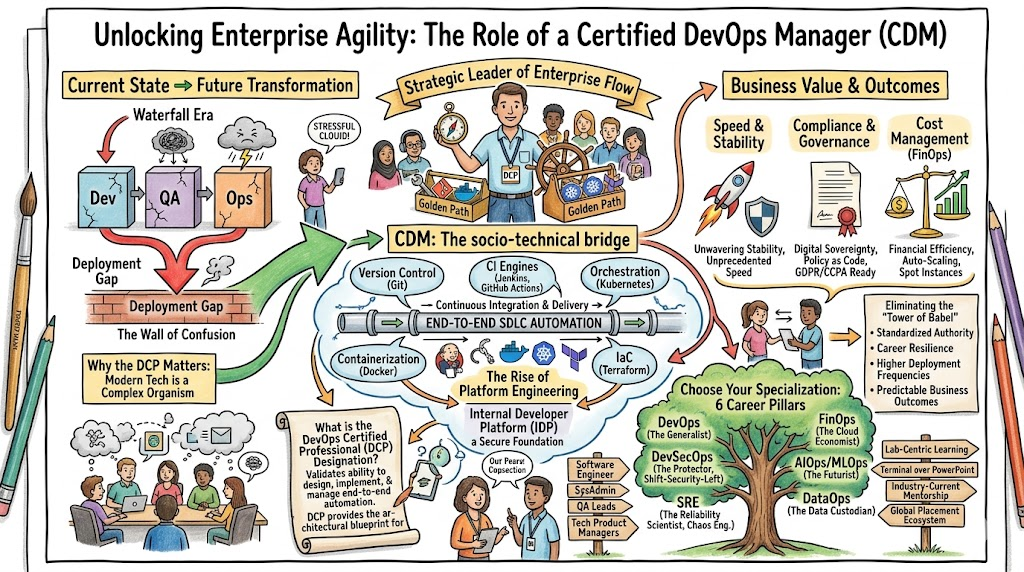
For decades, the “Waterfall” model governed Information Technology. It was an era defined by rigid phases, siloed handovers, six-month release cycles, and an incredibly high risk of catastrophic deployment failure. While the Agile movement significantly improved how we track tasks and manage stakeholder requirements, it did not solve the notorious “Deployment Gap”—that friction-filled, high-stress “wall of confusion” that exists between a developer’s stable local environment and the chaotic reality of the customer’s browser.
DevOps emerged not merely as a collection of trendy tools, but as a socio-technical bridge designed to ensure that software is delivered with unwavering stability, ironclad security, and unprecedented speed. DevOps has transcended its status as a mere methodology to become the core operating system of modern digital business. Organizations that fail to automate their infrastructure, ignore their CI/CD security, or neglect their observability stacks face catastrophic technical debt and rapid market irrelevance. The DevOps Certified Professional (DCP) program is specifically engineered to transform standard engineers into “Architects of Flow”—strategic experts who can take a raw business hypothesis and transform it into a globally available, hardened service with minimal friction and maximum reliability.
What is the DevOps Certified Professional (DCP) Designation?
The DevOps Certified Professional (DCP) is a high-level, practitioner-focused certification that validates your comprehensive ability to design, implement, and manage the end-to-end automation of the modern Software Development Lifecycle (SDLC). Unlike entry-level certifications that might only cover the basics of a single cloud provider’s web console or a single scripting language, the DCP curriculum is holistic, vendor-neutral, and deeply rooted in production reality.
The certification focuses on the “Golden Path” of modern engineering: the seamless, automated integration of Version Control Systems (Git), Continuous Integration engines (Jenkins, GitHub Actions, GitLab CI), Containerization technologies (Docker), Orchestration platforms (Kubernetes), and Infrastructure as Code (Terraform, Pulumi). Earning this designation proves to the global market that you don’t just know how to run a few disparate scripts; you know how to architect a Scalable Internal Developer Platform (IDP). This platform empowers entire organizations to move at the speed of thought without compromising on the guardrails of safety and governance.
Why the DCP Matters in Today’s Software, Cloud, and Automation Ecosystem
The modern tech stack is no longer a simple collection of servers; it is a complex, living organism composed of ephemeral microservices, serverless functions, and multi-cloud clusters spanning the globe. Managing this without the rigorous framework provided by the DCP is akin to trying to pilot a supersonic jet through a storm without an instrument panel—eventual failure is statistically guaranteed.
- The Rise of Platform Engineering: Top-tier companies are rapidly moving away from manual, “ticket-based” infrastructure requests that take days to fulfill. They are shifting toward Platform Engineering, where developers use an IDP to self-serve their own environments within pre-defined safety guardrails. DCP provides the architectural blueprint to build these systems from the ground up.
- Digital Sovereignty, Compliance, and Governance: With the enforcement of strict international data laws like GDPR, CCPA, and the Digital India Act, compliance can no longer be a manual, yearly checklist. The DCP integrates the concept of “Policy as Code” directly into the deployment pipeline, ensuring that every piece of infrastructure is legally compliant and secure by default before it ever hits production.
- Cost Management and Performance Optimization (FinOps): In an era of ballooning cloud bills, a DCP-certified professional understands how to architect for financial efficiency. By mastering auto-scaling, resource quotas, and spot instance orchestration, they ensure that a spike in user traffic doesn’t lead to a linear, budget-breaking increase in cloud expenditure.
The Strategic Importance of Certification for Engineers and Management
For the Individual Contributor (Engineer, Senior Developer, & Architect)
In an age where Generative AI can produce boilerplate code in milliseconds, your true professional value has shifted away from syntax toward System Integrity and Orchestration.
- Standardized Authority: The DCP moves your professional profile from “I have some experience with DevOps tools” to “I am a globally recognized expert who has been vetted against industry-leading benchmarks.”
- Career Resilience and Mobility: During economic downturns or “tech winters,” “T-shaped” professionals—those who possess deep DevOps expertise combined with a broad understanding of the development lifecycle—are the most protected and highest-paid assets in any firm. They are the individuals who make the rest of the engineering team more productive.
For Engineering Leadership (Managers, Directors, & CTOs)
For those responsible for steering the organizational ship, the DCP serves as a vital Risk Management and Quality Assurance tool.
- Eliminating the “Tower of Babel”: One of the biggest causes of engineering failure is communication friction. When every engineer on a team follows DCP standards, they share a common technical vocabulary. This drastically reduces the risk of misunderstandings during high-pressure incidents or major architectural migrations.
- Driving Predictable Business Outcomes: Certified teams consistently demonstrate higher deployment frequencies, lower “Change Failure Rates,” and significantly faster “Mean Time to Recovery” (MTTR). For a manager, this translates directly into predictable product release cycles and highly satisfied business stakeholders.
Why Choose DevOpsSchool as Your Training Partner?
DevOpsSchool’s Lab-Centric Learning Architecture is built on the core philosophy of “Terminal over PowerPoint,” prioritizing immersive, sandbox environments over static lectures. By spending the vast majority of training hours breaking, debugging, and fixing real-world production setups, students develop the critical muscle memory required to perform under pressure in high-stakes settings. This hands-on rigor is guided by Industry-Current Mentorship, where instructors are active senior consultants—not career academics—who bring “war stories” from solving complex architectural outages and scaling challenges for Fortune 500 companies directly into the classroom. Furthermore, the experience extends into a Global Placement and Support Ecosystem that serves as a robust bridge to the international job market. Beyond the certificate, the school actively assists alumni in navigating rigorous hiring processes at top-tier tech hubs through personalized portfolio reviews and interview coaching specifically tailored to the nuances of the DevOps role.
About the Certification: DevOps Certified Professional (DCP) Deep Dive
What it is
The DCP is a professional-grade validation of your capability to implement the full spectrum of DevOps methodologies. It focuses on the radical removal of “Toil” (manual, repetitive, low-value work), the total automation of legacy manual processes, and the cultivation of a high-trust, feedback-driven engineering culture that celebrates continuous improvement.
Who Should take this?
- Software Engineers: Developers who want to “own” the deployment and performance of their code to become true full-stack professionals.
- System Administrators: Infrastructure professionals transitioning from manual GUI-based management to the programmatic world of “Infrastructure as Code.”
- QA Leads and Automation Testers: Those looking to integrate Continuous Quality gates and automated security scanning directly into the CI/CD pipeline.
- Technical Product Managers: Leaders who need a deep technical grounding to effectively guide, resource, and evaluate modern SRE and Platform teams.
Comprehensive Skills You Will Master
- CI/CD Pipeline Design: Learn to architect resilient, multi-stage delivery flows that include automated canary deployments and instant rollback capabilities.
- Enterprise Container Orchestration: Move far beyond basic Docker commands to manage production-grade Kubernetes (K8s) clusters, including complex networking, persistent storage, and Helm-based release management.
- Advanced Infrastructure as Code (IaC): Treat your entire data center like software. Use Terraform for multi-cloud provisioning and Ansible/SaltStack for immutable configuration management.
- Full-Stack Observability: Build the “Eyes of the System.” Master the implementation of Prometheus for metrics, Grafana for visualization, and the ELK/Loki stack for distributed logging.
- DevSecOps Integration: Shift security to the left. Implement automated secret management (HashiCorp Vault), container image scanning, and real-time vulnerability assessment at every stage of the build.
Real-World Projects You Will Execute
- The Multi-Cloud Hybrid Setup: Architect and deploy a high-availability microservices application that spans both AWS and Azure simultaneously, controlled by a single unified GitOps command.
- Zero-Downtime Release Strategies: Successfully implement Blue-Green, Canary, and A/B testing release strategies for applications serving millions of users without losing a single packet of traffic.
- The “Phoenix” Infrastructure Project: Use Terraform to script the entire recreation of a production environment—including VPCs, Databases, and Clusters—from a completely empty cloud account in under 20 minutes.
- Intelligent Self-Healing Clusters: Configure Kubernetes Horizontal and Vertical Pod Autoscalers combined with custom Prometheus alerts to ensure the system handles 10x traffic spikes automatically.
The Master Certification Matrix: Strategizing Your Growth
| Track | Level | Primary Target Audience | Prerequisites | Core Skills Covered | Order |
| DevOps | Professional | Engineers, Leads, Managers | Linux Basics, Git | CI/CD, K8s, Terraform, Docker | 1st |
| DevSecOps | Advanced | Security Teams, Devs | DCP Foundation | Vault, Snyk, OPA, Sec-as-Code | 2nd |
| SRE | Advanced | Ops, Reliability Engineers | DevOps Mastery | SLOs, Error Budgets, Chaos Eng | 2nd |
| AIOps | Specialized | ML Engineers, Data Ops | Python, DevOps | ML Pipelines, Model Monitoring | 3rd |
| DataOps | Specialized | Data Architects, Eng | SQL, DevOps | Data Quality, ETL Automation | 3rd |
| FinOps | Management | Tech Leads, Finance | Cloud Basics | Cost Optimization, Unit Billing | 2nd |
Preparation Blueprints: Tailored Strategies for Professional Success
7–14 Days: The Executive Sprint (For Seasoned Engineers)
- Strategic Focus: Skip the basics and deep-dive into advanced Git branching strategies (Trunk-based development) and the internal logic of declarative CI/CD engines.
- Practical Action: Execute high-intensity labs focused on Dockerizing complex legacy monoliths and troubleshooting Pod scheduling failures in Kubernetes.
30 Days: The Professional Track (For Working Mid-Level Engineers)
- Week 1: Achieve total mastery of the Linux Command Line (grep, awk, sed) and Git internals.
- Week 2: Immersion in the Container ecosystem. Focus on Docker networking, multi-stage builds, and K8s persistent volumes.
- Week 3: Infrastructure as Code. Build modular, reusable Terraform libraries and Ansible playbooks for server hardening.
- Week 4: Observability and Security. Integrate SonarQube for code quality and Prometheus for custom application metrics.
60 Days: The Foundation Builder (For Career Switchers or Juniors)
- Month 1: The Core. Solidify your understanding of the Linux Kernel, Networking fundamentals (DNS, TCP/UDP, Load Balancing), and Python/Bash scripting for automation.
- Month 2: The Toolchain. Dedicated “Deep Dive” weeks for Jenkins, Docker, K8s, and Terraform, culminating in a massive “Capstone Project” that simulates a real-world startup launch.
Choose Your Destination: 6 Specialized Career Pillars
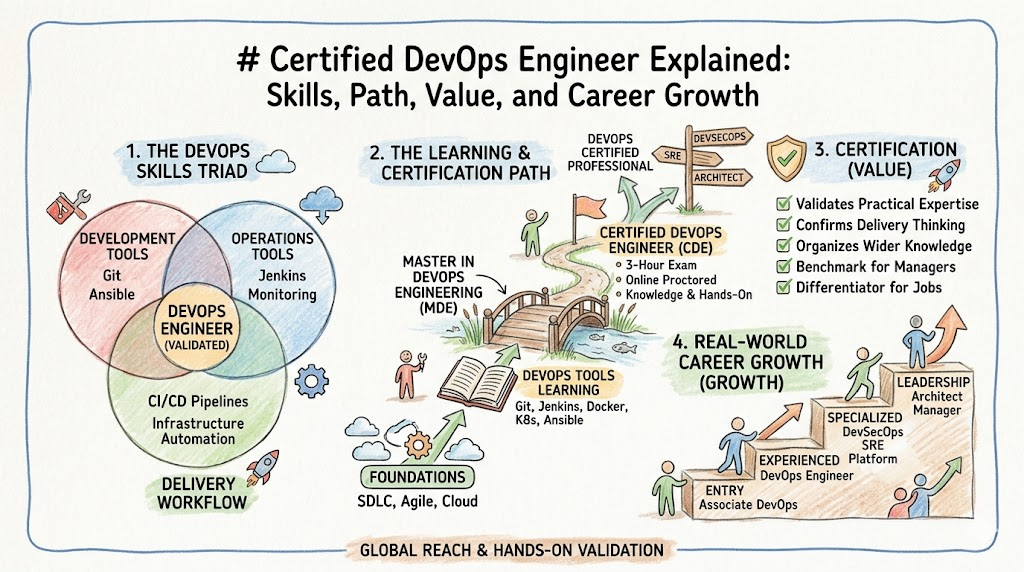
- DevOps (The Generalist/Architect): The flagship path. Master the “Whole Picture” and prepare for high-level roles like DevOps Architect or Head of Infrastructure.
- DevSecOps (The Protector): A mission-critical niche focusing on automating security gates, static/dynamic analysis, and “Identity as the New Perimeter.”
- SRE (The Reliability Scientist): Focus on the mathematical science of uptime. Learn to manage “Error Budgets,” conduct blameless “Post-Mortems,” and deliberately break systems via Chaos Engineering.
- AIOps/MLOps (The Futurist): Apply DevOps rigor to the world of AI. Automate the training, versioning, and deployment of Machine Learning models at massive scale.
- DataOps (The Data Custodian): Focus on the “Data Pipeline.” Ensure that data flowing into AI and Analytics engines is clean, timely, and governed by automated quality checks.
- FinOps (The Cloud Economist): Master the “Business of the Cloud.” Use data to drive down cloud waste and ensure every dollar spent on infrastructure provides maximum business value.
Roles and Recommended Progressions
| Role | Phase 1: Foundation | Phase 2: Core Tooling | Phase 3: Mastery & Authority |
| Cloud Infrastructure | DCP Certification | HashiCorp Terraform | AWS/Azure Architect Prof. |
| DevSecOps Specialist | DCP Certification | DevSecOps Certified | CEH or OSCP |
| Big Data Automation | DCP Certification | DataOps Certification | Big Data Specialty (Cloud) |
| Engineering Leadership | DCP Certification | FinOps Practitioner | Leadership & Agile Workshops |
| Platform Engineer | DCP Certification | Kubernetes Admin (CKA) | Kubernetes Security (CKS) |
Top Global Training Providers and Academic Ecosystems
DevOpsSchool
This provider is a leader in the DevOps education space, offering deep technical bootcamps and certification support for a global audience. They focus on providing hands-on labs that simulate real-world production environments, ensuring that students gain practical experience. Their instructors are seasoned industry veterans who provide mentorship beyond the curriculum, helping engineers solve actual work challenges during the training process.
Cotocus
A specialized training and consulting firm that focuses on high-end engineering practices and digital transformation. They provide tailored learning paths for enterprises and individuals looking to master complex toolchains. Their approach is highly practical, emphasizing the integration of security tools within existing workflows to achieve a true DevSecOps culture in large-scale organizations.
Scmgalaxy
As one of the largest communities for DevOps and SCM professionals, this provider offers a wealth of resources, including free tutorials and premium certification support. They are known for their community-driven approach to learning, where professionals can share insights and stay updated on the latest trends in software configuration and security automation.
BestDevOps
This platform offers curated training programs designed to help engineers move from foundational knowledge to advanced architectural mastery. They emphasize the career impact of certifications, providing students with the technical skills and the professional guidance needed to secure top-tier roles in the tech industry globally.
devsecopsschool.com
This is the official platform for the Certified DevSecOps Engineer program, offering direct access to the curriculum and certification exams. It provides a comprehensive ecosystem for learners, including study materials, practice labs, and official documentation. The site serves as the primary hub for professionals looking to validate their expertise through a recognized industry standard.
sreschool.com
Focusing on the intersection of reliability and security, this provider offers specialized training for Site Reliability Engineers. Their modules cover how to build resilient systems that can withstand both traffic spikes and security incidents. They provide deep dives into observability and automated response, which are critical for maintaining modern distributed systems.
aiopsschool.com
This provider is at the forefront of the AIOps movement, teaching engineers how to leverage artificial intelligence for IT operations. Their curriculum includes using AI to detect security threats and automate operational decision-making. It is an ideal resource for those looking to stay ahead of the curve in automated system management.
dataopsschool.com
A dedicated training site for data professionals who need to implement security and operations best practices within their data pipelines. They cover the unique challenges of securing large-scale data environments and ensuring compliance with global data protection laws through automation and rigorous testing.
finopsschool.com
This platform provides training on cloud financial management, helping professionals optimize their cloud spend while maintaining a secure infrastructure. They teach the essential skills of balancing cost, speed, and security, which is a growing requirement for modern cloud-native enterprises looking to maximize their ROI.
FAQs: General Career Evolution and Certification Outcomes
1. How difficult is the DCP exam compared to standard cloud certifications?
The DCP is intentionally designed to be rigorous. Unlike many cloud certifications that rely on multiple-choice memory, the DCP is a scenario-based exam. It tests your diagnostic ability to troubleshoot a broken pipeline or design a multi-tier deployment architecture under time pressure.
2. What kind of salary increase can a certified professional realistically expect?
While variables such as location and experience play a role, DCP-certified professionals typically command a 30% to 55% premium over their non-certified peers. “Platform Engineering” and “SRE” roles remain among the highest-paid positions in the 2026 tech market.
3. Do I need to be a professional Software Developer to pass?
No. While you do not need to be a coding prodigy, you must be comfortable with the logic of scripting. If you can write a logical Bash script or a simple Python function to parse a JSON file, you possess the requisite foundation for the DCP.
4. Is this certification recognized internationally for remote roles?
Absolutely. DevOps is a global standard. The principles and tools taught in the DCP (Kubernetes, Terraform, GitOps) are universal. A DCP holder is as relevant in Silicon Valley as they are in Berlin, Singapore, or Sydney.
5. How long does the DCP certificate remain valid?
While the foundational principles of DevOps are timeless, the tools evolve at a staggering pace. It is highly recommended to refresh your certification or progress to an advanced specialization track every 24 months to maintain your edge.
6. Does the exam involve a live, hands-on lab component?
The exam is an online-proctored session that utilizes complex, multi-step scenario analysis. You are required to evaluate technical problems and select the optimal architectural or command-line solution based on production best practices.
7. Can someone from a completely non-technical background transition into this?
It is a steep climb, but entirely possible with the right plan. Such candidates are advised to follow the 60-day “Foundation Builder” blueprint, which focuses on building the Linux and Networking basics before touching any automation tools.
8. Does the DCP cover specific cloud providers like AWS or Azure?
The DCP focuses on Cloud-Agnostic tools like Kubernetes and Terraform. This is a strategic advantage; it ensures you are not “locked in” to a single vendor and can manage infrastructure across AWS, Azure, Google Cloud, or on-premise data centers.
9. Is this certification useful for Engineering Managers? Highly. It helps managers identify bottlenecks, set realistic SLOs (Service Level Objectives), and understand the “Toil” their teams face, leading to better resource allocation.
10. What is the most common mistake candidates make during prep? “Tool-Hopping.” Candidates often try to learn five different CI tools at once. It’s better to master one (like Jenkins or GitHub Actions) deeply, as the principles translate to all others.
11. How do I know I am truly “Exam Ready”? You are ready when you can break a configuration (e.g., a networking error in K8s) and use logs/debugging tools to find the root cause without searching for a tutorial.
12. What is the best “next step” after achieving the DCP? Pick a specialty pillar: DevSecOps if you enjoy security, SRE if you love high-scale reliability, or FinOps if you want to focus on cloud cost optimization.
FAQs: DevOps Certified Professional (DCP) Technical Specifics
1. Is the DCP certification officially recognized by major Global MNCs?
Yes. Major global system integrators (TCS, Accenture, Infosys) and product giants (Amazon, Meta, Google) actively seek the specific validated skill set provided by the DCP when hiring for infrastructure and delivery roles.
2. What is the process for registering for the final exam?
Registration is managed through the official provider, DevOpsSchool. Candidates can select their preferred time slot for the online-proctored exam once they have completed the required training modules and lab hours.
3. Is deep-dive Kubernetes training included in the standard DCP curriculum?
Yes. Kubernetes is not treated as an optional “add-on” in the DCP; it is a central pillar. You will learn everything from basic Pod manifests to advanced Service Mesh (Istio) and Helm deployments.
4. Is there a post-certification community for DCP holders?
Successful candidates gain entry into an exclusive global alumni network. This community serves as a private forum for troubleshooting real-world production issues, networking for senior roles, and sharing internal job referrals.
5. What happens if I fail the exam on my first attempt?
Most training packages offered by DevOpsSchool include a dedicated retake policy. This allows candidates to review their performance metrics, focus on their weak areas with a mentor, and attempt the exam again after a brief cooling-off period.
6. Does the curriculum stay updated with the latest versions of Terraform and Ansible?
Yes. The DCP curriculum is a “living document” that is updated quarterly. It ensures that students are learning the latest declarative syntax and best practices for the current versions of all core tools.
7. What is the minimum passing threshold for the DCP exam?
The passing score is typically set at 70%. This high bar ensures that the DCP designation remains a prestigious and meaningful marker of professional technical competence.
8. How does the DCP differ from a standard “DevOps Foundation” course?
A “Foundation” course teaches you the vocabulary of DevOps—it tells you what things are. The DCP is a practitioner’s certificate that shows you how to do it. It is the difference between knowing the rules of aviation and actually being able to land a plane.
Conclusion
The industrial revolution of the software world is already here, and it is powered by automation. By earning the DevOps Certified Professional (DCP), you are making a definitive statement about your career: you are no longer just a “worker” in the tech factory; you are the architect designing the automated factory itself. In a 2026 market where speed-to-market and system reliability are the only metrics that truly matter to the C-suite, the DCP is your premium ticket to the front of the line.