Tag: #DevOpsCareer

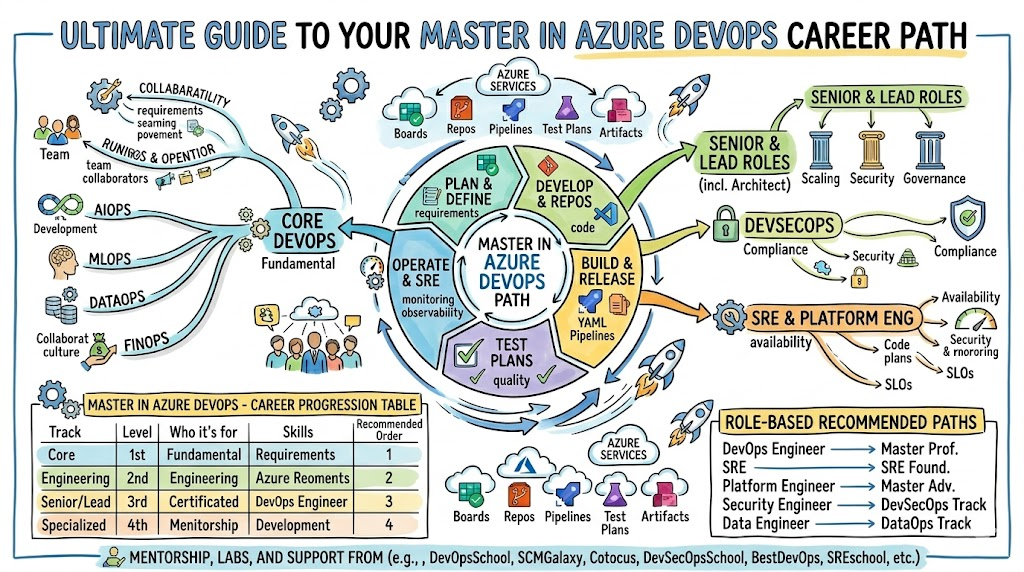
  • Ultimate Guide to Your Master in Azure DevOps Career Path

    Introduction

    In the current landscape of enterprise cloud computing, the ability to architect seamless delivery systems is the hallmark of a high-level technical professional. This guide to the Master in Azure DevOps is meticulously designed for engineers who want to move beyond basic automation into the realm of strategic platform engineering. For those aspiring to be a Site Reliability Engineer or a Cloud Solutions Architect, understanding the end-to-end integration of the Microsoft ecosystem is a career-defining necessity. This roadmap ensures that both practitioners and technical leads can align their skills with the rigorous demands of global digital infrastructure and high-velocity delivery.

    What is the Master in Azure DevOps?

    Master in Azure DevOps is a comprehensive professional framework that treats the entire software development and deployment cycle as a single engineering discipline. It exists to provide a standardized, production-focused methodology for shipping software that is secure, compliant, and highly available. This program emphasizes a “production-first” mindset, ensuring that practitioners are prepared to handle the high-concurrency and high-availability demands of modern business.

    At its core, this mastery is about shifting from manual, error-prone deployments to repeatable, version-controlled systems. It teaches the practical application of the Azure suite to manage infrastructure as code, ensuring that every deployment is predictable and every change is auditable. By mastering this suite, you transition from a reactive “fix-it” culture to a proactive engineering culture focused on stability and velocity.

    Why it Matters in Today’s Software, Cloud, and Automation Ecosystem


    The software industry now runs on continuous change. Teams are expected to build, test, release, and improve applications much faster than before, while also keeping systems stable and secure. Cloud platforms have made it easier to scale applications, but they have also increased the need for better automation, smoother deployment processes, and stronger collaboration between development and operations teams. This is where Azure DevOps becomes highly relevant. It supports modern delivery practices by helping teams manage code, automate workflows, reduce manual work, and improve release consistency. Learning these skills is important because companies need professionals who can work effectively in environments driven by speed, reliability, and operational efficiency.

    Why Certifications are Important for Engineers and Managers


    Certifications are valuable because they give professionals a clear learning direction and help them build skills in a structured and measurable way. For engineers, they show that the person has taken time to understand important tools, methods, and workflows that are commonly used in real projects. They also strengthen a resume and can improve confidence when applying for technical roles or handling more complex responsibilities. For managers, certifications help in identifying capable team members, planning skill development, and creating stronger technical teams. In many cases, a certification acts as a practical signal that someone is serious about professional growth and has validated their knowledge through a recognized path.

    Why Choose DevOpsSchool?


    DevOpsSchool is a preferred option for many learners because it gives more attention to practical understanding than theoretical discussion alone. The training is designed around real implementation needs, which helps professionals learn how concepts are applied in day-to-day DevOps work. This approach is especially useful for engineers who want job-ready knowledge and for managers who want their teams to gain useful, applicable skills. The programs are usually built in a way that supports gradual learning, better clarity, and stronger confidence in handling real tools and workflows. With a focus on hands-on practice, guided learning, and industry-oriented teaching, DevOpsSchool provides a learning experience that aligns well with professional career goals.

    Complete Master in Azure DevOps Certification Table

    TrackLevelWho it’s forPrerequisitesSkills CoveredRecommended Order
    OperationsFoundationJunior Ops/SupportBasic OS knowledgeBoards, Basic CI1
    EngineeringProfessionalDevOps EngineersFoundation LevelCD, YAML, Docker2
    StrategyAdvancedArchitects/LeadsProfessional LevelCompliance, Scaling3
    ReliabilitySpecializedSRE ProfessionalsCore DevOpsObservability, SLAs4
    DataSpecializedData EngineersCore DevOpsData Pipelines4

    Detailed Guide for Each Master in Azure DevOps Certification

    What it is

    This certification validates the essential knowledge required to participate in a modern, agile software team. It focuses on the communication and collaborative tools within Azure DevOps that keep projects on track and codebases organized.

    Who should take it

    This is the ideal starting point for project managers, manual testers, and junior developers who need a formal understanding of how professional software teams organize their daily work.

    Skills you’ll gain

    • Mastery of the Azure Boards interface for task and bug tracking.
    • Basic understanding of Git branching and pull request workflows.
    • Ability to navigate and document processes using the Azure Wiki.

    Real-world projects you should be able to do

    • Setup a project backlog and organize tasks into two-week sprints.
    • Create a documentation portal for a team’s onboarding process.
    • Configure basic notifications and dashboard widgets for project health.

    Preparation plan

    • 7-14 Days: Explore the Azure DevOps user interface and settings.
    • 30 Days: Practice linking work items to code commits in a test repo.
    • 60 Days: Complete a small project setup from start to finish.

    Common mistakes

    • Over-complicating the board setup before the team understands the process.
    • Using the platform as a simple storage site rather than a collaborative tool.

    Best next certification after this

    • Same-track: Master in Azure DevOps – Professional
    • Cross-track: Certified Site Reliability Engineer – Foundation
    • Leadership: Agile Project Management

    Choose Your Learning Path

    DevOps Path

    The DevOps path focuses on the flow of value. You will learn to remove friction from the delivery process, making deployments boring and predictable. This path is ideal for those who want to be the “engine” of the engineering organization, enabling developers to ship code faster and with higher confidence.

    DevSecOps Path

    The DevSecOps path is about building security into the DNA of the delivery pipeline. You will learn to automate security checks so that they happen every time code is pushed. This path is essential for professionals in finance, health, and government sectors where security is a top priority.

    SRE Path

    The SRE path is for the system’s “guardians.” You will use engineering principles to keep services running smoothly. This path teaches you how to balance the need for new features with the need for system stability, making it one of the most respected roles in the industry.

    AIOps Path

    AIOps is the future of automated maintenance. In this path, you will learn to use AI and data science to predict when a system might fail and take action before it affects users. This is a high-level technical path for those who want to work with the next generation of intelligent systems.

    MLOps Path

    MLOps is designed for those who work with data science teams. You will learn how to bring the discipline of DevOps to machine learning, ensuring that models are trained, tested, and deployed just like regular code. This is a vital path as more companies integrate AI into their products.

    DataOps Path

    The DataOps path applies DevOps thinking to the world of data engineering. You will learn how to automate the movement and transformation of data, ensuring that your organization has reliable data for making decisions. This path is perfect for data engineers looking to modernize their workflows.

    FinOps Path

    FinOps is about the economics of the cloud. You will learn how to manage and optimize cloud costs, ensuring that your organization gets the most value from its Azure investment. This path is ideal for senior engineers and managers who are responsible for cloud budgets.

    Role → Recommended Master in Azure DevOps Certifications

    RoleRecommended Certifications
    DevOps EngineerMaster in Azure DevOps – Professional
    SRECertified Site Reliability Engineer – Foundation
    Platform EngineerMaster in Azure DevOps – Advanced
    Cloud EngineerMaster in Azure DevOps – Professional
    Security EngineerMaster in Azure DevOps – DevSecOps Track
    Data EngineerMaster in Azure DevOps – DataOps Track
    FinOps PractitionerMaster in Azure DevOps – FinOps Track
    Engineering ManagerMaster in Azure DevOps – Foundation & Leadership

    Next Certifications to Take After Master in Azure DevOps

    Same Track Progression

    After the Professional and Advanced levels, the next step is to lead global engineering standards. This involves mastering the governance of multiple Azure organizations, setting up global networking for pipelines, and creating shared toolsets for thousands of developers. You will transition from being an engineer to being a policy-maker for the entire technology stack.

    Cross-Track Expansion

    To broaden your impact, consider expanding into cloud architecture or specialized security. Understanding the infrastructure that your pipelines deploy into allows you to build more resilient systems. This broader perspective is what separates a senior engineer from a principal architect who can design entire business systems.

    Leadership & Management Track

    For those aiming for management, the goal is to use technical knowledge to drive business outcomes. Certifications in technical leadership and agile management will help you lead teams, manage budgets, and align technology with the company’s long-term goals. You will learn to speak both “code” and “business.”

    Training & Certification Support Providers for Master in Azure DevOps

    • DevOpsSchool

    DevOpsSchool offers a practical approach that bridges the gap between basic theory and real-world execution. Their training focuses on the actual tools used in the industry, providing students with the hands-on experience needed to succeed in an enterprise environment.

    • Cotocus

    Cotocus specializes in intensive technical bootcamps for modern cloud technologies. Their curriculum is designed for professionals who need deep technical knowledge and practical skills to manage complex Azure and DevOps infrastructures.

    • Scmgalaxy

    Scmgalaxy is a leading community resource for anyone involved in software delivery. They provide an extensive range of tutorials, documentation, and expert advice to help professionals navigate their certification and career journey.

    • BestDevOps

    BestDevOps focuses on delivering job-ready training that meets the current demands of the global tech market. Their courses are built on real-world scenarios, ensuring that graduates are ready to contribute to their teams from day one.

    • Devsecopsschool

    Devsecopsschool is dedicated to the integration of security into the DevOps workflow. They offer specialized training that helps professionals build secure, compliant, and automated pipelines within the Azure ecosystem.

    • Sreschool

    Sreschool focuses on the disciplines of reliability and performance. Their training programs are designed for engineers who want to specialize in keeping complex systems stable and available using modern SRE methodologies.

    • Aiopsschool

    Aiopsschool provides training on the future of IT operations, showing how AI and machine learning can be used to automate and optimize the DevOps lifecycle. This training is essential for staying at the cutting edge of the industry.

    • Dataopsschool

    Dataopsschool teaches data professionals how to apply DevOps principles to their data pipelines. This improves the speed and quality of data delivery, ensuring that organizations can rely on their data for critical decisions.

    • Finopsschool

    Finopsschool addresses the financial challenges of the cloud. Their training helps engineers and managers optimize their cloud spending, ensuring that technical innovation remains cost-effective and sustainable.

    Frequently Asked Questions (General)

    How much time is required to prepare for the Professional track?

    Most professionals find that spending 10-15 hours a week over three months allows them to thoroughly master the lab environments and theoretical concepts.

    Is Azure DevOps a better career choice than AWS DevOps?

    Both are high in demand, but Azure DevOps is often preferred by large enterprises heavily invested in Microsoft’s ecosystem, offering deep integration and simplified management.

    Do I need to be an expert in Git to start?

    No, the Foundation level covers basic version control. However, a willingness to learn Git-flow and branching strategies is essential for the higher-level engineering tracks.

    Can I use Azure DevOps with open-source tools like Jenkins?

    Yes, the platform is extremely flexible. You can trigger Jenkins builds from Azure DevOps or use Azure Pipelines to deploy code built in other CI systems.

    Is this certification recognized by Fortune 500 companies?

    Absolutely. Many major enterprises require these certifications for their senior cloud roles because they validate hands-on engineering capability rather than just theory.

    How do I access the lab environments?

    Training providers like DevOpsSchool provide dedicated lab access. You can also use a personal Azure account with the “Free Tier” to practice many of the core services.

    Is there any prerequisite for the Advanced level?

    Yes, you must have achieved the Professional certification and have significant hands-on experience managing production-grade cloud deployments.

    How does this certification help in the global job market?

    It proves your competency in the Microsoft Cloud ecosystem, which is used by millions of organizations globally, making your skills transferable across countries.

    Can I specialize in just one area like security?

    While the Master program is broad, it allows you to specialize in DevSecOps or SRE tracks after you have established your core DevOps foundation.

    Is the training available online?

    Yes, most authorized training partners offer flexible online schedules, including live instructor-led sessions and self-paced video modules.

    How often is the curriculum updated?

    The curriculum is reviewed quarterly to ensure it reflects the latest updates to the Azure platform, including new pipeline features and security tools.

    Is there any career support provided?

    Most leading institutions offer comprehensive career support, including resume optimization, interview coaching, and access to hiring partners in the tech industry.

    FAQs on Master in Azure DevOps

    What is “YAML as Code” in Azure DevOps?

    This is the practice of defining your entire build and release process in a text file within your repository, allowing for version control and peer reviews of your pipelines.

    How do “Self-Hosted Agents” differ from Microsoft-hosted ones?

    Microsoft-hosted agents are managed by Azure, while self-hosted agents run on your own infrastructure, giving you more control over the software and network access.

    What is the purpose of “Variable Groups” in the library?

    Variable groups allow you to store and share configurations and secrets across multiple pipelines, reducing duplication and improving security management.

    Can I use Azure DevOps for containerized applications?

    Yes, it has native integrations for Docker and Azure Kubernetes Service (AKS), allowing you to build, scan, and deploy containers at scale.

    What are “Deployment Gates” in a release pipeline?

    These are automated checks—like monitoring alerts or health probes—that must pass before a release is allowed to move to the next environment, like Production.

    How does Azure Boards help with Agile tracking?

    It provides customizable Kanban boards, sprint backlogs, and velocity charts that allow teams to visualize progress and identify bottlenecks in real-time.

    What is the role of Azure Artifacts?

    It acts as a private package repository for your team, allowing you to host and version your own NuGet, npm, or Python packages securely.

    How do I secure my Azure DevOps organization?

    Security is handled through Microsoft Entra ID integration, fine-grained permissions, and branch policies that prevent unauthorized code from being merged.

    Conclusion

    Master in Azure DevOps is a highly practical certification for professionals who want to build strong, real-world skills in cloud-based DevOps practices. It goes beyond theory and focuses on how modern software systems are actually built, deployed, and maintained using Azure tools and automation. If you are aiming to work in environments that demand continuous delivery, scalable infrastructure, and reliable systems, this certification provides a clear and structured learning path. For engineers, it helps in gaining confidence, improving problem-solving ability, and handling production-level challenges more effectively. For managers, it offers better visibility into team capabilities and helps in making informed technical decisions. Overall, it is a valuable step for anyone looking to grow in DevOps, cloud engineering, or platform roles, especially if your goal is long-term career stability and progression in a competitive technology landscape.astery is rigorous because the responsibilities of a senior cloud engineer are significant. However, the career rewards—both in terms of influence and financial compensation—are equally high. If you are ready to move from being a technician to a technical architect who designs the systems of the future, then this certification is absolutely worth your time and effort.
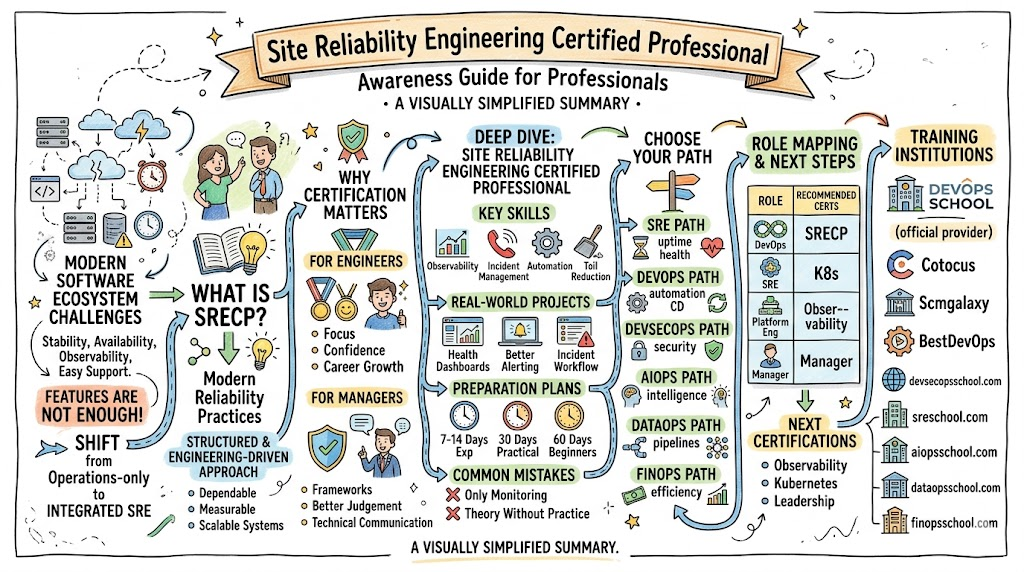
  • Site Reliability Engineering Certified Professional Awareness Guide for Professionals

    Introduction

    Every modern company depends on software behaving well in production. It is not enough to build features quickly. Those features must also remain stable, available, observable, and easy to support. When an application slows down, fails under traffic, or creates repeated incidents, the problem is not only technical. It affects user trust, team productivity, release confidence, and business reputation.

    In earlier technology environments, operations often focused on keeping systems running after development was complete. That model is harder to sustain today. Modern applications run across cloud platforms, APIs, microservices, containers, CI/CD pipelines, automation tools, and shared infrastructure. Because of this, reliability cannot be treated as a separate final step. It must be built into the engineering process itself.

    This guide explains what SRECP is, why it matters, why certifications are useful, why DevOpsSchool is relevant, what the certification covers, how to prepare, what paths it supports, and what steps may come next in your growth journey.


    What is Site Reliability Engineering Certified Professional (SRECP)?

    Site Reliability Engineering Certified Professional is a professional certification focused on modern reliability engineering practices. It is designed to help learners understand how production systems can be made more dependable, measurable, scalable, and easier to operate.

    In simple words, SRECP teaches professionals how to approach reliability in a more structured and engineering-driven way.

    That matters because many professionals already perform reliability-related work without seeing it as one complete discipline. A DevOps engineer may automate deployments. A cloud engineer may handle uptime and infrastructure scaling. A platform engineer may support shared services. A system administrator may respond to production incidents. A manager may review downtime and escalation patterns. These responsibilities are all connected to reliability, but many teams still learn them in isolated pieces.

    SRECP helps connect those pieces.

    It helps professionals move from task-level thinking to service-level thinking. Instead of focusing only on fixing what breaks, they begin to think about how systems should behave, how reliability should be measured, how operations should be improved, and how repeated support pain can be reduced through better engineering.

    That is what gives the certification real value.

    It is not just about theory and not just about tools. It is about understanding how reliable services are designed, supported, observed, reviewed, and improved in modern production environments.


    Why It Matters in Today’s Software, Cloud, and Automation Ecosystem

    Modern systems are much more complex than before. Applications now depend on many moving parts at the same time. A single service may rely on APIs, cloud components, orchestration platforms, databases, pipelines, observability tools, and network dependencies. Teams release changes quickly, environments scale dynamically, and business expectations remain high.

    This creates a major challenge.

    The faster systems move, the more discipline is required to keep them stable. Without clear reliability practices, teams often fall into reactive operations. They fix issues one by one, respond to noisy alerts, struggle during incidents, and spend too much time on repeated manual work.

    For engineers, SRE makes production work more measurable and purposeful.

    For managers, it helps connect technical operations with business outcomes.

    That is why SRE has become important across software engineering, DevOps, cloud operations, platform teams, and service leadership. It gives teams a shared language for discussing service health, operational improvement, and long-term stability.


    Why Certifications Are Important for Engineers and Managers

    Real-world experience is always important, but experience alone does not always create a complete framework. Many professionals become highly skilled in one part of the system while missing other important dimensions. Someone may know observability tools but not understand service objectives. Another person may understand cloud infrastructure but not think clearly about toil reduction. Another may manage incidents well but have little focus on prevention.

    A good certification helps organize that learning.

    It shows professionals how the pieces fit together. It gives them a clear learning path instead of leaving them to pick topics randomly. It also helps them identify where their current knowledge is strong and where it needs more depth.

    For engineers, certification can be useful in several ways.

    It improves focus because it points attention toward the ideas that matter most.

    It strengthens confidence because it gives structure to what they may already be doing in fragments.

    It also supports career growth because it shows that their knowledge is relevant, intentional, and aligned with modern engineering roles.

    For managers, certification adds value in another way.

    Managers need frameworks. They need to understand service quality, operational maturity, escalation readiness, engineering trade-offs, and production reliability at a practical level. A relevant certification helps them build stronger judgment and communicate more clearly with technical teams.

    It is important to be realistic. Certification does not replace real project ownership. It works best when it supports actual work. But when combined with hands-on experience, it can turn scattered knowledge into a much stronger professional capability.


    Why Choose DevOpsSchool?

    DevOpsSchool is well aligned with working professionals who want practical, role-based learning. That matters because most people pursuing SRECP are not learning only for general awareness. They want to improve how they handle modern systems in production.

    Another strength is the broad role relevance. SRECP is useful not only for people who want the title of Site Reliability Engineer. It also helps DevOps engineers, cloud engineers, platform engineers, operations teams, technical leads, and engineering managers. A provider that understands this wider audience makes the certification more practical and more career-relevant.

    For learners who want reliability education that connects directly to modern software delivery and platform operations, DevOpsSchool is a strong fit.


    Certification Deep-Dive: Site Reliability Engineering Certified Professional (SRECP)

    What is this certification?

    SRECP is a professional certification that helps learners understand the key ideas behind Site Reliability Engineering and how those ideas are used in real environments. It focuses on service behavior, observability, incident readiness, automation, operational discipline, and long-term reliability improvement.

    This certification is not only about learning what reliability means.

    It is about learning how to support reliable systems through better engineering decisions.

    Who should take this certification?

    This certification is a good fit for a wide range of professionals.

    It is valuable for DevOps engineers who want stronger production and support depth.

    It is useful for SRE aspirants who want a clear and structured entry into reliability engineering.

    It supports platform engineers who are responsible for stable internal platforms and shared services.

    It fits cloud engineers who work with uptime, performance, infrastructure behavior, and operational readiness.

    It can also help operations professionals who want to move away from reactive support and toward more engineering-led reliability practices.

    Engineering managers can benefit too, especially if they are responsible for service quality, operational maturity, incident readiness, and production stability.

    Software engineers who work close to backend systems and production releases can also gain a lot from understanding this area.


    Certification Overview Table

    Certification NameTrackLevelWho it’s forPrerequisitesSkills CoveredRecommended Order
    Site Reliability Engineering Certified Professional (SRECP)SREProfessionalDevOps engineers, SRE aspirants, platform engineers, cloud engineers, operations professionals, engineering managersBasic understanding of Linux, cloud, CI/CD, monitoring, and production support is helpfulReliability engineering, observability, incident management, service-level thinking, automation, operational maturity, production stabilityStrong starting point for the SRE track

    Site Reliability Engineering Certified Professional (SRECP)

    What it is

    SRECP is a certification built for people who want to understand reliability as a complete discipline rather than as a collection of separate support tasks. It helps learners think clearly about how stable systems are supported, measured, and improved.

    Who should take it

    • DevOps engineers
    • SRE aspirants
    • Platform engineers
    • Cloud engineers
    • Operations professionals
    • System administrators
    • Technical leads
    • Engineering managers
    • Software engineers working close to production systems

    Skills you’ll gain

    • Understanding of core Site Reliability Engineering principles
    • Better thinking around service quality and user experience
    • Clearer understanding of service-level concepts
    • Stronger awareness of observability and alert quality
    • Better incident-response and escalation thinking
    • Stronger automation-first mindset
    • Better awareness of operational toil and how to reduce it
    • More mature production-support thinking
    • Better alignment between engineering work and business outcomes
    • Stronger reliability mindset for modern cloud and platform systems

    Real-world projects you should be able to do after it

    • Define reliability expectations for a service or platform
    • Create dashboards to review service health
    • Improve alerting so teams focus on meaningful signals
    • Build a simple incident-handling workflow
    • Review repeated support problems and identify automation opportunities
    • Improve release readiness with reliability checks
    • Add stronger service-quality thinking to engineering discussions
    • Support platform-stability improvements in cloud environments
    • Improve visibility into performance and operational behavior
    • Contribute to long-term reliability improvement initiatives

    Preparation plan

    7–14 days

    This path works best for experienced professionals who already work in DevOps, cloud, platform, or production-support roles. Use this time for revision and focused concept review. Concentrate on SRE basics, observability, incident thinking, service-level concepts, and automation ideas.

    30 days

    This is the most practical plan for most working professionals. Use the first phase to build concept clarity. Use the middle phase to connect those ideas with examples from real systems. Use the final phase for revision, practical notes, and scenario-based preparation.

    60 days

    This is a better option for beginners or people changing direction. Start with Linux basics, cloud fundamentals, monitoring, CI/CD, containers, and operations foundations. Then move into SRE principles, reliability thinking, observability, incidents, and automation. Finish with review and small hands-on exercises.

    Common mistakes

    • Thinking SRE is only about monitoring
    • Studying tools without understanding principles
    • Ignoring service-level thinking
    • Focusing only on incident response and not prevention
    • Treating automation as optional
    • Learning theory without practical scenarios
    • Forgetting that reliability has business impact
    • Preparing without connecting concepts to real production systems

    Best next certification after this

    The best next step depends on your goals.

    If you want to stay in the same domain, an observability-focused certification is a strong option.

    If you want deeper infrastructure and cloud-native depth, a Kubernetes-related certification makes sense.

    If you want broader delivery or leadership growth, a DevOps or management-oriented certification can be the next step.


    Choose Your Path

    DevOps path

    This path is ideal for professionals focused on automation, CI/CD, infrastructure, and release systems. SRECP adds reliability depth and helps DevOps professionals move beyond delivery speed into production quality and operational maturity.

    DevSecOps path

    This path suits professionals working where security and delivery meet. SRECP strengthens this direction by adding resilience, operational discipline, and incident readiness to secure engineering practices.

    SRE path

    This is the most direct path for professionals who want to specialize in uptime, service health, incident response, observability, and long-term reliability improvement. SRECP is a strong starting point here.

    AIOps/MLOps path

    This path is useful for professionals working with intelligent automation or machine learning systems. These environments still need strong operational visibility, stability, and disciplined support. SRECP helps provide that reliability base.

    DataOps path

    Data systems also depend on reliability. Pipelines, workflows, and data platforms need stability, predictable behavior, and strong operational visibility. SRECP helps DataOps professionals bring stronger service thinking into these environments.

    FinOps path

    FinOps focuses on cost efficiency and cloud governance. Reliability supports this because unstable systems often create waste, repeated manual effort, and emergency work. SRECP can therefore complement a FinOps journey very well.


    Role → Recommended Certifications Mapping

    RoleRecommended certifications
    DevOps EngineerSRECP, DevOps-focused certifications, Kubernetes-related certifications
    SRESRECP first, then observability and advanced reliability certifications
    Platform EngineerSRECP plus Kubernetes, Terraform, and platform-engineering learning
    Cloud EngineerSRECP plus cloud operations or architecture certifications
    Security EngineerDevSecOps certifications first, then SRECP for resilience and operational depth
    Data EngineerDataOps learning plus SRECP for operational reliability
    FinOps PractitionerFinOps learning plus SRECP for stability and efficiency alignment
    Engineering ManagerSRECP plus leadership-focused DevOps, SRE, or platform strategy certifications

    Next Certifications to Take

    Same track

    An observability-focused certification is one of the smartest next steps after SRECP. Once you understand reliability ideas, stronger capability in logs, metrics, traces, dashboards, and telemetry can make your operational decisions much better.

    Cross-track

    A Kubernetes-related certification is a strong cross-track option. Since many modern production services run in container-based environments, Kubernetes knowledge makes reliability work more practical and more relevant.

    Leadership

    A DevOps or engineering-management-focused certification is a useful leadership move. It is a good fit for professionals who want to move from hands-on technical work into platform ownership, operational governance, and team leadership.


    Institutions That Help in Training cum Certifications for Site Reliability Engineering Certified Professional (SRECP)

    DevOpsSchool

    DevOpsSchool is the direct provider of the SRECP certification, which makes it the most aligned option for learners who want official guidance and structured preparation. It is suitable for both working engineers and managers who want practical learning in reliability engineering.

    Cotocus

    Cotocus can be useful for professionals looking for implementation-focused learning and technical support. It may help learners who want stronger practical understanding around cloud, automation, and engineering workflows related to reliability work.

    Scmgalaxy

    Scmgalaxy is known for technical education around DevOps, automation, and engineering tools. It can support learners who want to strengthen their foundations before going deeper into specialized reliability topics.

    BestDevOps

    BestDevOps is often recognized in the wider DevOps and cloud training ecosystem. It can help professionals looking for structured education across automation, infrastructure, and engineering practices that connect well with reliability careers.

    devsecopsschool.com

    This platform is useful for learners who want to combine reliability thinking with secure delivery practices. It is especially relevant in environments where resilience and security both matter.

    sreschool.com

    SRESchool is naturally relevant for learners who want deeper focus on reliability engineering. It can support stronger understanding in service health, observability, incident handling, and operational maturity.

    aiopsschool.com

    AIOpsSchool can be useful for professionals interested in intelligent automation and analytics-driven operations. It is a good complementary path for advanced operations learning.

    dataopsschool.com

    DataOpsSchool is helpful for professionals working on data platforms, pipelines, and analytics operations. It supports stronger operational consistency and reliability thinking in data-heavy systems.

    finopsschool.com

    FinOpsSchool is relevant for professionals focused on cloud efficiency, cost governance, and optimization. Since reliable systems often support better cost outcomes, it complements SRE learning well.


    Frequently Asked Questions

    1. Is SRECP a beginner-level certification?

    It is better described as a professional-level certification. Beginners can still pursue it, but they usually need a longer preparation plan and stronger fundamentals.

    2. How difficult is the SRECP certification?

    Its difficulty is moderate to high depending on your background. Professionals already working in DevOps, cloud, platform, or operations roles generally find it more manageable.

    3. How much preparation time is enough?

    For many working professionals, 30 days is a practical target. Experienced engineers may need less. Beginners may need closer to 60 days.

    4. Do I need prior operations experience?

    It helps, but it is not mandatory. DevOps, cloud engineering, backend development, platform work, and system administration can all support SRE learning.

    5. Is SRECP useful for software engineers?

    Yes. Software engineers who work near APIs, backend systems, cloud services, or production releases can benefit a lot from understanding reliability better.

    6. Is it only for people with the SRE title?

    No. It is useful across DevOps, platform engineering, cloud operations, support engineering, and management roles.

    7. Will it help with career growth?

    Yes. It can strengthen your profile for reliability-focused roles and improve readiness for production ownership responsibilities.

    8. Is this certification useful for managers?

    Yes. Managers benefit because it helps them understand service quality, incidents, uptime, and operational maturity in a more structured way.

    9. What should I study before starting?

    Linux basics, cloud concepts, monitoring, containers, CI/CD, and production-support fundamentals are all useful preparation topics.

    10. Is SRECP only about monitoring and alerts?

    No. Monitoring is only one part of reliability work. The certification also covers service-level thinking, automation, incident discipline, observability, and operational improvement.

    11. Should I take Kubernetes certification before SRECP?

    That depends on your role. If your current work is more reliability-focused, SRECP is a strong first step. If your environment is heavily Kubernetes-based, both paths can complement each other well.

    12. Will SRECP help in real-world projects?

    Yes. Its value becomes much stronger when you apply it to dashboards, alerting, incident flow, automation, and service-improvement efforts in production.


    FAQs on Site Reliability Engineering Certified Professional (SRECP)

    1. What does SRECP stand for?

    It stands for Site Reliability Engineering Certified Professional.

    2. What is the main purpose of this certification?

    Its main purpose is to help professionals understand and apply reliability engineering practices in modern production environments.

    3. Is SRECP a good option for DevOps engineers?

    Yes. It is a strong next step for DevOps professionals who want deeper reliability and production maturity.

    4. Can managers benefit from SRECP?

    Yes. It helps managers make better decisions around service health, uptime, incidents, and operational readiness.

    5. Is SRECP relevant in cloud-native environments?

    Yes. Cloud-native systems are exactly where structured reliability practices become highly valuable.

    6. What makes it different from general operations learning?

    It focuses on engineering-led reliability rather than only reactive support and manual troubleshooting.

    7. Is SRECP useful for platform engineers?

    Yes. Platform engineers can use it to improve stability, observability, and production discipline across shared services.

    8. What is the biggest value of SRECP?

    Its biggest value is that it turns scattered operational experience into a clearer and more complete reliability mindset.


    Conclusion

    Site Reliability Engineering Certified Professional is a strong certification for professionals who want meaningful growth in modern reliability work. It does not stay limited to one tool, one cloud platform, or one narrow support activity. Instead, it helps learners understand how service quality, observability, automation, incident response, and system stability work together inside real engineering environments. That makes it highly relevant for DevOps engineers, SRE aspirants, cloud professionals, platform teams, software engineers, and engineering managers. In today’s technology landscape, users expect systems to be dependable, fast, and always available. SRECP offers a practical and structured path to build the mindset and capabilities needed to support that expectation with confidence.

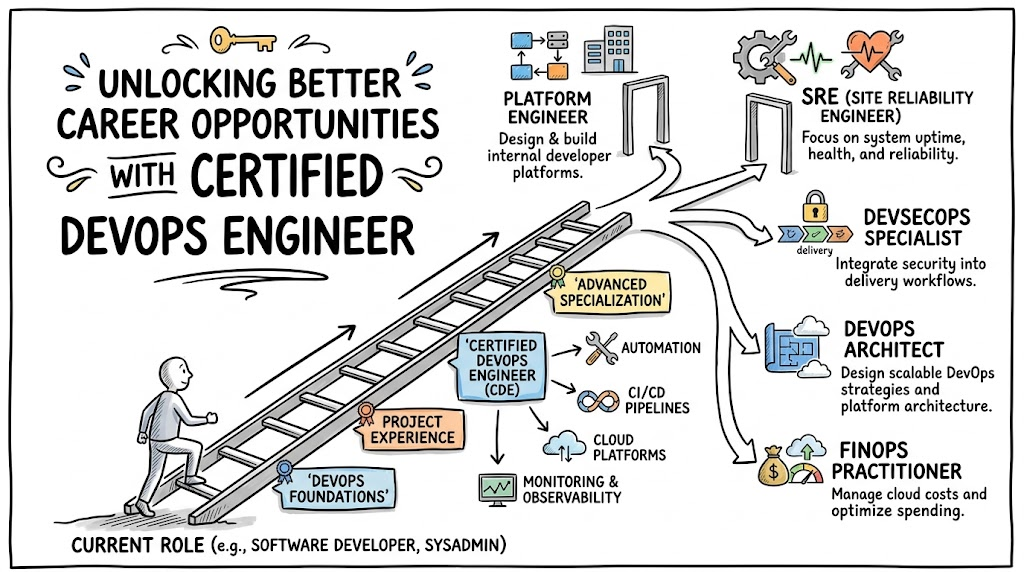
  • Unlocking Better Career Opportunities with Certified DevOps Engineer

    Software teams are no longer judged only by how fast they write code. They are judged by how well they release, how safely they automate, how quickly they recover, and how clearly they observe systems in production. That is why DevOps has become a real career discipline for engineers, cloud teams, platform teams, release specialists, and technical managers.

    Certified DevOps Professional is built for professionals who want to move from basic DevOps familiarity to stronger delivery ownership. DevOpsSchool describes it as an advanced certification for experienced professionals. Its official scope includes CI/CD, monitoring and logging, automation, cloud platform management, microservices, and container orchestration, and the exam is presented as a 3-hour exam-only format.

    That makes this certification useful for people who already know parts of the DevOps world but want a more complete view. Many professionals know one tool well. Fewer can connect pipelines, release flow, cloud operations, observability, and deployment strategy into one working system. This certification is valuable because it helps build that larger picture. DevOpsSchool also places it in a broader ecosystem that includes DevOps, DevSecOps, SRE, and MLOps-related learning paths.

    The provider is DevOpsSchool, and the official certification page is the reference point for the program details.


    Certification Overview

    CertificationProviderLevelBest For
    Certified DevOps ProfessionalDevOpsSchoolProfessional / AdvancedExperienced DevOps practitioners, build and release engineers, automation specialists, cloud and platform professionals

    The official page presents Certified DevOps Professional as an advanced certification aimed at experienced professionals rather than complete beginners.


    Certification Table

    TrackLevelWho it’s forPrerequisitesSkills coveredRecommended order
    DevOpsProfessionalDevOps Engineers, Build Engineers, Release Engineers, Platform Engineers, Cloud Engineers, Automation Specialists, senior software professionalsDevOps basics, Linux comfort, CI/CD familiarity, cloud exposure, containers; the official page also points to Master in DevOps Engineering as a prerequisite pathCI/CD, automation, monitoring, logging, cloud platform management, microservices, container orchestrationLearn core DevOps first, get project experience, then take this certification

    This summary is based on the official certification page, which explicitly lists the major topic areas and describes the certification as advanced.


    What Is Certified DevOps Professional?

    Certified DevOps Professional is a professional-level certification for people who want stronger command of modern software delivery. It is not mainly for first-time learners. It is better for professionals who already understand the basics of development, deployment, cloud, or operations and now want a broader DevOps perspective.

    What makes it useful is its focus on connected delivery thinking. Real-world DevOps is never only about one tool. It includes how code moves through integration, testing, release automation, deployment, logging, monitoring, cloud environments, and production readiness. The official certification scope reflects that broader delivery view.

    In simple words, this certification helps professionals move from “I know some DevOps tools” to “I understand how a modern delivery system works.”


    Why This Certification Matters

    A lot of engineers build knowledge in fragments. One person gets good at Jenkins. Another learns Docker. Someone else understands Kubernetes or cloud services. But strong engineering teams need people who can connect those skills into one dependable delivery model.

    That is why this certification matters. It gives structure to practical knowledge. It helps professionals think in terms of release flow, automation maturity, observability, cloud readiness, and deployment consistency. That kind of thinking is useful not only for DevOps engineers, but also for platform engineers, cloud engineers, release engineers, and technical managers.

    It also matters because it can open later career paths. DevOpsSchool’s wider certification listings and Gurukul Galaxy’s certification articles both point to adjacent tracks such as DevSecOps, SRE, MLOps, DataOps, and related growth areas.


    Certified DevOps Professional

    What it is

    Certified DevOps Professional is an advanced DevOps certification designed for experienced professionals who want stronger delivery capability. According to the official page, it focuses on continuous integration, continuous delivery, monitoring and logging, automation, cloud platform management, microservices, and container orchestration.

    It is best understood as a certification for delivery maturity rather than entry-level exposure.

    Who should take it

    • DevOps Engineers
    • Build Engineers
    • Release Engineers
    • Platform Engineers
    • Cloud Engineers
    • Automation Specialists
    • Senior software engineers involved in release and deployment
    • Operations professionals moving into DevOps
    • Technical leads
    • Engineering managers with delivery responsibility

    The official page directly identifies DevOps practitioners, build and release engineers, and automation specialists among the intended audience.

    Skills you’ll gain

    • stronger CI/CD understanding
    • better automation thinking
    • clearer release workflow awareness
    • monitoring and logging integration knowledge
    • cloud platform management concepts
    • microservices deployment understanding
    • container orchestration familiarity
    • stronger view of delivery from end to end
    • better collaboration awareness across development and operations
    • improved readiness for scalable deployment models

    These areas align with the scope listed on the official certification page.

    Real-world projects you should be able to do after it

    • build or improve a CI/CD pipeline
    • automate build, test, and deployment stages
    • support release flow across environments
    • help containerize delivery workflows
    • work with orchestration-driven deployments
    • connect monitoring and logging with live services
    • support microservices delivery practices
    • improve deployment consistency across teams
    • help define DevOps workflow standards
    • contribute to cloud-native delivery efforts

    Preparation plan

    7–14 days

    This plan works best for professionals who already use DevOps practices regularly.

    • revise DevOps lifecycle concepts
    • review CI/CD and automation flow
    • refresh containers, monitoring, logging, and cloud basics
    • spend extra time on weak areas
    • do quick scenario-based revision daily

    30 days

    This is the most balanced plan for most working professionals.

    • Week 1: DevOps concepts, SDLC flow, collaboration mindset
    • Week 2: CI/CD, automation, build and release practices
    • Week 3: cloud, containers, microservices, orchestration
    • Week 4: monitoring, logging, revision, self-checks

    60 days

    This plan works well for people moving into DevOps from development, support, or administration.

    • Days 1–15: DevOps foundations and delivery lifecycle
    • Days 16–30: automation and CI/CD understanding
    • Days 31–45: cloud, Docker, orchestration, deployment flow
    • Days 46–60: observability, revision, and practice scenarios

    Common mistakes

    • treating DevOps as only a tool topic
    • focusing on one tool and ignoring the full workflow
    • skipping monitoring and logging
    • weak understanding of cloud’s role in delivery
    • learning containers without learning release flow
    • memorizing terms without practical context
    • ignoring rollback and production-readiness thinking
    • forgetting that collaboration is central to DevOps

    Best next certification after this

    The next step depends on your goal.

    • Same track: Certified DevOps Architect
    • Cross-track: DevSecOps Certified Professional or an SRE path
    • Leadership: Certified DevOps Manager

    These kinds of adjacent paths fit the broader DevOpsSchool ecosystem and the wider software-certification landscape reflected in Gurukul Galaxy’s certification articles.


    Choose Your Path

    1. DevOps Path

    This path is best for professionals who want to go deeper into CI/CD, automation, release improvement, platform enablement, and delivery quality. A practical sequence is fundamentals first, then project work, then Certified DevOps Professional, followed by architect-level growth.

    2. DevSecOps Path

    This path is for professionals who want security to become part of software delivery. After a DevOps base, the next focus is usually secure pipelines, secrets handling, compliance-aware automation, and safer releases. DevOpsSchool publicly lists DevSecOps as a related certification area.

    3. SRE Path

    This path is for professionals who care most about uptime, system health, alerting, incident response, and production stability. DevOps gives the delivery base, while SRE strengthens reliability thinking. SRE appears in DevOpsSchool’s broader certification lineup.

    4. AIOps / MLOps Path

    This path fits engineers who want to move toward intelligent operations or model delivery. Once automation and deployment fundamentals are strong, it becomes easier to branch into MLOps or AIOps. DevOpsSchool’s public site highlights MLOps among its popular certifications.

    5. DataOps Path

    This path is useful for data engineers and analytics teams that need repeatable pipelines, quality checks, governance, and operational discipline in data systems. Gurukul Galaxy’s certification content includes DataOps-related learning among broader technology certification tracks.

    6. FinOps Path

    This path suits cloud and platform professionals who want to connect delivery operations with cost awareness, cloud optimization, and financial governance. The broader certification ecosystem described in Gurukul Galaxy also reflects cross-functional certification growth beyond core DevOps.


    Role → Recommended Certifications

    RoleRecommended certifications
    DevOps EngineerDevOps foundation → Certified DevOps Professional → Certified DevOps Architect
    SRECertified DevOps Professional → SRE specialization
    Platform EngineerCertified DevOps Professional → Certified DevOps Architect
    Cloud EngineerCertified DevOps Professional → cloud-focused specialization or FinOps
    Security EngineerCertified DevOps Professional → DevSecOps Certified Professional
    Data EngineerCertified DevOps Professional → DataOps specialization
    FinOps PractitionerCertified DevOps Professional → FinOps specialization
    Engineering ManagerCertified DevOps Professional → Certified DevOps Manager

    This mapping is a practical interpretation based on the CDP scope and the broader certification families surfaced across DevOpsSchool and Gurukul Galaxy references.


    Next Certifications to Take

    Same track option

    Certified DevOps Architect
    This is the strongest next move for professionals who want to work on platform design, delivery standards, tooling strategy, and large-scale DevOps architecture.

    Cross-track option

    DevSecOps Certified Professional
    A strong next step for professionals who want to make security a larger part of release and automation work. DevOpsSchool publicly offers DevSecOps certification and training.

    SRE specialization
    A better fit for professionals who want stronger depth in service reliability, observability, and operational excellence. SRE appears in DevOpsSchool’s certification family.

    Leadership option

    Certified DevOps Manager
    Useful for people moving toward governance, mentoring, process ownership, and team enablement. Gurukul Galaxy’s certification coverage also supports leadership-oriented progression beyond purely technical tracks.


    List of Top Institutions Which Provide Help in Training cum Certifications for Certified DevOps Professional

    DevOpsSchool

    DevOpsSchool is the official provider of Certified DevOps Professional. It is the most directly aligned option for learners who want training and certification preparation closely tied to the actual program. Its public site also presents a wider ecosystem that includes DevOps, DevSecOps, SRE, and MLOps-related tracks.

    Cotocus

    Cotocus is often treated as an industry-oriented learning and consulting name. It can be useful for professionals who want technical learning with stronger business and implementation context.

    ScmGalaxy

    ScmGalaxy is widely associated with software configuration management, build processes, and CI/CD learning support. It is often useful for professionals who want stronger release-process maturity.

    BestDevOps

    BestDevOps is commonly considered by professionals seeking practical training in DevOps and related technical areas. It is often seen as a career-focused learning option.

    devsecopsschool.com

    This is relevant for learners who want to move from DevOps into secure delivery, secure automation, and policy-aware pipelines after building a strong foundation.

    sreschool.com

    This is useful for professionals interested in reliability engineering, observability, incident response, and service stability.

    aiopsschool.com

    This is helpful for professionals who want to move toward intelligent operations and AI-assisted operational analysis.

    dataopsschool.com

    This is useful for data teams that want stronger governance, repeatability, and operational discipline in data delivery.

    finopsschool.com

    This is valuable for cloud professionals who want better understanding of cost optimization, usage governance, and finance-aware engineering.

    The wider DevOpsSchool and Gurukul Galaxy sources support these adjacent learning families and certification tracks.


    FAQs on Certified DevOps Professional

    1. Is Certified DevOps Professional a beginner certification?

    No. The official page presents it as an advanced certification for experienced professionals.

    2. How difficult is this certification?

    It is moderate to advanced. It becomes much easier if you already understand CI/CD, cloud basics, containers, and monitoring.

    3. How much time should I prepare?

    Some experienced professionals may revise in 7 to 14 days, but most working professionals benefit from a 30-day plan.

    4. Do I need prior DevOps experience?

    Some hands-on exposure is strongly helpful because the certification is aimed at experienced professionals rather than complete beginners.

    5. Is Linux knowledge important?

    Yes. Basic Linux familiarity helps because many DevOps environments and automation tasks rely on command-line work.

    6. Is it useful for software developers?

    Yes. Developers can benefit because it improves understanding of deployment, release flow, automation, and production-facing delivery.

    7. Can cloud engineers use it to move into DevOps roles?

    Yes. It is a strong bridge for cloud professionals who want broader delivery and automation ownership.

    8. Is Kubernetes mandatory?

    Not necessarily at expert level, but orchestration and container-related understanding is very useful because those areas are part of the official scope.

    Additional FAQs for Career Growth

    9. What should I do after this certification?

    Choose the next step based on your goal: Architect for deeper design, DevSecOps for security, SRE for reliability, or Manager for leadership.

    10. Is this certification useful outside India?

    Yes. The DevOps skills it covers are relevant across global software teams and delivery environments.

    11. Can operations professionals move into DevOps with this?

    Yes. It can be a practical transition path for administrators and operations professionals who want to move toward automation-led delivery work.

    12. Is it useful for platform engineering?

    Yes. Platform engineering depends on automation, repeatability, observability, and delivery consistency, which align closely with DevOps.


    Conclusion

    Certified DevOps Professional is a strong certification for professionals who want to move from scattered DevOps knowledge to a more complete delivery mindset. It is especially useful for engineers and managers who already know the basics and now want stronger capability in CI/CD, automation, cloud operations, monitoring, microservices, and orchestration. The official DevOpsSchool page positions it as an advanced certification for experienced professionals, which makes it more suitable for serious career growth than beginner exploration.

    For software engineers, platform engineers, cloud professionals, release teams, and technical managers, this certification can serve as both a learning milestone and a career signal. It can also support future growth into architecture, DevSecOps, SRE, MLOps, DataOps, FinOps, or leadership. If your goal is to become more structured, more dependable, and more effective in modern software delivery, Certified DevOps Professional is a practical next step.