Introduction
Software delivery has changed in a major way. Teams are no longer working in slow release cycles with long gaps between development, testing, and deployment. Today, software moves through CI/CD pipelines, cloud platforms, containers, APIs, and automation-driven environments. This has improved speed, but it has also increased the chance of security gaps moving quickly across the delivery process.
That is why DevSecOps has become so important. It is not only a technical trend. It is a practical way of building software where security becomes part of development, testing, release, deployment, and operations. Instead of treating security as a final review step, DevSecOps makes it part of everyday engineering work.
For working engineers and managers, this matters a lot. Fast delivery alone is not enough anymore. Teams must also protect applications, infrastructure, data, and customer trust. A team that delivers quickly but ignores security creates long-term risk. A team that focuses only on control but cannot deliver on time creates business friction. DevSecOps helps balance both sides.
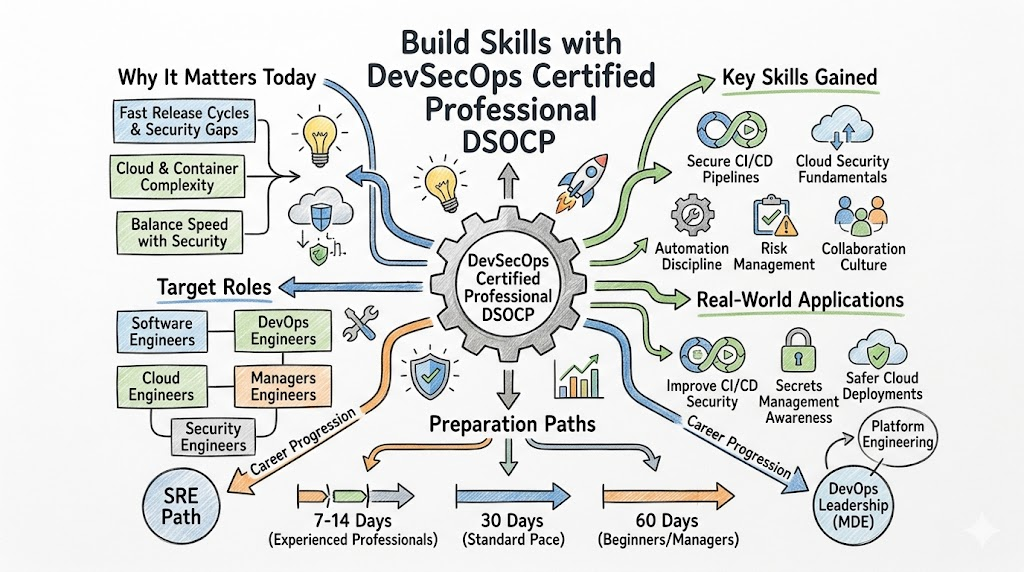
This is where the DevSecOps Certified Professional, also called DSOCP, becomes valuable. It gives software engineers, DevOps professionals, cloud engineers, platform teams, security engineers, and managers a structured way to understand secure software delivery. This guide explains what DSOCP is, why it matters, who should take it, how to prepare, and what path can come next.
What is DevSecOps Certified Professional (DSOCP)
DevSecOps Certified Professional is a professional certification focused on secure software delivery in modern engineering environments. It is designed for professionals who want to understand how security should be included across development, automation, CI/CD, release workflows, cloud operations, and team practices.
In simple words, DSOCP teaches how to make software delivery secure without making delivery slow and painful. It shows how security should fit into the normal engineering lifecycle instead of remaining a separate activity handled only at the end.
This certification is especially useful because many professionals know one side of the system very well but not the full picture. A software engineer may know application design. A DevOps engineer may know automation and pipelines. A cloud engineer may know infrastructure. A security engineer may know controls and risk. DSOCP helps connect these areas into one practical model.
Why It Matters in Today’s Software, Cloud, and Automation Ecosystem
Modern software systems move very fast. Teams release updates often. Infrastructure is created through code. Containers and orchestration platforms make environments more dynamic. Cloud services add flexibility, but they also add complexity. In such an environment, one small mistake can become a large risk.
A leaked secret can expose access. A vulnerable dependency can enter the delivery pipeline. A bad permission model can create cloud security issues. A poorly controlled build flow can allow risky code to move forward too easily. A rushed deployment can skip needed checks. These are not rare cases anymore. They are part of normal software delivery.
This is why DevSecOps matters. It helps teams think about security at the same speed as development and operations. Instead of fixing problems later, teams learn to reduce them earlier. This improves engineering confidence, release quality, and operational trust.
For software engineers, DevSecOps means writing and delivering with better awareness. For DevOps and cloud engineers, it means building automation that is not only efficient, but also safe. For managers, it means creating teams that can move fast without creating silent risk. For organizations, it means stronger delivery maturity and stronger customer confidence.
Why Certifications are Important for Engineers and Managers
Many professionals learn through project work, and that is important. Real projects teach pressure, deadlines, collaboration, trade-offs, and problem-solving. But project learning is often uneven. One person may know deployment pipelines deeply but know very little about secure release controls. Another may know cloud services well but not understand secure delivery flow. A manager may understand delivery goals but not know how to judge DevSecOps maturity inside a team.
A certification helps bring structure to that gap.
For engineers, certification gives a clear path. It shows what to learn, how topics connect, and how to build a more complete skill set. It reduces random learning and gives stronger direction.
For managers, certification provides a useful framework. It helps define skill expectations, team learning goals, and role progression. A manager who understands certification paths can support engineers more clearly and make better capability decisions.
Certifications also help with credibility. In interviews, role changes, consulting work, and internal promotions, they show that the professional has taken a focused step to strengthen an important skill area.
A certification does not replace hands-on work. But when combined with real project experience, it becomes a strong career advantage.
Why Choose DevOpsSchool?
DevOpsSchool is a good choice for professionals who want practical and career-focused learning in modern engineering domains. One strong reason is that it supports a broader ecosystem of connected learning areas such as DevOps, DevSecOps, SRE, AIOps, DataOps, and FinOps. That is useful because technical careers often move across multiple paths over time.
A software engineer may grow into DevOps. A DevOps engineer may move into DevSecOps. A cloud engineer may shift toward platform engineering or reliability. A technical lead may grow into broader architecture or management. A provider that supports connected growth is often more useful than one that covers only one narrow topic.
Another reason to choose DevOpsSchool is practical relevance. Working professionals do not need only theory. They need learning that connects with real pipelines, real cloud environments, real release challenges, and real team workflows. A provider that understands this makes certification more valuable.
DevOpsSchool also supports continuity. DSOCP can be a strong starting point, but many learners will later want deeper specialization or wider growth. That journey becomes easier when the provider already supports related paths.
Certification Deep-Dive: DevSecOps Certified Professional (DSOCP)
What is this certification?
DSOCP is a professional certification built to help engineers and managers understand secure delivery in modern software environments. It focuses on integrating security into the DevOps lifecycle, not as a final gate but as an active part of design, coding, testing, building, releasing, deploying, and operating software.
Who should take this certification?
This certification is suitable for:
- Software Engineers
- DevOps Engineers
- Cloud Engineers
- Platform Engineers
- Security Engineers
- Build and Release Engineers
- SRE-focused professionals
- Technical Leads
- Engineering Managers
It is especially useful for professionals who already work near application delivery, automation, infrastructure, or cloud systems and want deeper security understanding in their role.
Certification Overview Table
| Certification Name | Track | Level | Who it’s for | Prerequisites | Skills covered | Recommended order |
|---|---|---|---|---|---|---|
| DevSecOps Certified Professional (DSOCP) | DevSecOps | Professional | Software engineers, DevOps engineers, cloud engineers, platform engineers, security engineers, managers | Basic Linux, Git, CI/CD, scripting, cloud, and DevOps concepts are helpful | DevSecOps fundamentals, secure delivery, security-aware CI/CD, release discipline, secure engineering mindset | Main certification in the DevSecOps path |
| DevOps Certified Professional (DCP) | DevOps | Professional | Engineers who want stronger delivery and automation foundations | Basic Linux, Git, scripting, and CI/CD understanding | Automation, release flow, delivery basics, DevOps workflow | Before or alongside DSOCP |
| Master in DevOps Engineering (MDE) | DevOps / Leadership | Advanced | Engineers and managers who want broader technical and leadership growth | Prior DevOps and delivery experience | Advanced DevOps, broader system thinking, architecture awareness, leadership growth | After DSOCP for wider progression |
DevSecOps Certified Professional (DSOCP)
What it is
DSOCP is a career-focused certification for professionals who want to improve how software is delivered with stronger security awareness. It helps turn security into part of engineering behavior instead of keeping it as a separate approval activity.
Who should take it
It is ideal for professionals already involved in application delivery, automation, release pipelines, cloud platforms, infrastructure operations, or technical team leadership. It is also useful for managers who want better visibility into how secure delivery should work across teams.
Skills you’ll gain
- Strong understanding of DevSecOps fundamentals
- Better awareness of security across the software lifecycle
- Clear understanding of secure CI/CD practices
- Better knowledge of common risk points in cloud and automation workflows
- Improved collaboration across development, operations, and security
- Better understanding of governance and delivery controls
- Stronger release discipline and risk awareness
- A more practical secure engineering mindset
Real-world projects you should be able to do after it
- Review a CI/CD pipeline and identify likely security gaps
- Improve release workflows with stronger control points
- Help a team move security checks earlier in the lifecycle
- Support safer cloud deployment practices
- Improve secrets handling awareness in delivery workflows
- Contribute to a DevSecOps adoption roadmap
- Build a security-aware release checklist
- Improve coordination between engineering and security teams
Preparation plan
7–14 days
This plan is best for experienced DevOps, cloud, or platform professionals. Focus on revising DevOps basics, secure delivery principles, cloud risk areas, and common DevSecOps scenarios. This path works well if you already understand software delivery flow.
30 days
This is the most balanced plan for most working professionals. Start with DevOps and CI/CD basics. Then move into security concepts, release risks, and secure lifecycle thinking. Use the final phase for practical review, self-testing, and revision.
60 days
This plan is best for beginners, career changers, or managers from less technical backgrounds. Start with Linux, Git, scripting, CI/CD, cloud basics, and deployment flow. Then gradually move into DevSecOps concepts and secure engineering examples.
Common mistakes
- Trying to learn DevSecOps without understanding basic DevOps
- Treating DevSecOps as only a tools topic
- Ignoring cloud and container fundamentals
- Studying only for certification and not for real-world use
- Thinking security belongs only to the security team
- Learning concepts without mapping them to delivery workflows
- Missing the importance of collaboration and team culture
Best next certification after this
The best next certification depends on your goal.
- If you want deeper security specialization, continue further in the DevSecOps direction.
- If you want stronger production reliability and resilience, move toward the SRE path.
- If you want broader platform thinking, architecture visibility, and leadership growth, move toward Master in DevOps Engineering.
Choose Your Path
DevOps
Choose this path if your main goal is automation, CI/CD maturity, deployment quality, and faster software delivery. DSOCP strengthens this route by adding security depth to your DevOps capability.
DevSecOps
Choose this path if secure software delivery is the area where you want to specialize. DSOCP is a strong foundation because it connects engineering speed with security discipline in a practical way.
SRE
Choose this path if your focus is reliability, resilience, observability, and production stability. DevSecOps supports this path because secure systems and reliable systems both depend on strong process discipline.
AIOps/MLOps
Choose this path if you want to work with intelligent operations, predictive workflows, and machine learning-driven automation. DSOCP gives useful delivery discipline before moving into advanced automated operations.
DataOps
Choose this path if your role involves data pipelines, governance, analytics platforms, and controlled delivery. Security-aware engineering practices matter in data systems too, which makes DSOCP a valuable supporting certification.
FinOps
Choose this path if your work includes cloud cost control, governance, budgeting, and accountability. Disciplined engineering and secure delivery often support better cloud governance, so DSOCP is also useful here.
Role → Recommended Certifications
| Role | Recommended certifications |
|---|---|
| DevOps Engineer | DCP → DSOCP → MDE |
| SRE | DCP or DSOCP → SRE path → MDE |
| Platform Engineer | DCP → DSOCP → MDE |
| Cloud Engineer | DCP → DSOCP → MDE |
| Security Engineer | DSOCP → deeper DevSecOps specialization |
| Data Engineer | DCP or DSOCP → DataOps path |
| FinOps Practitioner | DevOps basics → DSOCP → FinOps path |
| Engineering Manager | DSOCP → MDE → leadership-oriented growth |
Next Certifications to Take
Same track
Stay in the DevSecOps direction if you want deeper specialization in secure delivery, secure architecture, and stronger engineering controls.
Cross-track
Move into the SRE path if you want to combine secure delivery with reliability, resilience, service quality, and production discipline.
Leadership
Move toward Master in DevOps Engineering if your goal is broader technical maturity, platform thinking, architecture awareness, and long-term leadership growth.
Training and Certification Support Providers
DevOpsSchool
DevOpsSchool is the official provider linked to the DSOCP certification page. It is a strong option for professionals who want structured, practical, and career-focused learning in DevSecOps and related engineering domains. Its wider ecosystem also supports long-term growth after one certification.
Cotocus
Cotocus is known for training and consulting support across engineering and technology domains. It can be useful for professionals and teams looking for applied learning, structured capability building, and practical guidance connected to real delivery environments.
ScmGalaxy
ScmGalaxy is associated with technical training, workshops, and certification-oriented learning. It is useful for professionals who want broader DevOps exposure, hands-on understanding, and support in automation and delivery-related areas.
BestDevOps
BestDevOps is another recognized name in the training and certification support space. It is useful for learners seeking project-oriented learning, practical guidance, and structured technical growth in modern engineering workflows.
devsecopsschool.com
DevSecOpsSchool is a specialized platform focused on secure software delivery and DevSecOps-centered learning. It is a good option for professionals who want stronger specialization in security-aware engineering practices after or alongside DSOCP.
SRESchool
SRESchool is a specialized learning platform focused on Site Reliability Engineering skills. It is useful for professionals who want to build knowledge in reliability, monitoring, incident response, automation, SLIs, SLOs, and production operations. For learners coming from a DevSecOps background, SRESchool can be a strong next step because it helps connect secure delivery with stable and dependable production systems.
AIOpsSchool
AIOpsSchool is designed for professionals who want to understand how artificial intelligence and machine learning can improve IT operations. It supports learners who are interested in intelligent monitoring, event correlation, anomaly detection, predictive operations, and automated incident handling. For engineers who already know DevOps or DevSecOps, this platform can help expand into modern AI-driven operations.
DataOpsSchool
DataOpsSchool is aimed at learners who want to improve data pipeline delivery, governance, quality, and collaboration across data teams. It is helpful for data engineers, analytics teams, and platform professionals who want to bring automation, security, and reliability into data workflows. For someone pursuing DSOCP, DataOpsSchool can add value when working in data-heavy cloud environments where secure and controlled delivery matters.
FinOpsSchool
FinOpsSchool focuses on cloud financial operations and helps professionals understand cost optimization, cloud usage visibility, budgeting, governance, and cost accountability. It is especially useful for cloud engineers, platform teams, and managers who want to connect technical decisions with financial impact. For learners with DevSecOps knowledge, FinOpsSchool adds a strong business perspective to engineering and operations work.
FAQs
1. Is DSOCP difficult for beginners?
It can feel challenging if you are completely new to DevOps, cloud, and automation. It becomes much easier if you already understand delivery basics.
2. How much time should I keep for preparation?
Most working professionals can prepare in around 2 to 8 weeks depending on their background and study time.
3. Do I need DevOps knowledge before taking DSOCP?
Basic DevOps understanding is strongly helpful. DevSecOps becomes easier when you already know automation, CI/CD, and release flow.
4. Is this certification only for security engineers?
No. It is relevant for software engineers, DevOps engineers, cloud engineers, platform teams, and managers as well.
5. Can managers benefit from DSOCP?
Yes. Managers gain a clearer understanding of secure delivery maturity, team capability, and engineering risk.
6. Does DSOCP help in interviews?
Yes. It gives you a structured way to explain secure delivery, security-aware automation, and DevSecOps thinking.
7. Is DSOCP useful for software engineers?
Yes. Modern software engineers need to understand how security fits into coding, building, releasing, and operating software.
8. Does this certification support career growth?
Yes. It strengthens your profile for roles that require secure delivery capability and broader engineering maturity.
9. What roles benefit most from DSOCP?
DevOps Engineer, DevSecOps Engineer, Cloud Engineer, Platform Engineer, Security Engineer, and Engineering Manager roles benefit strongly.
10. Is DSOCP practical or theory-focused?
It creates the most value when treated as a practical certification and connected to real delivery systems and workflows.
11. What should I study after DSOCP?
That depends on your career goal. Go deeper into DevSecOps, move toward SRE, or expand toward broader DevOps leadership and architecture.
12. Is DSOCP relevant outside India?
Yes. Secure software delivery is a global requirement, so the certification is useful across industries and regions.
FAQs on DevSecOps Certified Professional (DSOCP)
1. What does DSOCP stand for?
DSOCP stands for DevSecOps Certified Professional.
2. Who provides DSOCP?
The official certification page provided in this guide shows DevOpsSchool as the provider.
3. What is the main purpose of DSOCP?
Its main purpose is to help professionals understand how security should be integrated into modern software delivery.
4. Is DSOCP good for cloud engineers?
Yes. Cloud engineers benefit because secure automation and controlled delivery are essential in cloud environments.
5. Can DSOCP help me move from DevOps to DevSecOps?
Yes. It is a practical bridge for professionals who already know delivery automation and now want stronger security depth.
6. Is DSOCP useful for technical managers?
Yes. It helps managers understand delivery maturity, secure engineering practices, and team guidance.
7. Will DSOCP strengthen long-term career credibility?
Yes. It shows focused learning in a valuable area of modern engineering and supports stronger professional direction.
8. Why should someone consider DSOCP now?
Because today’s software teams need professionals who understand both speed and security, and DSOCP helps build that balance.
Conclusion
DevSecOps Certified Professional is a strong certification for engineers and managers who want to make software delivery safer, more mature, and more aligned with how modern engineering really works. Today’s delivery systems are fast, automated, cloud-driven, and full of moving parts. That makes security awareness essential, not optional. DSOCP helps professionals understand how secure delivery should live inside development, CI/CD, cloud usage, release flow, and operations. For software engineers, it improves role readiness. For managers, it improves team guidance. For both, it creates a stronger path toward long-term growth in modern engineering careers.
Leave a Reply