Introduction
Prospective engineers often struggle to bridge the gap between traditional operations and modern software development. The Certified Site Reliability Professional program solves this problem by providing a technical roadmap for those managing complex, cloud-native environments. This guide targets software engineers, DevOps practitioners, and engineering leaders who want to master the art of system resilience. By utilizing resources from SreSchool, professionals can build the skills necessary to handle massive traffic and distributed architectures. This comprehensive analysis helps you determine which certification tier aligns with your current experience and future career aspirations in the global tech market.
What is the Certified Site Reliability Professional?
The Certified Site Reliability Professional represents a shift from reactive firefighting to proactive system engineering. It stands as a rigorous validation of an engineer’s ability to treat operations as a software problem. Instead of relying on manual checklists, this program teaches practitioners how to use code to manage infrastructure, ensuring that systems scale predictably and recover automatically.
This certification exists to formalize the SRE discipline within enterprises that require 99.9% uptime or higher. It emphasizes a production-focused mindset where students learn to balance the need for rapid feature delivery with the absolute necessity of system health. By aligning with modern engineering workflows, the program ensures that every participant understands how to protect the user experience in high-velocity environments.
Who Should Pursue Certified Site Reliability Professional?
Software engineers who enjoy solving infrastructure puzzles and systems administrators looking to modernize their skill sets should pursue this path. The program provides immense value to Cloud Architects, Platform Engineers, and Security Specialists who manage critical production workloads. Both individual contributors in India and engineering managers across the globe find that this certification establishes a high standard of technical credibility.
Beginners who want to enter the DevOps field find a structured entry point here, while senior leaders use the advanced tracks to refine their strategic oversight. The curriculum specifically helps those responsible for large-scale microservices, database clusters, and Kubernetes environments. If you aim to lead a high-performing engineering team or manage a global platform, this certification provides the necessary technical and cultural foundation.
Why Certified Site Reliability Professional is Valuable
Enterprise organizations now prioritize reliability as their most important product feature, making SREs some of the most sought-after professionals in the industry. This certification ensures you stay relevant in a rapidly changing market by teaching principles that transcend specific cloud vendors or programming languages. It offers a high return on investment because companies willingly pay a premium for engineers who can prevent costly outages.
Earning this credential proves that you possess the discipline to manage risk effectively through data and automation. It builds a long-term career path that withstands shifts in tool popularity by focusing on core reliability logic. Ultimately, the program helps you transition into high-impact roles where you directly influence the scalability and financial health of your organization.
Certified Site Reliability Professional Certification Overview
SreSchool hosts the entire curriculum, providing a centralized environment for learning, practice labs, and final assessments. The program uses a tiered structure that allows professionals to advance from foundational knowledge to professional mastery at their own pace.
The certification focuses on practical application, requiring candidates to demonstrate their skills in realistic production scenarios. Each level tests specific competencies, from basic service level monitoring to complex disaster recovery architecture. This structure ensures that the certification holds significant weight during technical interviews and internal performance reviews.
Certified Site Reliability Professional Certification Tracks & Levels
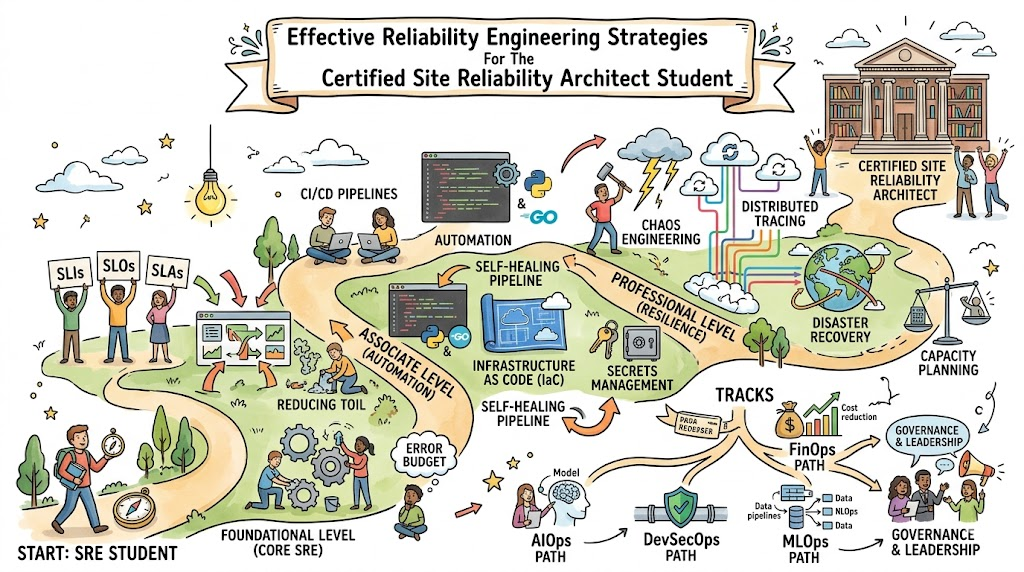
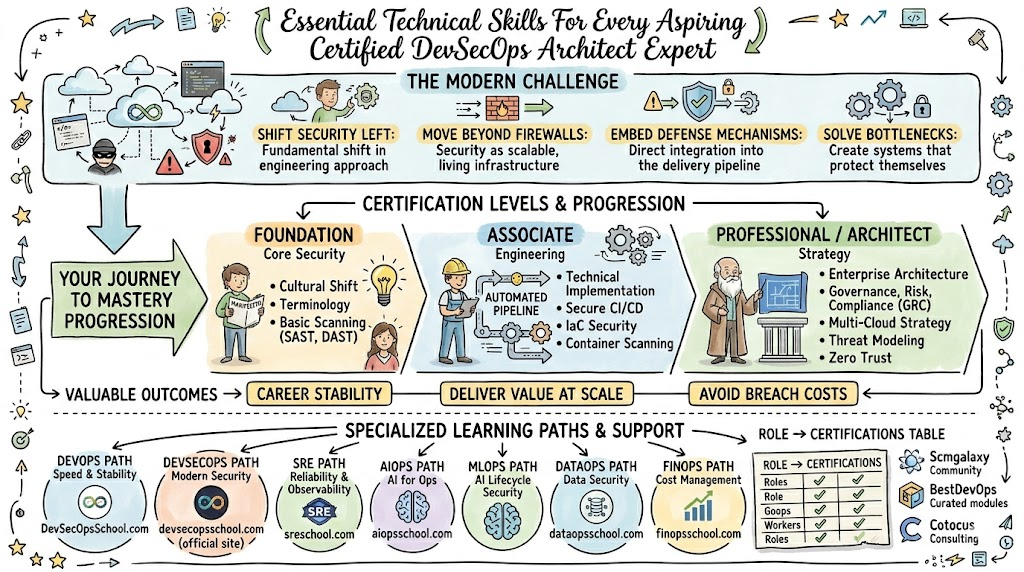
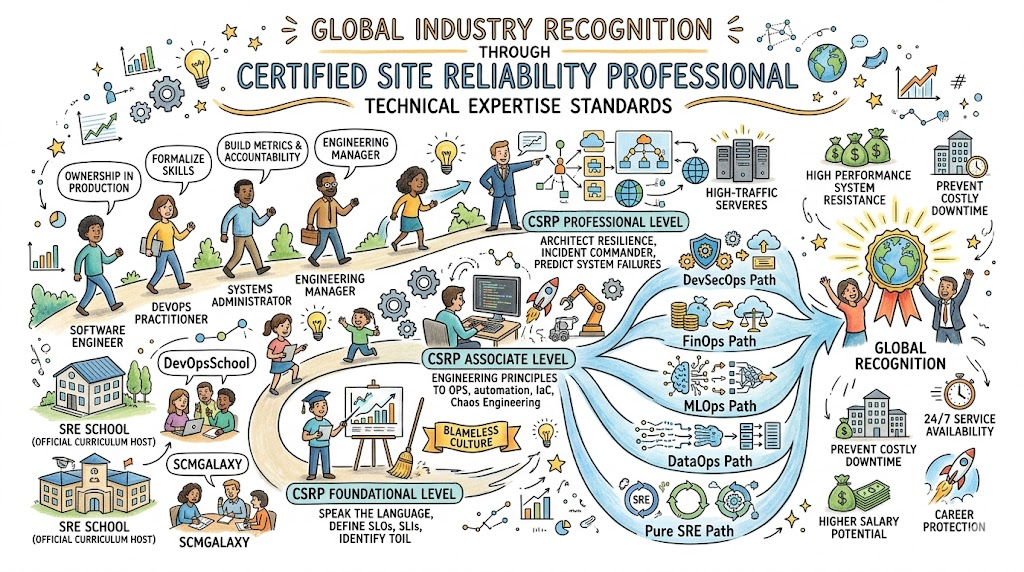
The program divides learning into three primary tiers: Foundational, Professional, and Advanced tracks. The Foundation level introduces core SRE terminology and the cultural shift required to implement these practices. The Professional level dives into hands-on automation and monitoring techniques that engineers use in daily production environments.
Specialization tracks allow practitioners to focus on specific domains such as Security (DevSecOps) or Cost Management (FinOps). These tracks align with career progression, helping junior engineers become senior leads and architects. By following this structured hierarchy, you ensure that your technical growth matches the increasing complexity of modern enterprise systems.
Complete Certified Site Reliability Professional Certification Table
| Track | Level | Who it’s for | Prerequisites | Skills Covered | Recommended Order |
| Core SRE | Foundation | New Engineers & PMs | Basic IT Knowledge | SLIs, SLOs, Toil Reduction | 1 |
| SRE Ops | Professional | DevOps & Cloud Engineers | 1-2 Years Experience | Monitoring, Automation, Incident Response | 2 |
| SRE Arch | Advanced | Senior SREs & Architects | Professional Cert | Scaling, DR, Performance Engineering | 3 |
| DevSecOps | Specialty | Security Professionals | Professional Cert | Secure CI/CD, Threat Modeling | 4 |
| FinOps | Specialty | FinOps Practitioners | Professional Cert | Cloud Cost Optimization, Budgeting | 4 |
Detailed Guide for Each Certified Site Reliability Professional Certification
Foundational Level
Certified Site Reliability Professional – Foundation
What it is
This level validates an engineer’s understanding of SRE history and the fundamental metrics that define system health. It ensures the candidate can communicate effectively using the language of reliability.
Who should take it
Junior developers, IT project managers, and students should take this exam. It serves as the perfect entry point for anyone transitioning into the DevOps ecosystem.
Skills you’ll gain
- Defining Service Level Indicators (SLIs) for various application types.
- Establishing Service Level Objectives (SLOs) that align with business goals.
- Managing Error Budgets to balance speed and stability.
- Identifying and documenting operational toil.
Real-world projects you should be able to do
- Create a basic reliability dashboard for a web application.
- Draft an error budget policy for a development team.
- Perform a toil audit on a manual deployment process.
Preparation plan
- 7 Days: Memorize core definitions and the SRE manifesto principles.
- 30 Days: Watch all foundational video modules and complete the practice quizzes.
- 60 Days: Participate in community study groups to discuss real-world case studies.
Common mistakes
- Confusing SLOs with rigid SLAs that have legal consequences.
- Ignoring the cultural aspect of SRE in favor of purely technical definitions.
Best next certification after this
Same-track option: Associate/Professional Level SRE.
Cross-track option: DevOps Foundation.
Leadership option: Certified Process Owner.
Associate Level
Certified Site Reliability Professional – Associate
What it is
The Associate level confirms your ability to implement monitoring and automation tools in a live environment. It focuses on the technical execution of SRE principles.
Who should take it
Mid-level Cloud Engineers and DevOps practitioners who handle daily operations should pursue this. It validates your hands-on proficiency in production systems.
Skills you’ll gain
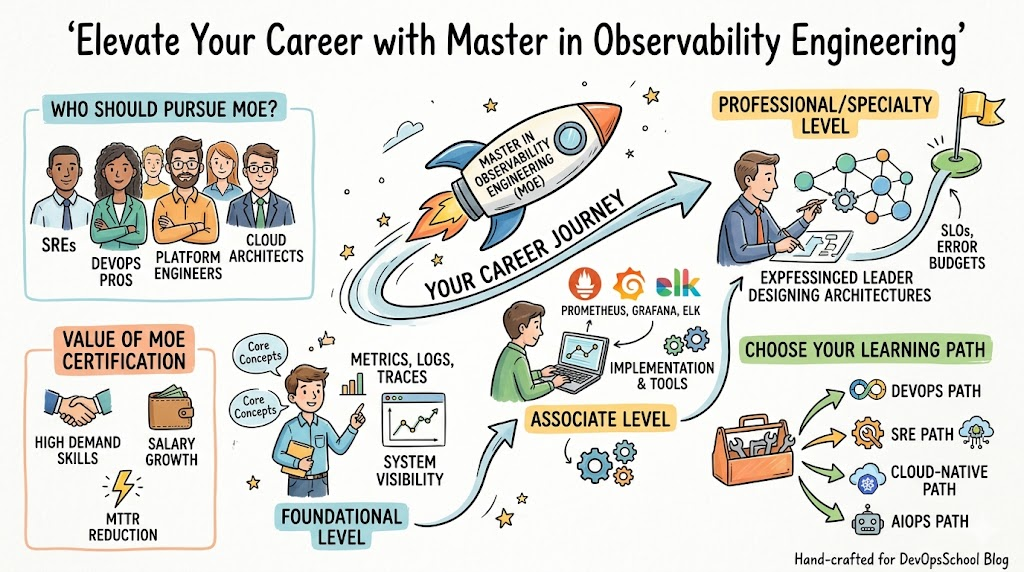
- Implementing observability stacks using Prometheus and Grafana.
- Writing automation scripts to eliminate repetitive manual tasks.
- Leading incident response calls and documenting root causes.
- Configuring automated alerting based on SLO breaches.
Real-world projects you should be able to do
- Deploy a centralized logging system for a microservices cluster.
- Build a self-healing script that restarts failed services automatically.
- Lead a post-mortem session after a simulated production outage.
Preparation plan
- 7 Days: Review Linux internals and basic shell scripting.
- 30 Days: Complete all hands-on labs involving monitoring and alerting.
- 60 Days: Build a complete end-to-end automation pipeline in a sandbox.
Common mistakes
- Over-alerting, which leads to alert fatigue for the engineering team.
- Focusing too much on one tool instead of the underlying reliability pattern.
Best next certification after this
Same-track option: Professional SRE Architect.
Cross-track option: Certified Kubernetes Administrator.
Leadership option: SRE Team Lead Certification.
Professional/Specialty Level
Certified Site Reliability Professional – Professional
What it is
This elite certification proves you can design and manage large-scale distributed systems. It focuses on architecture, high availability, and long-term capacity planning.
Who should take it
Senior SREs and Principal Architects with 5+ years of experience should take this. It identifies you as an expert capable of leading an organization’s infrastructure strategy.
Skills you’ll gain
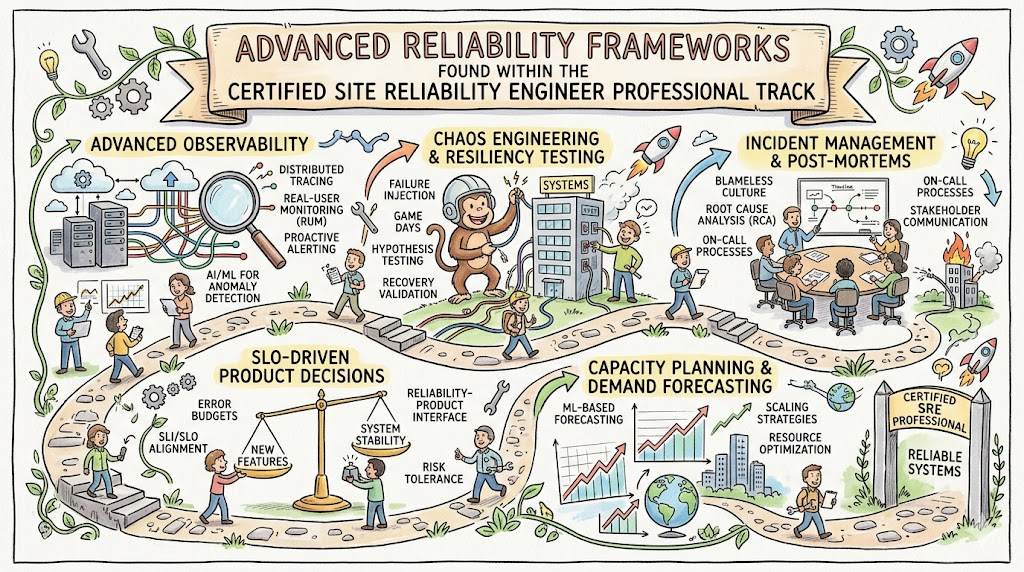
- Designing multi-region failover strategies for global applications.
- Conducting chaos engineering experiments to find system weaknesses.
- Advanced capacity modeling using historical data and traffic trends.
- Optimizing performance across the entire application stack.
Real-world projects you should be able to do
- Architect a disaster recovery plan with a 15-minute recovery time objective.
- Execute a controlled chaos experiment on a staging Kubernetes cluster.
- Design a globally distributed database layer with high consistency.
Preparation plan
- 7 Days: Study advanced networking and distributed system theory.
- 30 Days: Analyze famous industry outages and their architectural solutions.
- 60 Days: Spend significant time in high-level architectural simulation labs.
Common mistakes
- Designing overly complex solutions that the team cannot maintain.
- Failing to account for latency in multi-region data replication.
Best next certification after this
Same-track option: FinOps or DevSecOps Specialty.
Cross-track option: Cloud Solutions Architect Professional.
Leadership option: Director of Engineering Track.
Choose Your Learning Path
DevOps Path
The DevOps path emphasizes the integration of development cycles with automated operations. You focus on building pipelines that enable developers to ship code frequently while maintaining high quality. This path suits those who want to master CI/CD, configuration management, and the cultural alignment between dev and ops teams.
DevSecOps Path
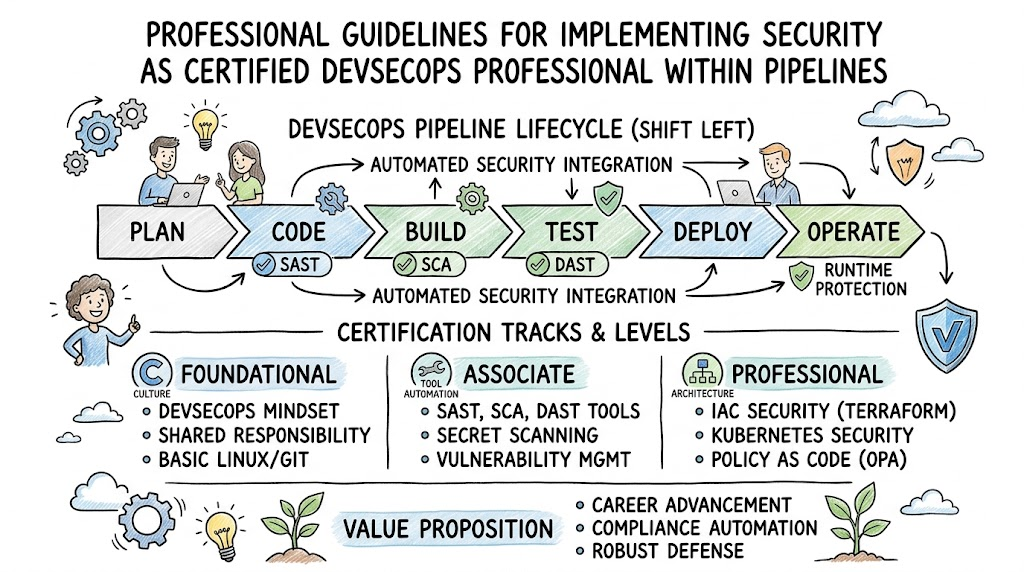
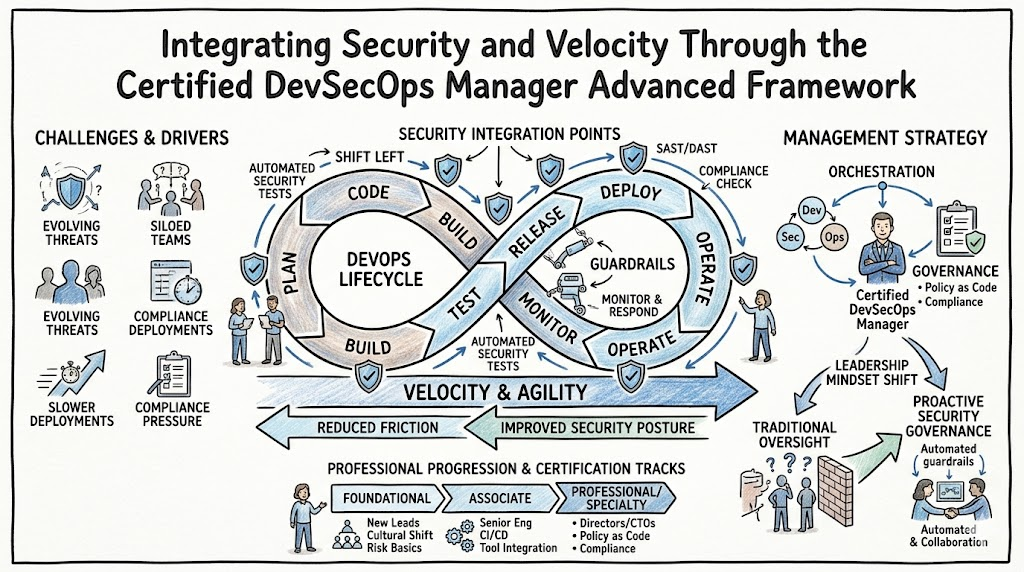
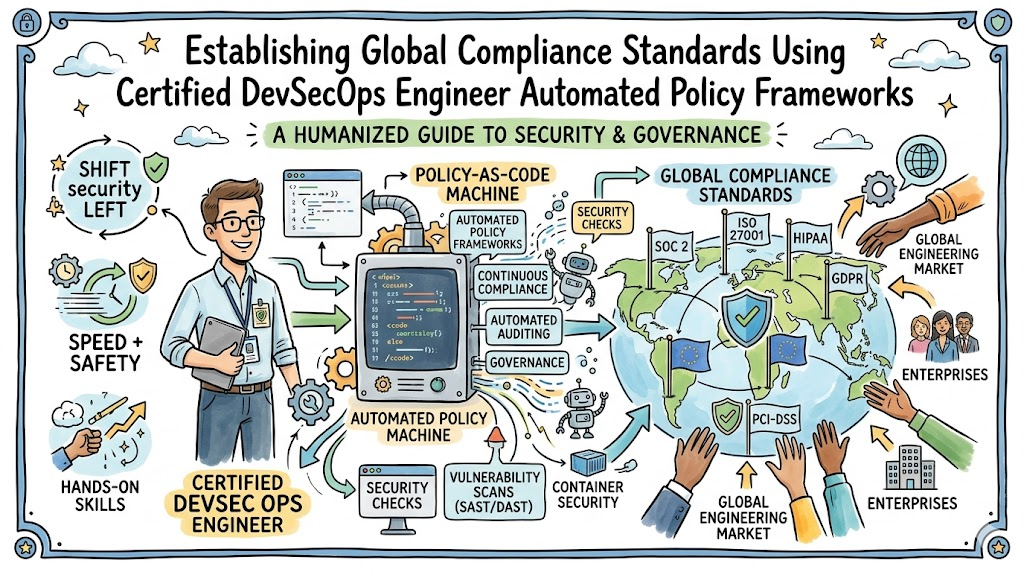
Professionals on the DevSecOps path learn to integrate security into every stage of the software lifecycle. You focus on automating security scans, managing secrets, and ensuring compliance without slowing down the deployment process. This path is critical for engineers working in highly regulated industries like finance or healthcare.
SRE Path
The SRE path provides the deepest dive into system reliability, observability, and incident management. You focus on engineering the production environment to survive failures and scale efficiently. Choose this path if you want to become the ultimate guardian of system uptime and performance.
AIOps Path
The AIOps path teaches you how to use artificial intelligence and machine learning to automate IT operations. You learn to analyze massive amounts of telemetry data to predict failures before they happen. This path represents the future of managing complex, high-scale digital environments.
MLOps Path
The MLOps path focuses on the reliability and deployment of machine learning models. You learn how to manage data pipelines, monitor model performance in production, and automate retraining cycles. This is the ideal choice for engineers supporting data science teams and AI-driven products.
DataOps Path
The DataOps path applies SRE principles to the world of data engineering and analytics. You focus on the reliability of data pipelines, the uptime of data warehouses, and the accuracy of automated reports. This path ensures that the organization can always trust its data for critical decision-making.
FinOps Path
The FinOps path centers on the financial management and optimization of cloud infrastructure. You learn how to balance performance with cost-efficiency, ensuring the organization gets the most value from its cloud spend. This path is essential for architects and managers responsible for large cloud budgets.
Role → Recommended Certified Site Reliability Professional Certifications
| Role | Recommended Certifications |
| DevOps Engineer | Foundation SRE, Professional SRE |
| SRE | Professional SRE, Advanced SRE Architecture |
| Platform Engineer | Professional SRE, Advanced SRE Architecture |
| Cloud Engineer | Foundation SRE, FinOps Specialty |
| Security Engineer | Foundation SRE, DevSecOps Specialty |
| Data Engineer | Foundation SRE, DataOps Specialty |
| FinOps Practitioner | Foundation SRE, FinOps Specialty |
| Engineering Manager | Foundation SRE, SRE Leadership |
Next Certifications to Take After Certified Site Reliability Professional
Same Track Progression
Once you master the professional tier, you should focus on deep technical specialization. This might include becoming an expert in specific technologies like Service Mesh, advanced Kubernetes networking, or specialized database reliability. Deepening your expertise within the SRE track makes you an indispensable asset for solving the industry’s most difficult infrastructure problems.
Cross-Track Expansion
Broadening your skills into adjacent fields like security or data engineering increases your versatility as a leader. By earning certifications in DevSecOps or DataOps, you learn how to apply reliability principles to different parts of the business. This cross-track approach prepares you for “T-shaped” roles where you provide both deep expertise and broad organizational value.
Leadership & Management Track
If you aim to lead large departments, you should transition into the management track. This path focuses on team building, budget management, and strategic planning rather than hands-on coding. You learn how to build a culture of reliability across an entire enterprise and align technical goals with high-level business objectives.
Training & Certification Support Providers for Certified Site Reliability Professional
- DevOpsSchool offers a wide range of instructor-led training programs designed for working professionals. They provide comprehensive study materials and live sessions that cover the entire SRE and DevOps spectrum. Their instructors bring decades of industry experience, ensuring that students learn practical skills that apply directly to their jobs.
- Cotocus specializes in high-end consulting and technical training for enterprise teams looking to adopt SRE practices. They provide customized workshops and hands-on labs that simulate complex production environments. Their approach focuses on helping organizations transform their operational culture through structured certification paths.
- Scmgalaxy provides a massive library of community-driven resources, including tutorials, scripts, and documentation for SRE candidates. They host regular webinars and technical discussions that help engineers stay updated with the latest tools and trends. It is an excellent resource for self-learners who need extra technical depth.
- BestDevOps focuses on delivering high-quality, practical training for the next generation of reliability engineers. They offer focused certification bootcamps that help students prepare for exams quickly and effectively. Their curriculum emphasizes the most in-demand tools in the current global market.
- devsecopsschool.com serves as the primary resource for engineers who want to merge security with reliability. They provide specialized courses that teach you how to build secure infrastructure and automate compliance checks. Their training is essential for anyone pursuing the DevSecOps specialty track.
- sreschool.com acts as the official platform for the Certified Site Reliability Professional program, providing all official courseware and labs. They ensure that the curriculum stays current with industry standards and enterprise requirements. By training here, you guarantee that your certification meets the official standards of the program.
- aiopsschool.com leads the industry in teaching engineers how to apply AI and machine learning to IT operations. They provide cutting-edge courses on predictive monitoring and automated root cause analysis. This provider is the top choice for those looking to enter the AIOps specialty field.
- dataopsschool.com focuses on the intersection of data engineering and operational reliability. They provide specialized training for managing large-scale data pipelines and ensuring data integrity. Their courses help data professionals adopt an SRE mindset to improve their daily workflows.
- finopsschool.com offers specialized training in cloud financial management and cost optimization. They help engineers and managers understand the economic impact of their architectural decisions. Their certification support is vital for anyone looking to master the FinOps domain.
Frequently Asked Questions
1. What makes this certification different from a general DevOps certificate?
While DevOps focuses on the entire lifecycle, this certification focuses specifically on the engineering and mathematical principles required for system reliability and uptime.
2. Do I need to know a specific programming language to pass the exam?
The exams are generally language-agnostic, but you should have a functional understanding of scripting languages like Python, Bash, or Go for the professional levels.
3. Is the Certified Site Reliability Professional recognized in India?
Yes, many major Indian tech hubs and global IT firms recognize this certification as a standard for hiring senior engineering talent.
4. How long does the average person study for the Foundation exam?
Most candidates find that 30 days of consistent study allows them to master the foundational concepts and pass the exam confidently.
5. Are there hands-on labs included in the certification package?
Yes, the SreSchool platform includes interactive lab environments where you can practice monitoring and automation in a safe sandbox.
6. Does the certification expire over time?
The certification typically requires renewal every two years to ensure that your skills remain current with the latest industry technology and practices.
7. Can I take the exam remotely?
Yes, SreSchool offers proctored online exams that you can take from the comfort of your home or office.
8. Is there a prerequisite for the Professional level?
You must typically hold the Foundation level certification or demonstrate significant industry experience before attempting the Professional exam.
9. How does this certification help an Engineering Manager?
It provides managers with the vocabulary and strategic frameworks needed to lead reliability teams and set realistic performance targets.
10. What is the difficulty level of the Professional exam?
The Professional exam is challenging and requires a high degree of hands-on technical skill and problem-solving ability in live environments.
11. Are there any community forums for students?
Yes, most support providers offer access to forums and chat groups where you can ask questions and share knowledge with other candidates.
12. Does the program cover Kubernetes?
The curriculum heavily features Kubernetes as it is the industry standard for container orchestration and modern reliability engineering.
FAQs on Certified Site Reliability Professional
1. Does the curriculum include incident management protocols?
The program teaches standardized incident response frameworks, ensuring that you can lead teams through high-pressure production outages with a clear, blameless strategy.
2. How much focus is placed on automation?
Automation serves as a core pillar of the certification, as the program requires you to demonstrate how to eliminate manual tasks using code and scripts.
3. Does the certification cover multi-cloud strategies?
The advanced levels teach you how to design for reliability across multiple cloud providers like AWS, Azure, and GCP to avoid vendor lock-in.
4. What is the role of observability in this program?
You will learn to go beyond basic monitoring by implementing deep observability that allows you to understand the internal state of complex systems.
5. Are there real-world case studies in the training?
The training includes detailed analysis of famous outages from major tech companies, helping you learn from real industry mistakes and architectural failures.
6. Does the program teach how to manage on-call rotations?
Yes, the cultural modules explain how to build sustainable on-call schedules that prevent burnout while ensuring 24/7 system coverage.
7. Is there a focus on cost optimization?
The Specialty tracks, particularly FinOps, dive deep into how reliability decisions impact the monthly cloud bill and overall business profitability.
8. How do I get started with the program?
You can start by visiting sreschool.com to explore the introductory modules and determine which track best suits your current career level.
Final Thoughts: Is Certified Site Reliability Professional Worth It?
Deciding to pursue this certification demonstrates your commitment to the highest standards of modern engineering. In an era where a single hour of downtime can cost an organization millions, the ability to engineer for reliability is a superpower. This program provides you with more than just a certificate; it gives you a mental framework for solving the industry’s most complex technical challenges.
The demand for these skills will only grow as more companies move their mission-critical workloads to the cloud. By mastering the principles of SLOs, error budgets, and automation, you position yourself at the very top of the global talent pool. If you want to work on systems that impact millions of people and command a top-tier salary, the Certified Site Reliability Professional is an essential step in your journey.