Introduction
The software world has changed in a major way. There was a time when developers wrote code, operations teams managed servers, and both groups worked in separate lanes. That model stayed in place for years. But modern software delivery has made that separation far less useful. Today, organizations need faster releases, stronger reliability, better automation, and smoother collaboration across the full engineering lifecycle.
After watching the industry move from traditional server management to cloud platforms, containers, automation, and continuous delivery, one reality stands out: companies no longer gain much from isolated technical roles. They want engineers who can understand the full path of software, from code creation to deployment and production support. They need professionals who can connect development, infrastructure, testing, security, and operations into one efficient system. That is exactly why the Master in DevOps Engineering (MDE) matters.
What is Master in DevOps Engineering (MDE)?
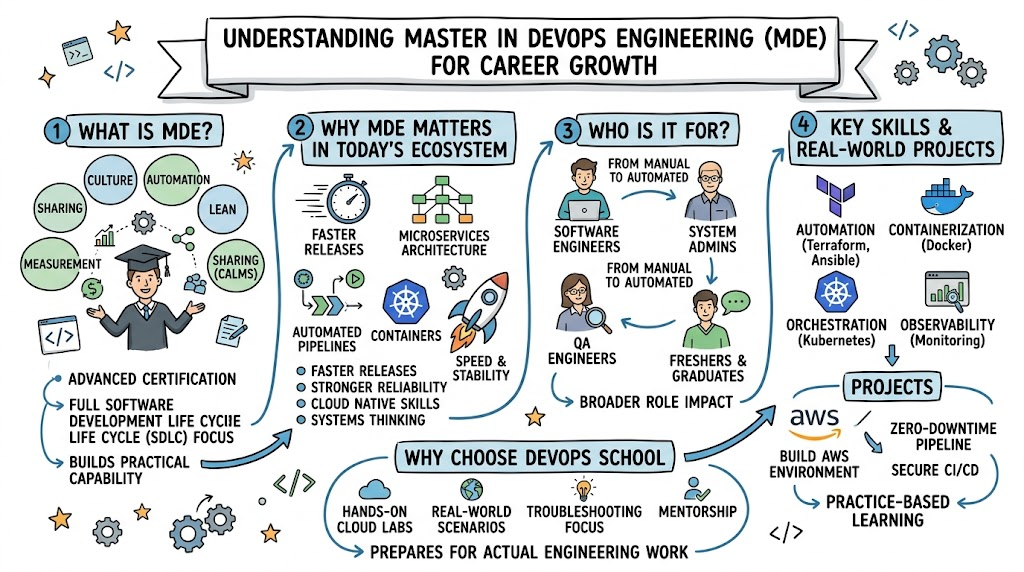
The Master in DevOps Engineering (MDE) is an advanced certification and training program created for professionals who want to build complete DevOps capability rather than learn only one tool or one stage of the process. It is a broad, practice-focused program that combines engineering culture, automation, infrastructure, cloud delivery, monitoring, and operational thinking.
The program is designed around the full Software Development Life Cycle and follows the CALMS model: Culture, Automation, Lean, Measurement, and Sharing. Instead of producing engineers who only know a few popular tools, MDE develops professionals who understand how modern delivery systems are designed, automated, monitored, and improved. By completing this certification, you build the ability to support modern software teams with a much wider and more valuable skill set.
Why it Matters in Today’s Software, Cloud, and Automation Ecosystem
Technology teams now operate in an environment where speed and stability must exist together. Businesses cannot afford slow release processes, long approval chains, or infrastructure that depends too heavily on manual intervention. Software has become a direct business driver, and the teams behind that software must be able to deliver updates quickly while keeping systems dependable.
This challenge becomes even bigger when organizations move to microservices, containers, and multi-cloud environments. As architectures grow, manual work becomes risky, expensive, and difficult to scale. This is why DevOps practices and platforms such as CI/CD pipelines, Kubernetes, Terraform, and observability tools have become essential. Engineers are expected to automate, standardize, and orchestrate more than ever before.
Reliability has also become a major customer expectation. Users no longer accept frequent downtime or slow recovery. Systems must be designed to remain available, adapt to changes, and recover quickly from failure. In addition, companies now pay closer attention to cost efficiency. Cloud growth is no longer judged only by speed and innovation. It is also judged by how responsibly teams use resources. This has made financial awareness and operational efficiency part of modern engineering.
Why Certifications are Important for Engineers and Managers
A certification helps turn learning into visible proof. Many professionals study through blogs, tutorials, and videos, which can be useful for exposure. However, that style of learning often creates gaps. It may help someone recognize tools, but it does not always help them build a connected understanding of how modern engineering works. Certifications solve that problem by providing a structured path and a clear benchmark.
For engineers, this creates confidence and direction. Instead of feeling stuck in random or incomplete learning, they can move through a guided program that covers the major areas in the right order. It also gives them a stronger way to present their value to employers, managers, and interview panels.
For managers, certifications make skill evaluation easier. When a team member earns a serious certification like MDE, it gives leadership more confidence in that person’s practical and conceptual knowledge. It also helps build a common language inside teams. That common understanding improves communication, planning, and execution. In many organizations, certification programs also support retention by showing employees that the company is investing in long-term growth.
Why Choose DevOpsSchool?
There are many learning providers in the market, but not all of them prepare learners for real engineering work. DevOpsSchool has earned attention because its approach stays close to actual industry needs. Their training is not built only around presentations and theory. It focuses on doing, testing, practicing, and troubleshooting.
A major strength is their hands-on cloud lab model, which allows learners to practice in environments that feel close to real-world engineering setups. This matters because DevOps is not a subject that can be mastered by reading alone. Another important advantage is that their mentors understand real implementation problems. They know that in actual projects, pipelines fail, deployments break, infrastructure behaves unexpectedly, and troubleshooting becomes part of the learning. That practical mindset is one of the biggest reasons many learners find value in DevOpsSchool.
Certification Deep-Dive: Master in DevOps Engineering (MDE)
What is this certification?
The Master in DevOps Engineering is a professional certification that validates a learner’s ability to work across the major areas of modern DevOps practice. It covers source code management, integration, delivery automation, infrastructure provisioning, configuration management, containers, orchestration, and observability.
Who should take this certification?
- Software Engineers: Those who want to understand how applications move from development into production.
- System Administrators: Those who want to move from routine infrastructure management toward automation and scalable operations.
- QA Engineers: Those who want to strengthen their role in automation, testing pipelines, and release quality.
- Release Managers: Those responsible for coordinating complex deployments across teams and environments.
- Freshers and Graduates: Those with technical interest and strong logical ability who want to enter a fast-growing engineering field.
Certification Overview Table
| Track | Level | Who it’s for | Prerequisites | Skills Covered | Recommended Order |
|---|---|---|---|---|---|
| Foundation | Associate | Aspiring DevOps Engineers | Basic Linux / Networking | Git, Maven, Shell Scripting | 1 |
| Core MDE | Professional | Working Engineers | Foundation Skills | Docker, Jenkins, Ansible, Terraform | 2 |
| Advanced Orchestration | Expert | Senior Engineers / SREs | Core MDE | Kubernetes, Helm, Service Mesh (Istio) | 3 |
| Strategy & Leadership | Master | Managers / Architects | Expert Track | Culture, ROI, AIOps, Governance | 4 |
About Certification Name: Master in DevOps Engineering (MDE)
What it is
MDE is a project-driven certification built to prepare professionals for full-lifecycle DevOps work. It is not limited to learning a few tools in isolation. Instead, it helps learners understand how to design and manage delivery systems that are practical, scalable, and aligned with real engineering needs. It is meant for people who want to move into broader and more strategic technical roles.
Who should take it
This certification is a strong fit for professionals who feel limited in traditional IT roles and want to move into more impactful and future-focused work. It is ideal for those who want stronger salary growth, better technical positioning, and access to global opportunities in cloud and automation-driven environments.
Skills you’ll gain
- Automation: Building repeatable workflows that reduce manual steps and improve delivery consistency.
- Containerization: Packaging applications in a way that keeps them portable and stable across environments.
- Orchestration: Managing container-based workloads efficiently across clusters.
- Configuration Management: Maintaining consistency across multiple servers and environments.
- Security: Embedding security checks and controls into the delivery pipeline.
- Observability: Using system insights such as logs, metrics, and traces to understand failures and performance issues.
Real-world projects you should be able to do after it
- Build an Automated AWS Environment: Use Terraform to provision infrastructure such as networking, databases, and application layers.
- Design a Zero-Downtime Delivery Pipeline: Use Jenkins and Kubernetes to release updates gradually and safely.
- Create Self-Healing Services: Use health checks and policies in Kubernetes to recover from service failures automatically.
- Build a Secure CI/CD Pipeline: Integrate scanning tools such as SonarQube and Snyk to block risky changes before release.
Preparation plan
- 7–14 Days: Best for learning one important tool in depth, such as Docker, Git, or Jenkins.
- 30 Days: Suitable for learners who want practical experience with the major DevOps tools and can dedicate steady daily effort.
- 60 Days: Best for serious learners who want a full DevOps journey, starting with foundations and moving toward orchestration, infrastructure, and observability.
Common mistakes
- Skipping fundamentals: Many learners rush toward advanced tools before understanding Linux, networking, and version control properly.
- Trying too many tools too fast: Surface-level exposure to many tools is less useful than strong command over a core stack.
- Avoiding scripting: DevOps work often requires small but important automation scripts, so ignoring Bash or Python becomes a weakness.
- Watching more than practicing: Real progress comes from using the terminal, building pipelines, and fixing mistakes, not just consuming lessons.
Best next certification after this
A good next move after MDE depends on your career direction. If you want to focus on secure engineering, DevSecOps certification is a strong option. If you want to specialize in uptime and production stability, SRE-focused certification is a better next step.
Choose Your Path: 6 Learning Journeys
One of the biggest strengths of DevOps is that it opens more than one career route. After building the base, you can move into a path that matches your interest and working style.
DevOps Path
This path is for professionals who enjoy building pipelines, improving release speed, and connecting the full delivery workflow from code to production.
DevSecOps Path
This path is for professionals who want security to become part of the engineering process rather than an afterthought at the end.
SRE Path
This path is for engineers who care deeply about uptime, resilience, operational excellence, and system behavior under pressure.
AIOps/MLOps Path
This path suits those who want to work at the intersection of automation, machine learning systems, and intelligent operational workflows.
DataOps Path
This path is ideal for professionals working with data pipelines, analytics platforms, and reliable movement of data across environments.
FinOps Path
This path is useful for those who want to balance cloud engineering decisions with financial efficiency and cost control.
Role → Recommended Certifications Mapping
| If your role is… | You should take… |
|---|---|
| DevOps Engineer | MDE + Kubernetes (CKA) + Terraform Associate |
| SRE | MDE + SRE Professional + Prometheus/Grafana Cert |
| Platform Engineer | MDE + Advanced Kubernetes + Service Mesh Specialist |
| Cloud Engineer | MDE + AWS/Azure Solution Architect |
| Security Engineer | MDE + DevSecOps Professional + Container Security |
| Data Engineer | MDE + DataOps Professional + Snowflake/Databricks |
| FinOps Practitioner | MDE + FinOps Certified Practitioner |
| Engineering Manager | MDE (Leadership Track) + DevOps Leader (DOL) |
Next Certifications to Take
After completing MDE, it is wise to keep building in a direction that supports your long-term goals.
- Deepening Your Core Skills: Certified Kubernetes Administrator is a natural next step for those who want stronger proof of orchestration expertise.
- Expanding Across Disciplines: Certified DevSecOps Professional is useful for engineers who want to connect delivery speed with secure engineering practices.
- Moving Toward Leadership: DevOps Leader is well suited for professionals who want to guide teams, influence culture, and drive transformation at a broader level.
Top Training and Certification Providers
DevOpsSchool
DevOpsSchool is widely recognized for practical DevOps learning. It is known for interactive sessions, real-world labs, mentor access, and project-focused training. It remains a strong option for both individual professionals and corporate teams.
Cotocus
Cotocus is known for focused training and consulting-style learning. It is often chosen by organizations and teams looking for structured skill development.
Scmgalaxy
Scmgalaxy has built a large community over time and offers coverage across many areas of DevOps, from foundational topics to modern practices.
BestDevOps
BestDevOps is a good option for learners who want strong exposure to essential tools and practical implementation in a direct format.
devsecopsschool.com
This provider focuses on security in modern software delivery and is a good home for professionals who want to grow in DevSecOps.
sreschool.com
This provider concentrates on reliability engineering, monitoring, and the practices needed to keep production systems healthy and dependable.
aiopsschool.com
This provider supports learners who want to understand how artificial intelligence and machine learning are shaping modern operations.
dataopsschool.com
This platform is designed for professionals working on data movement, data platform reliability, and operational discipline in data workflows.
finopsschool.com
This provider focuses on helping engineering teams understand cloud cost, usage patterns, and financial optimization.
FAQs (General)
1. Is MDE suitable for beginners?
Yes, but beginners should be prepared to invest real effort in learning the foundations. Strong basics make the rest of the journey much easier.
2. How long does the MDE certificate last?
The validity period often depends on the provider, but many certifications are treated as relevant for around two years before upskilling or renewal becomes important.
3. What is the difficulty level?
It is an advanced program, but it is achievable for working professionals who follow the labs, practice regularly, and stay disciplined.
4. Does MDE cover AWS, Azure, and GCP?
The certification usually focuses on platform-independent skills and tools, which makes it useful across major cloud environments.
5. How much time do I need to commit weekly?
A realistic commitment for a strong learning path is about 10 to 12 hours per week.
6. Can I get a job abroad with this certification?
Yes, DevOps skills are in demand across international markets, and practical knowledge supported by certification can strengthen global opportunities.
7. Do I need to be a coding genius?
No, but you should be comfortable with scripting, automation logic, and basic technical problem-solving.
8. What is the sequence of tools I should learn?
A sensible path is Git, Docker, Jenkins, Ansible, Terraform, Kubernetes, and Prometheus.
9. Is there any placement assistance?
Many known training providers offer some level of career support, interview guidance, or network-based hiring help.
10. What is the ROI of an MDE certification?
The return can be strong for professionals who actively apply their skills in projects and move into higher-value roles involving automation and platform work.
11. Is the exam lab-based or multiple choice?
The strongest certification programs often combine theoretical questions with practical hands-on tasks.
12. Can I take this while working a 9-to-5 job?
Yes, most serious training programs are designed in a way that working professionals can manage them with proper planning.
FAQs on Master in DevOps Engineering (MDE)
1. What makes MDE different from a standard DevOps course?
A standard course may teach tools one by one. MDE teaches how those tools work together in a real engineering environment.
2. Is the training live or recorded?
Good providers usually offer a mix of live training and recorded access so learners get both flexibility and guidance.
3. Do I get hands-on experience with production-grade clusters?
Yes, quality MDE programs generally include practical cloud-based labs that feel close to real production systems.
4. How does MDE prepare me for an SRE role?
It gives you the automation, deployment, and systems foundation that SRE work depends on.
5. What happens if I get stuck in a lab?
Most serious institutes provide support through mentors, doubt-clearing, or technical assistance channels.
6. Is there a final project?
Yes, many MDE programs include a capstone project where learners build an end-to-end delivery and deployment setup.
7. Are there any discounts for group enrollments?
Many providers offer special pricing for team registrations or corporate batches.
8. Is the certification recognized by recruiters?
Yes, especially when the certification is backed by practical projects and visible hands-on capability.
Conclusion
The Master in DevOps Engineering is not just another technical certification. It is a strong career-development pathway for professionals who want to stay relevant in an industry shaped by automation, cloud-native systems, rapid delivery, and operational excellence. It helps learners build practical skill, stronger confidence, and a wider understanding of how modern software systems are delivered and maintained. Instead of remaining limited to one narrow role, you become capable of contributing across the engineering lifecycle.
With the right effort and the right learning partner, such as DevOpsSchool, MDE can help you move into more valuable roles and more future-ready opportunities. For engineers and managers who want to stay competitive, adaptable, and impactful, this certification offers a strong and practical way forward.
Leave a Reply