Introduction
Cybersecurity remains the highest priority for organizations navigating the complexities of the modern cloud. Professionals who master Microsoft Azure Security Technologies (AZ-500) possess the technical skills required to protect digital assets against sophisticated threats. This guide assists engineers and managers in choosing the right path toward technical excellence in cloud defense. By partnering with DevOpsSchool, you gain access to structured mentorship and hands-on labs that reflect real-world production environments. This document explains the strategic value of security certification and provides a clear roadmap for career advancement within the global technology sector.
What is the Microsoft Azure Security Technologies (AZ-500)?
Microsoft Azure Security Technologies (AZ-500) serves as the primary technical validation for cloud security implementation. This program moves beyond basic cloud administration and focuses on the actual construction of secure environments. It requires engineers to demonstrate mastery in managing identity, protecting networks, and securing data across the Azure ecosystem.
The curriculum forces you to solve practical problems that arise in modern enterprise workflows. Instead of memorizing definitions, you learn how to automate threat responses and configure complex firewalls. Organizations rely on this certification to identify practitioners who can maintain a zero-trust architecture in live production settings. Achieving this status proves that you possess the technical depth to safeguard sensitive corporate information.
Who Should Pursue Microsoft Azure Security Technologies (AZ-500)?
Cloud administrators who wish to specialize in defensive strategies find this path most rewarding. Site Reliability Engineers (SREs) benefit by learning to balance system availability with rigorous security protocols. Even experienced developers who manage cloud-native applications use this knowledge to implement “security as code” within their delivery pipelines.
Engineering managers in India and major global tech hubs prioritize this credential when hiring for senior infrastructure roles. Beginners with a firm grasp of cloud networking can use this as a direct route to becoming a specialized security analyst. Senior IT professionals also pursue this validation to modernize their skills and lead large-scale digital transformation projects. Every professional responsible for data privacy or platform integrity should consider this certification essential.
Why Microsoft Azure Security Technologies (AZ-500) is Valuable
Enterprise cloud adoption continues to accelerate, creating an urgent demand for verified security experts. Microsoft Azure Security Technologies (AZ-500) provides professional longevity because it teaches fundamental security principles that apply regardless of minor tool updates. You stay relevant in a competitive market by proving you can defend the identity perimeter and automate resource hardening.
Investing time in this program yields a high return by qualifying you for specialized roles such as Cloud Security Engineer or DevSecOps Lead. Companies continue to increase security budgets, ensuring that skilled practitioners enjoy significant career stability and high salary potential. Mastering these technologies moves you from a generalist role into a strategic position where you guide critical organizational safety measures. You gain the confidence to lead security audits and influence long-term architectural decisions.
Microsoft Azure Security Technologies (AZ-500) Certification Overview
This associate-level certification requires you to demonstrate hands-on proficiency in the Azure portal and command-line interfaces. The assessment measures your ability to handle identity and access, platform protection, security operations, and data safety.
Microsoft designs the exam to simulate the daily challenges that security engineers face in the field. You must successfully navigate case studies and technical scenarios to prove your implementation skills. The structure of the program ensures that you gain a balanced understanding of all four security pillars. Completing this certification indicates that you can manage the entire security lifecycle for a global enterprise cloud environment.
Microsoft Azure Security Technologies (AZ-500) Certification Tracks & Levels
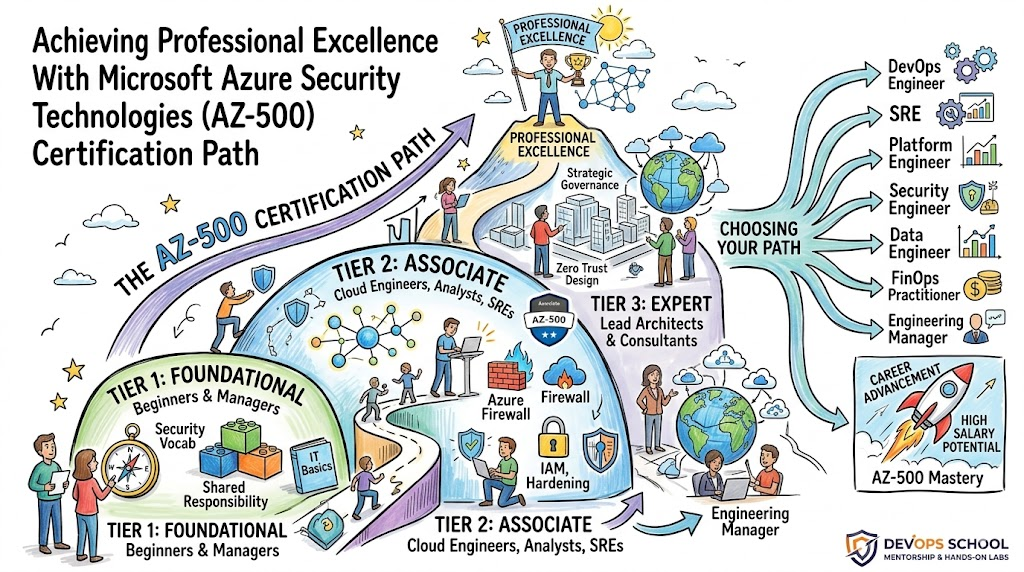
The Azure security ecosystem guides professionals through three distinct tiers of technical mastery.
- Foundational Tier: This level establishes the basic vocabulary of security and compliance. It helps new entrants understand the shared responsibility model and fundamental identity concepts.
- Associate Tier (AZ-500): This is the core implementation level where you build and manage defensive systems. It serves as the primary technical benchmark for the industry.
- Advanced Tier: This tier targets lead architects who design holistic security strategies for hybrid environments. It focuses on strategic governance and complex risk management across the entire enterprise stack.
Complete Microsoft Azure Security Technologies (AZ-500) Certification Table
| Track | Level | Who it’s for | Prerequisites | Skills Covered | Recommended Order |
| Cloud Defense | Foundational | Beginners/Managers | General IT Basics | Security Vocab | 1 |
| Implementation | Associate | Engineers/SREs | Azure Admin Skills | Hardening, IAM | 2 |
| Architecture | Expert | Lead Architects | Associate Cert | Zero Trust Design | 3 |
| Identity Ops | Specialist | IAM Engineers | Entra ID Basics | Governance, PIM | Optional |
| Compliance | Specialist | Auditors/GMLs | Basic Governance | Policy, Audit | Optional |
Detailed Guide for Each Microsoft Azure Security Technologies (AZ-500) Certification
Microsoft Azure Security Technologies (AZ-500) – Foundational Level
What it is
This certification validates a baseline understanding of security, identity, and compliance. It confirms that you understand the terminology and the shared responsibility between the cloud provider and the customer.
Who should take it
Technical managers and students new to the cloud should start here. It provides a conceptual gateway for those who do not yet perform daily technical configurations.
Skills you’ll gain
- Understanding authentication and authorization principles.
- Describing identity services like Microsoft Entra ID.
- Defining data privacy and sovereign requirements.
- Identifying core defensive tools within the Azure platform.
Real-world projects you should be able to do
- Perform a basic security audit on a testing environment.
- Explain the benefits of cloud-native security to business stakeholders.
Preparation plan
- 7–14 days: Review official terminology and shared responsibility diagrams.
- 30 days: Complete a foundational video course and practice quizzes.
- 60 days: Most professionals finish this level in under a month.
Common mistakes
- Ignoring the legal definitions of compliance terms.
- Skipping the study of identity basics.
Best next certification after this
- Same-track option: AZ-500 Associate
- Cross-track option: AZ-900 Fundamentals
- Leadership option: Cloud Business Management
Microsoft Azure Security Technologies (AZ-500) – Associate Level
What it is
The core AZ-500 certification proves your technical ability to implement and monitor security. It serves as the standard for hands-on security engineers in the modern workplace.
Who should take it
Cloud engineers, security analysts, and SREs who manage infrastructure daily must pursue this. It validates that you can handle production-grade hardening tasks.
Skills you’ll gain
- Configuring Conditional Access and identity governance.
- Implementing Azure Firewall and Network Security Groups.
- Managing Key Vault, encryption, and data protection.
- Setting up monitoring with Microsoft Sentinel and Defender.
Real-world projects you should be able to do
- Deploy a secure multi-tier virtual network with strict egress control.
- Automate secret rotation using Azure Functions and Key Vault.
Preparation plan
- 7–14 days: Intensive lab review for current Azure administrators.
- 30 days: Daily labs focusing on identity and networking domains.
- 60 days: Comprehensive learning path for generalist IT professionals.
Common mistakes
- Focusing only on the portal and ignoring CLI commands.
- Underestimating the complexity of networking rules.
Best next certification after this
- Same-track option: SC-100 Expert Architect
- Cross-track option: AZ-400 DevOps Expert
- Leadership option: Information Security Manager
Microsoft Azure Security Technologies (AZ-500) – Expert Level
What it is
This tier targets senior professionals who design enterprise-wide security solutions. It shifts the focus from configuration to high-level strategic architecture.
Who should take it
Lead architects and senior security consultants who define organizational safety standards should take this. You must demonstrate a strategic vision for protecting hybrid clouds.
Skills you’ll gain
- Designing Zero Trust architectures for global firms.
- Creating governance frameworks with Azure Policy.
- Developing incident response plans for major breaches.
- Integrating security across multi-cloud environments.
Real-world projects you should be able to do
- Architect a comprehensive compliance strategy for a regulated industry.
- Design a disaster recovery plan that prioritizes data security.
Preparation plan
- 7–14 days: High-level review of architectural case studies.
- 30 days: Focus on governance strategy and risk assessment.
- 60 days: Deep research into multi-cloud and cross-platform security.
Common mistakes
- Focusing too much on individual service buttons rather than strategy.
- Ignoring the cost implications of security architecture.
Best next certification after this
- Same-track option: Vendor-neutral certs like CISSP.
- Cross-track option: AZ-305 Solutions Architect.
- Leadership option: CISO Professional Path.
Choose Your Learning Path
DevOps Path
Engineers on the DevOps track use the Microsoft Azure Security Technologies (AZ-500) curriculum to integrate safety into the build process. You learn to manage secrets without exposing them and enforce security policies using automation. This path ensures that security moves at the same speed as your development team, preventing organizational bottlenecks.
DevSecOps Path
This specialized path creates practitioners who live at the intersection of security and delivery. By mastering AZ-500, you gain the skills to automate vulnerability scanning and real-time threat detection. You focus on creating a “Security First” culture where automated audits provide continuous protection for all production workloads.
SRE Path
Site Reliability Engineers leverage security knowledge to prevent outages caused by unauthorized access or misconfigurations. You focus on building resilient perimeters and implementing robust identity controls to protect system uptime. This path ensures that security measures strengthen system availability rather than compromising overall performance.
AIOps Path
Professionals in AIOps apply Microsoft Azure Security Technologies (AZ-500) to protect the infrastructure hosting intelligent automation. You learn to secure the data feeds and processing units that drive AI-driven operational insights. This path focuses on maintaining the confidentiality and integrity of your automated operations center assets.
MLOps Path
This path focuses on securing the entire machine learning lifecycle, from training to model deployment. You learn to manage access to sensitive datasets and protect the API endpoints that serve your models. Securing the machine learning pipeline prevents data poisoning and protects valuable corporate intellectual property.
DataOps Path
Data practitioners utilize AZ-500 to master the art of data sovereignty and high-level encryption. You learn to secure storage accounts, SQL databases, and data lakes using advanced identity and key management. This path ensures that your organization meets global data privacy standards while maintaining high-speed delivery.
FinOps Path
FinOps practitioners learn to balance high-level security with cost-effective configurations in the Azure cloud. You will understand how security features like the Azure Firewall impact the budget and learn to optimize them. This path allows you to provide robust protection without causing unnecessary financial strain on the business.
Role → Recommended Microsoft Azure Security Technologies (AZ-500) Certifications
| Role | Recommended Certifications |
| DevOps Engineer | AZ-500 + AZ-400 |
| SRE | AZ-500 + AZ-700 |
| Platform Engineer | AZ-500 + AZ-104 |
| Cloud Engineer | AZ-500 + AZ-104 |
| Security Engineer | SC-900 + AZ-500 + SC-200 |
| Data Engineer | AZ-500 + DP-203 |
| FinOps Practitioner | AZ-500 + AZ-900 |
| Engineering Manager | SC-900 + AZ-500 |
Next Certifications to Take After Microsoft Azure Security Technologies (AZ-500)
Same Track Progression
Once you master implementation at the associate level, move into the expert architecture domain. Focus on certifications that teach you how to design a unified cybersecurity vision across multiple platforms. This transition moves you from a doer to a designer, allowing you to lead major security transformations for global firms.
Cross-Track Expansion
Expand your professional reach by pursuing the Azure DevOps Engineer track after you secure your AZ-500 badge. This combination makes you a high-value DevSecOps expert who can both build and protect complex automated systems. Most top-tier engineering organizations seek this unique blend of skills when hiring for senior leadership roles.
Leadership & Management Track
For those aiming for technical leadership, the focus shifts toward risk management and corporate governance. Pursue certifications that emphasize the business impact of security decisions and how to lead technical teams. This path leads to roles like Security Director or CISO, where you manage both technology and human capital.
Training & Certification Support Providers for Microsoft Azure Security Technologies (AZ-500)
- DevOpsSchool
The curriculum at DevOpsSchool provides an intensive, lab-focused environment that helps engineers master the Microsoft Azure Security Technologies (AZ-500) certification. Their expert mentors guide students through real-world scenarios, ensuring that every learner understands how to harden production infrastructures effectively. They prioritize hands-on mastery over simple exam preparation, giving you the skills to excel in global engineering roles. This institution offers extensive support, including updated course materials and project-based learning. - Cotocus
Cotocus delivers specialized cloud security training designed for the modern IT professional. They offer interactive sessions and deep-dive workshops that clarify the complexities of identity management and network isolation within the Azure ecosystem. Their training methodology focuses on practical outcomes, helping you bridge the gap between theoretical knowledge and professional implementation. Students benefit from personalized feedback and a curriculum that reflects the latest industry trends. This provider serves as a premier choice for career-oriented learners. - Scmgalaxy
As a comprehensive community hub, Scmgalaxy provides a wealth of technical resources for those pursuing Microsoft Azure Security Technologies (AZ-500). They offer detailed technical articles, practice assessments, and community forums where engineers can discuss complex configuration challenges. Their platform supports self-driven learners who want to supplement their training with practical insights and peer support. You gain access to a massive library of tutorials that simplify high-level security concepts into digestible information. - BestDevOps
The training program at BestDevOps focuses on delivering high-quality education for aspiring cloud security engineers. They offer structured courses that cover all domains of the AZ-500 exam with a focus on automation and shift-left security principles. Their instructors bring decades of industry experience, providing valuable insights into how global enterprises manage risk. You will master the use of native Azure tools to build resilient and compliant cloud-native environments. - devsecopsschool.com
devsecopsschool.com specializes in the intersection of security and software delivery, making them an ideal partner for the AZ-500 track. They teach students how to integrate defensive measures directly into CI/CD pipelines using Azure-native tools. Their curriculum emphasizes modern security operations and threat hunting, providing the skills needed for high-demand DevSecOps roles. You learn to automate vulnerability scanning and secret management to ensure continuous protection for all production workloads. - sreschool.com
sreschool.com tailors its Microsoft Azure Security Technologies (AZ-500) training for professionals who focus on system reliability and uptime. They emphasize the relationship between security controls and system stability, teaching students how to protect environments without compromising performance. Their instructors focus on network hardening and identity isolation as key strategies for maintaining resilient cloud systems. You will learn to use monitoring tools to detect and mitigate threats before they impact user experience. - aiopsschool.com
aiopsschool.com addresses the unique security requirements of AI and machine learning environments through their specialized AZ-500 training. they focus on securing data pipelines and protecting the integrity of automated decision-making systems within the Azure cloud. Students learn how to implement identity governance for complex AI workloads and how to encrypt massive datasets effectively. Their training prepares engineers to defend against emerging threats targeting artificial intelligence infrastructure and automated operations. - dataopsschool.com
dataopsschool.com focuses heavily on the data protection and compliance domains of the Microsoft Azure Security Technologies (AZ-500) certification. They teach students how to architect secure data lakes and implement robust encryption across all Azure storage services. Their curriculum emphasizes the importance of data privacy laws and how to enforce them through technical controls. Learners gain practical experience in managing SQL security and protecting sensitive information at an enterprise scale. - finopsschool.com
finopsschool.com provides a unique perspective on the AZ-500 certification by focusing on cost-optimized security implementation. They teach students how to provide high-level protection while managing the financial impact of expensive security tools like Azure Firewall. Their training helps professionals understand how to justify security costs to stakeholders through improved risk management. Learners discover how to use native tools to find a balance between safety and corporate budget.
Frequently Asked Questions
1. Does the Microsoft Azure Security Technologies (AZ-500) exam require prior cloud experience?
I recommend having at least one year of hands-on experience with Azure administration before attempting this exam because it requires deep technical proficiency.
2. How many questions usually appear in the Microsoft Azure Security Technologies (AZ-500) assessment?
Candidates typically face between 40 and 60 questions, including multiple-choice, case studies, and performance-based tasks that test implementation skills.
3. What passing score must I achieve to pass the Microsoft Azure Security Technologies (AZ-500)?
You must reach a scaled score of 700 out of 1000 to successfully pass the certification and earn your associate badge.
4. Can I renew the Microsoft Azure Security Technologies (AZ-500) certification for free?
Microsoft allows practitioners to renew their certifications annually by completing a free online assessment on the Microsoft Learn platform.
5. Is coding knowledge a requirement for the Microsoft Azure Security Technologies (AZ-500)?
Professionals should know basic PowerShell and Azure CLI commands, as the exam tests your ability to automate security tasks through scripting.
6. Does the Microsoft Azure Security Technologies (AZ-500) exam include live labs?
Microsoft frequently includes performance-based questions that require you to perform actual tasks within a live Azure environment during the test.
7. How much does the Microsoft Azure Security Technologies (AZ-500) exam cost in India?
The standard price for the exam is $165 USD, although the exact cost in local currency may vary based on current exchange rates.
8. Is the Microsoft Azure Security Technologies (AZ-500) harder than the administrator exam?
Most candidates find the security exam more challenging because it requires a deeper understanding of complex networking and identity protocols.
9. How long should I study for the Microsoft Azure Security Technologies (AZ-500)?
Experienced administrators often spend 30 to 60 days in dedicated study, while those new to security may require more time for labs.
10. Can I retake the Microsoft Azure Security Technologies (AZ-500) if I fail on the first try?
Microsoft allows you to retake the exam after a 24-hour waiting period for your second attempt, with longer waits for subsequent tries.
11. Does the Microsoft Azure Security Technologies (AZ-500) cover hybrid cloud security?
Yes, the certification includes topics related to securing connections between on-premises data centers and Azure resources using VPNs and ExpressRoute.
12. What is the best way to practice for the Microsoft Azure Security Technologies (AZ-500) labs?
I recommend using a free Azure trial account to manually configure security features like Key Vault, Firewalls, and RBAC roles.
FAQs on Microsoft Azure Security Technologies (AZ-500)
1. Does the Microsoft Azure Security Technologies (AZ-500) curriculum focus heavily on Microsoft Entra ID?
Identity serves as the most significant portion of the exam curriculum, accounting for a large percentage of technical questions. You must master conditional access policies, privileged identity management, and identity governance to pass. The program tests your ability to secure user accounts and service principals using a zero-trust model. Without a deep understanding of Entra ID, navigating the identity perimeter becomes nearly impossible.
2. Will I learn how to configure Microsoft Sentinel through this certification?
Microsoft Sentinel remains a core component of the security operations domain within the Microsoft Azure Security Technologies (AZ-500) track. You must know how to connect data sources and create custom alert rules for proactive threat hunting. The exam tests your ability to use Sentinel as a centralized hub for detecting and responding to threats across the organization. Mastering this SIEM tool is vital for any security professional.
3. How does the exam address the security of containerized workloads?
Securing Azure Kubernetes Service (AKS) and container instances has become a growing part of the Microsoft Azure Security Technologies (AZ-500) curriculum. You learn how to implement network isolation for pods and how to scan container images for vulnerabilities. The exam covers the management of secrets within containers and the use of Microsoft Defender to protect your orchestration platforms. This reflects the industry’s shift toward microservices.
4. Does the Microsoft Azure Security Technologies (AZ-500) cover data encryption techniques?
The certification requires a thorough understanding of both encryption at rest and encryption in transit for all Azure services. You must demonstrate proficiency in managing encryption keys in Key Vault and securing data in SQL and Storage accounts. The exam also tests your ability to implement dynamic data masking and transparent data encryption. Protecting the organization’s information assets is a top priority for any certified engineer.
5. How much emphasis falls on network security groups and firewalls?
Networking forms the physical and virtual barrier that protects your resources, making it a critical part of the AZ-500 assessment. You must know how to configure Azure Firewall, Application Gateway, and Network Security Groups to isolate traffic. The exam tests your ability to harden virtual networks and manage secure ingress and egress for your applications. Mastering these network controls is essential for any platform engineer.
6. Is Azure Policy used to enforce security compliance in this program?
Azure Policy serves as the primary tool for enforcing security standards at scale within the Microsoft Azure Security Technologies (AZ-500) framework. You learn how to create and assign policies that prevent the deployment of non-compliant resources. The exam validates your ability to automate compliance audits and ensure that all organizational resources meet safety requirements. Automated governance through policy is a key skill for senior security experts.
7. Does the certification help me understand incident response procedures?
You will learn how to interpret security alerts and use automated playbooks for remediation within the Microsoft Azure Security Technologies (AZ-500) curriculum. The exam covers the entire lifecycle of an incident, from initial detection in Defender to final investigation in Sentinel. You must know how to automate the response to common threats to reduce the time to remediation. This prepares you for a role in a modern security operations center.
8. Can the Microsoft Azure Security Technologies (AZ-500) help me with hybrid cloud security?
Practitioners must understand how to extend identity and security policies from on-premises environments to the cloud as part of the AZ-500 track. The exam covers the use of VPN gateways and hybrid identity synchronization to facilitate secure connectivity. You must prove that you can protect data as it moves between local servers and Azure resources. This knowledge is vital for enterprises that maintain complex hybrid infrastructures.
Final Thoughts: Is Microsoft Azure Security Technologies (AZ-500) Worth It?
Professionals who pursue the Microsoft Azure Security Technologies (AZ-500) certification demonstrate a serious commitment to the safety and integrity of modern cloud systems. This journey requires significant dedication, as the curriculum pushes you to master the most technical aspects of the Azure platform. By focusing on the defensive layer, you ensure that every project you touch remains resilient against evolving global threats. The value of this credential lies in its practical relevance; it transforms you from a generalist into a specialized guardian of digital assets. Achieving this certification offers unparalleled career mobility and provides the authority needed to lead major technical initiatives. I encourage you to take the first step today and commit to securing the future of the cloud. Your growth as a security practitioner will not only benefit your career but also strengthen the overall safety of the digital ecosystem.
Leave a Reply