Introduction
Professionals who oversee modern digital ecosystems recognize that uptime defines business success. The Certified Site Reliability Architect serves as a specialized credential for those ready to move beyond traditional administration into high-level system design. This guide helps engineers navigate the transition toward a reliability-first culture within their organizations. By following this path, you learn to harmonize the speed of software releases with the strict requirements of infrastructure stability. SreSchool hosts this rigorous curriculum to ensure that architects remain at the forefront of the DevOps and platform engineering revolution. Understanding this journey allows technical leaders to make strategic choices about their team’s skill development and operational maturity.
What is the Certified Site Reliability Architect?
The Certified Site Reliability Architect acts as a bridge between high-level architectural theory and the gritty reality of production environments. It validates an engineer’s ability to build systems that scale automatically while maintaining extreme levels of availability. This program replaces outdated operations models with a software-centric approach to infrastructure management. You learn to view every manual task as a candidate for automation and every failure as a data point for improvement.
The existence of this certification addresses the industry’s desperate need for architects who understand the lifecycle of a request from code to cloud. It aligns with modern enterprise standards by focusing on observability, incident response, and the strategic use of error budgets. By mastering these domains, you ensure that your organization treats reliability not as an afterthought, but as the foundational feature of every product.
Who Should Pursue Certified Site Reliability Architect?
Senior software engineers and DevOps practitioners find this certification essential for their progression into leadership roles. If you currently manage cloud-native applications or design CI/CD pipelines, this credential proves your ability to handle complex, distributed workloads. It also targets platform engineers who want to standardize reliability across multiple product teams.
Security and data professionals also gain a significant advantage by understanding the SRE architectural framework. It allows them to integrate their specialized requirements into a broader, more resilient system design. Engineering managers in India and across the globe use this certification to validate their technical judgment and improve their ability to lead high-performing SRE teams. Even beginners with a strong grasp of Linux and cloud basics can use the foundational tracks to accelerate their entry into the field.
Why Certified Site Reliability Architect is Valuable
Enterprises across the globe actively seek architects who can lower the cost of outages while increasing the frequency of deployments. This certification proves that you possess a rare skill set that directly impacts the bottom line of any digital business. It offers professional longevity because SRE principles remain relevant even as specific tools and cloud providers change.
The program delivers a massive return on investment by teaching you how to build self-healing systems that reduce the need for midnight on-call sessions. You move from a reactive “firefighting” role into a proactive “architectural” position where you control the system’s risk profile. This expertise makes you a primary candidate for high-level engineering roles at top-tier technology firms.
Certified Site Reliability Architect Certification Overview
The official program website provides the syllabus, and the platform at SreSchool hosts the entire learning and assessment experience. You progress through a multi-tiered journey that starts with core philosophies and culminates in advanced architectural mastery. The program utilizes a combination of theoretical modules, practical laboratory work, and rigorous examinations to verify your competence.
The structure allows you to build skills incrementally, ensuring that you master the basics before tackling advanced resilience patterns. SreSchool manages the ownership of the curriculum, ensuring the content reflects the latest industry shifts and technological advancements. This approach ensures that every certified professional holds a credential that carries significant weight in the competitive tech job market.
Certified Site Reliability Architect Certification Tracks & Levels
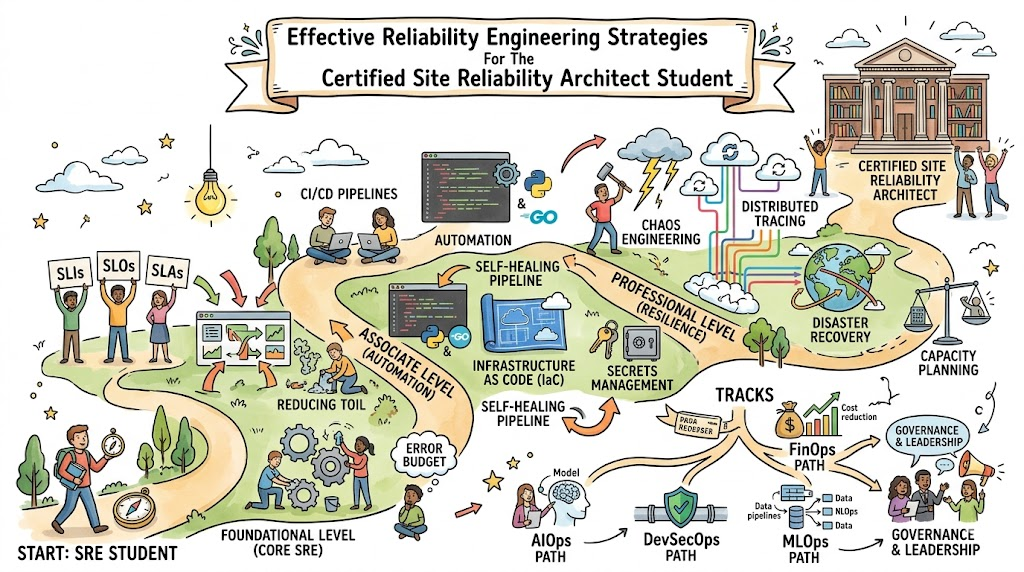
The certification levels divide the learning journey into foundational, associate, and professional stages to match your career growth. You start by learning the language of SRE and progress toward designing complex, multi-region architectures that survive catastrophic failures. These tracks allow for specialization in areas like FinOps, security, or data operations, depending on your professional goals.
Each level aligns with specific job responsibilities, making it easy for employers to understand your capabilities. The foundation level ensures you understand basic reliability metrics, while the professional level confirms your ability to lead entire architectural transformations. This progression helps you build a comprehensive portfolio of skills that covers every aspect of modern system reliability.
Complete Certified Site Reliability Architect Certification Table
| Track | Level | Who it’s for | Prerequisites | Skills Covered | Recommended Order |
| Core SRE | Foundational | Beginners/Junior Ops | IT Basics | SLIs, SLOs, SLAs | 1st |
| Automation | Associate | DevOps Engineers | Foundational | Python, Go, CI/CD | 2nd |
| Resilience | Professional | Senior SREs | Associate | Chaos Engineering | 3rd |
| Efficiency | Specialty | FinOps Analysts | Cloud Knowledge | Cost Optimization | 4th |
| Governance | Leadership | Engineering Leads | Professional | SRE Team Culture | 5th |
| Security | Specialty | SecOps Engineers | Basic Security | DevSecOps, Compliance | 6th |
Detailed Guide for Each Certified Site Reliability Architect Certification
Certified Site Reliability Architect – Foundational Level
What it is
This certification confirms your understanding of the basic concepts that drive Site Reliability Engineering. It ensures you know how to measure success through the lens of the user rather than just server uptime.
Who should take it
Aspiring SREs, developers, and non-technical managers should pursue this entry-level credential. It provides the necessary vocabulary to participate in reliability-focused discussions within a tech organization.
Skills you’ll gain
- Defining Service Level Indicators (SLIs)
- Drafting effective Service Level Objectives (SLOs)
- Identifying and reducing manual toil
- Understanding the error budget philosophy
Real-world projects you should be able to do
- Create a reliability roadmap for a single microservice
- Design an SLO dashboard using standard monitoring tools
- Participate in a post-mortem meeting and contribute to the report
Preparation plan
- 7-14 Days: Read the official SRE handbooks and focus on core definitions.
- 30 Days: Take practice quizzes and watch introductory videos on the platform.
- 60 Days: This level usually requires less time for those already working in IT.
Common mistakes
- Confusing internal metrics with user-facing SLIs.
- Overlooking the importance of “toil” in a long-term SRE strategy.
- Treating SLAs and SLOs as the same concept.
Best next certification after this
- Same-track option: Associate Level
- Cross-track option: Cloud Practitioner
- Leadership option: Management Foundations
Certified Site Reliability Architect – Associate Level
What it is
The Associate level validates your ability to implement SRE concepts using actual code and automation tools. It focuses on the “engineering” part of SRE, requiring you to build and maintain automated workflows.
Who should take it
Active DevOps engineers and system administrators who want to specialize in reliability should take this exam. It serves as a benchmark for those responsible for production deployments.
Skills you’ll gain
- Automating infrastructure with code
- Implementing distributed tracing and observability
- Building self-healing deployment pipelines
- Managing secrets and configurations at scale
Real-world projects you should be able to do
- Deploy a multi-node cluster using automated scripts
- Configure a centralized log management system
- Build an automated rollback mechanism for failed releases
Preparation plan
- 7-14 Days: Practice infrastructure as code scripts in a sandbox.
- 30 Days: Build a complete monitoring and alerting stack from scratch.
- 60 Days: Study complex deployment patterns like Canary and Blue/Green.
Common mistakes
- Writing fragile automation scripts that lack error handling.
- Setting up too many alerts, leading to notification fatigue.
- Ignoring security best practices in the pursuit of speed.
Best next certification after this
- Same-track option: Professional Level
- Cross-track option: Security Specialty
- Leadership option: Team Lead Certification
Certified Site Reliability Architect – Professional/Specialty Level
What it is
This advanced certification marks you as an expert in large-scale system design and resilience. It confirms that you can architect solutions for global applications that demand five-nines of availability.
Who should take it
Senior architects, principal engineers, and SRE leads should aim for this professional credential. It proves you can manage the highest levels of technical risk and architectural complexity.
Skills you’ll gain
- Designing global disaster recovery strategies
- Leading chaos engineering experiments
- Performing deep capacity planning and forecasting
- Architecting multi-cloud resilience patterns
Real-world projects you should be able to do
- Design a data replication strategy across three continents
- Orchestrate a full-scale “Game Day” to test system failures
- Optimize a cloud architecture to save 30% in costs while maintaining uptime
Preparation plan
- 7-14 Days: Review advanced architectural case studies and whitepapers.
- 30 Days: Conduct mock disaster recovery drills in a lab environment.
- 60 Days: Deep dive into the mathematical models for reliability and scale.
Common mistakes
- Designing overly complex systems that are hard to troubleshoot.
- Failing to account for latency in multi-region architectures.
- Neglecting the financial impact of high-availability designs.
Best next certification after this
- Same-track option: Distinguished Architect
- Cross-track option: MLOps or DataOps Specialty
- Leadership option: CTO or VP of Engineering Track
Choose Your Learning Path
DevOps Path
This path focuses on the continuous integration and delivery aspects of software. You learn to build pipelines that move code from a developer’s machine to production with high confidence and minimal manual intervention.
DevSecOps Path
The security path ensures that your reliability architecture includes robust protection against cyber threats. You learn to automate security scanning and compliance checks so they happen as fast as your deployments.
SRE Path
The pure SRE path emphasizes system health, observability, and the elimination of manual work. You focus on building the tools and frameworks that allow other engineers to ship reliable software easily.
AIOps Path
This specialized track teaches you how to use artificial intelligence to manage vast amounts of telemetry data. You learn to build models that predict outages before they happen and automate initial incident triage.
MLOps Path
The MLOps path applies reliability principles to machine learning models and data pipelines. You learn how to monitor model drift and ensure that AI services remain available and accurate for end users.
DataOps Path
DataOps professionals focus on the reliability and flow of data across the organization. You learn to build resilient data pipelines that handle massive volumes while maintaining strict data quality standards.
FinOps Path
The FinOps path teaches you to balance technical excellence with financial responsibility. You learn how to optimize your cloud footprint so that your reliability goals align with the company’s budget.
Role → Recommended Certified Site Reliability Architect Certifications
| Role | Recommended Certifications |
| DevOps Engineer | Foundational, Associate, Automation Specialty |
| SRE | Foundational, Associate, Professional |
| Platform Engineer | Associate, Specialty Operations, System Design |
| Cloud Engineer | Associate, Resilience Specialty, Security Track |
| Security Engineer | Foundational, DevSecOps Track |
| Data Engineer | Foundational, DataOps Track |
| FinOps Practitioner | Foundational, FinOps Track |
| Engineering Manager | Foundational, Governance Leadership |
Next Certifications to Take After Certified Site Reliability Architect
Same Track Progression
Continuing your growth within the SRE domain allows you to reach the “Distinguished” or “Principal” levels. These advanced certifications focus on organizational strategy and the long-term evolution of the platform engineering department. You become a visionary who sets the technical standards for the entire company.
Cross-Track Expansion
Broadening your skills into areas like FinOps or DevSecOps makes you a more versatile architect. It allows you to understand how reliability affects every other part of the business, from the security posture to the annual budget. This versatility makes you an invaluable asset in cross-functional leadership teams.
Leadership & Management Track
If you prefer to lead people rather than just systems, the leadership track prepares you for executive roles. You learn how to build high-performing engineering cultures, manage large-scale technical debt, and align your department’s output with the company’s growth strategy.
Training & Certification Support Providers for Certified Site Reliability Architect
- DevOpsSchool
DevOpsSchool offers an extensive library of resources and live training sessions to help you master the SRE domain. They provide a hands-on learning environment where you can practice real-world automation scenarios under the guidance of industry experts. Their curriculum covers everything from basic CI/CD to advanced infrastructure as code, ensuring you are prepared for every level of the certification. Their support team stays available to help you troubleshoot lab exercises and understand complex architectural patterns. - Cotocus
Cotocus delivers high-end technical training for senior engineers who want to excel in reliability and platform engineering. They focus on the practical application of SRE principles in enterprise environments, providing deep insights into high-availability system design. Their trainers bring decades of industry experience to the classroom, offering unique perspectives on how to handle massive scale. By choosing this provider, you gain access to a network of professionals who are actively shaping the future of cloud operations. - Scmgalaxy
Scmgalaxy provides a massive repository of tutorials, videos, and technical blogs to support your learning journey. They emphasize a community-driven approach, allowing you to learn from the experiences of thousands of other SRE practitioners. Their platform is perfect for self-paced learners who need a wide variety of perspectives on different tools and methodologies. They help you stay updated on the latest trends in the SRE world, ensuring your skills remain sharp long after you earn your certificate. - BestDevOps
BestDevOps focuses on providing efficient and results-oriented training for busy IT professionals. Their boot camps are designed to get you ready for the certification exam in the shortest possible time without sacrificing quality. They provide high-quality practice exams that mirror the actual assessment environment, helping you build the confidence needed to pass on your first attempt. Their instructors focus on the most critical topics that appear in the exams, ensuring a high success rate for their students. - devsecopsschool.com
devsecopsschool.com serves as the premier training center for engineers who want to merge security with reliability. They offer specialized tracks that teach you how to build secure-by-default infrastructure using SRE principles. Their curriculum includes deep dives into automated compliance, vulnerability management, and secure coding practices. By following their training, you become an architect who can protect the system while ensuring it remains highly available to legitimate users. - sreschool.com
sreschool.com acts as the primary host and official provider for the Certified Site Reliability Architect program. They offer the most direct and accurate path to the credential, providing the official study materials and laboratory environments. Their platform is designed to take you from a beginner to an advanced architect through a structured and logical progression. By learning directly from the source, you ensure that your knowledge perfectly aligns with the standards set by the certification board. - aiopsschool.com
aiopsschool.com focuses on the future of operations by teaching you how to integrate artificial intelligence into your SRE workflows. They provide specialized training on anomaly detection, predictive maintenance, and automated incident resolution using machine learning. Their courses are essential for architects who manage massive systems that generate more data than a human can manually monitor. You learn to use AI as a force multiplier for your reliability and operations teams. - dataopsschool.com
dataopsschool.com addresses the unique challenges of maintaining reliability in data-intensive environments. They teach you how to apply SRE principles to big data platforms and real-time processing pipelines. Their training ensures that your data services remain available, accurate, and performant under heavy loads. This is the ideal choice for data engineers and architects who want to bring a higher level of discipline to their data operations and infrastructure. - finopsschool.com
finopsschool.com provides the necessary training to manage the financial health of your cloud environment. They teach you how to optimize your spending without compromising on the reliability or performance of your applications. Their curriculum covers cost allocation, forecasting, and the use of automated tools to keep your cloud bill under control. This training is vital for architects who want to prove their value by delivering high availability at the lowest possible cost.
Frequently Asked Questions
1. Can I attempt the Professional exam without the Foundational certificate?
The program generally requires you to complete the Foundational and Associate levels first to ensure you have the necessary building blocks for advanced design.
2. How long does the preparation usually take for a working engineer?
Most professionals dedicate four to six weeks of study to pass the Associate level, depending on their existing familiarity with automation tools.
3. Does the certification focus on a specific cloud like AWS or Azure?
The principles are entirely cloud-agnostic, meaning the skills you learn apply to any provider or even on-premises data centers.
4. What is the format of the assessment?
The exams include a mix of multiple-choice questions, scenario-based problem-solving, and practical lab tasks that verify your hands-on skills.
5. Is there a community for certified architects?
Yes, SreSchool hosts a private group where certified professionals can network, share job opportunities, and discuss the latest SRE trends.
6. How much does the exam cost for an individual?
Pricing varies by region and level, so you should check the official SreSchool website for the most current information regarding fees.
7. Do I need to be a senior developer to take these courses?
You do not need to be a senior developer, but you should be comfortable reading code and writing basic scripts in languages like Python or Go.
8. Are there any renewal requirements for the certificate?
The certification typically remains valid for two years, after which you must complete a refresher course or pass a higher-level exam.
9. Can my company pay for the certification for the whole team?
SreSchool offers corporate packages that include group training and bulk exam vouchers for organizations looking to upskill their entire engineering department.
10. What kind of salary increase can I expect after getting certified?
While results vary, many engineers see a 20-30% increase in their compensation after proving their expertise in the high-demand field of SRE architecture.
11. Is the exam proctored?
Yes, all professional-level exams use remote proctoring to maintain the integrity and global recognition of the certification.
12. What happens if I fail the exam?
The platform allows for a retake after a brief cooling-off period, during which you can review your performance and focus on your weak areas.
FAQs on Certified Site Reliability Architect
1. Why should a DevOps engineer choose an SRE architect path?
This path provides a more structured approach to system health and long-term resilience compared to traditional DevOps, which often focuses solely on deployment speed.
2. Does the curriculum include chaos engineering?
Yes, the professional and advanced tracks include dedicated modules on how to safely inject failures into a system to test its resilience.
3. Is this certification relevant for on-premises infrastructure?
Absolutely, as the principles of toil reduction, monitoring, and error budgets apply to any system regardless of where the servers are located.
4. How does the program address the “human” side of SRE?
The leadership and governance tracks specifically focus on building a blameless culture and managing on-call rotations to prevent engineer burnout.
5. What is the pass rate for the Professional level?
The Professional level is quite challenging and requires a deep understanding of architecture, resulting in a lower pass rate than the foundational exam.
6. Do I get access to lab environments during my study?
Most training providers listed above include access to cloud-based labs where you can practice setting up real SRE infrastructure.
7. Is there a focus on specific tools like Kubernetes or Prometheus?
The course uses these industry-standard tools for demonstrations, but the goal is to teach you the underlying principles that apply to any toolset.
8. How do I verify my certification for an employer?
SreSchool provides a digital link and a unique ID that employers can use to verify your status on their official registry.
Final Thoughts: Is Certified Site Reliability Architect Worth It?
Mastering the art of reliability places you in the top tier of technical professionals in the modern economy. As organizations move more of their critical services to the cloud, the role of the architect becomes the most important position in the engineering department. This certification represents more than just a piece of paper; it signifies your dedication to building systems that users can trust. You move away from being a “fixer” and become a “builder” who creates stable environments for business growth. The demand for these specialized skills shows no signs of slowing down, making this one of the safest career investments you can make. You gain the power to influence how your company builds products and how your team manages their daily workloads. For any engineer who values technical excellence and professional growth, the Certified Site Reliability Architect is an essential milestone. Take the first step today to future-proof your career and lead the next generation of cloud-native infrastructure.
Leave a Reply