Software teams are no longer judged only by how fast they write code. They are judged by how well they release, how safely they automate, how quickly they recover, and how clearly they observe systems in production. That is why DevOps has become a real career discipline for engineers, cloud teams, platform teams, release specialists, and technical managers.
Certified DevOps Professional is built for professionals who want to move from basic DevOps familiarity to stronger delivery ownership. DevOpsSchool describes it as an advanced certification for experienced professionals. Its official scope includes CI/CD, monitoring and logging, automation, cloud platform management, microservices, and container orchestration, and the exam is presented as a 3-hour exam-only format.
That makes this certification useful for people who already know parts of the DevOps world but want a more complete view. Many professionals know one tool well. Fewer can connect pipelines, release flow, cloud operations, observability, and deployment strategy into one working system. This certification is valuable because it helps build that larger picture. DevOpsSchool also places it in a broader ecosystem that includes DevOps, DevSecOps, SRE, and MLOps-related learning paths.
The provider is DevOpsSchool, and the official certification page is the reference point for the program details.
Certification Overview
| Certification | Provider | Level | Best For |
|---|---|---|---|
| Certified DevOps Professional | DevOpsSchool | Professional / Advanced | Experienced DevOps practitioners, build and release engineers, automation specialists, cloud and platform professionals |
The official page presents Certified DevOps Professional as an advanced certification aimed at experienced professionals rather than complete beginners.
Certification Table
| Track | Level | Who it’s for | Prerequisites | Skills covered | Recommended order |
|---|---|---|---|---|---|
| DevOps | Professional | DevOps Engineers, Build Engineers, Release Engineers, Platform Engineers, Cloud Engineers, Automation Specialists, senior software professionals | DevOps basics, Linux comfort, CI/CD familiarity, cloud exposure, containers; the official page also points to Master in DevOps Engineering as a prerequisite path | CI/CD, automation, monitoring, logging, cloud platform management, microservices, container orchestration | Learn core DevOps first, get project experience, then take this certification |
This summary is based on the official certification page, which explicitly lists the major topic areas and describes the certification as advanced.
What Is Certified DevOps Professional?
Certified DevOps Professional is a professional-level certification for people who want stronger command of modern software delivery. It is not mainly for first-time learners. It is better for professionals who already understand the basics of development, deployment, cloud, or operations and now want a broader DevOps perspective.
What makes it useful is its focus on connected delivery thinking. Real-world DevOps is never only about one tool. It includes how code moves through integration, testing, release automation, deployment, logging, monitoring, cloud environments, and production readiness. The official certification scope reflects that broader delivery view.
In simple words, this certification helps professionals move from “I know some DevOps tools” to “I understand how a modern delivery system works.”
Why This Certification Matters
A lot of engineers build knowledge in fragments. One person gets good at Jenkins. Another learns Docker. Someone else understands Kubernetes or cloud services. But strong engineering teams need people who can connect those skills into one dependable delivery model.
That is why this certification matters. It gives structure to practical knowledge. It helps professionals think in terms of release flow, automation maturity, observability, cloud readiness, and deployment consistency. That kind of thinking is useful not only for DevOps engineers, but also for platform engineers, cloud engineers, release engineers, and technical managers.
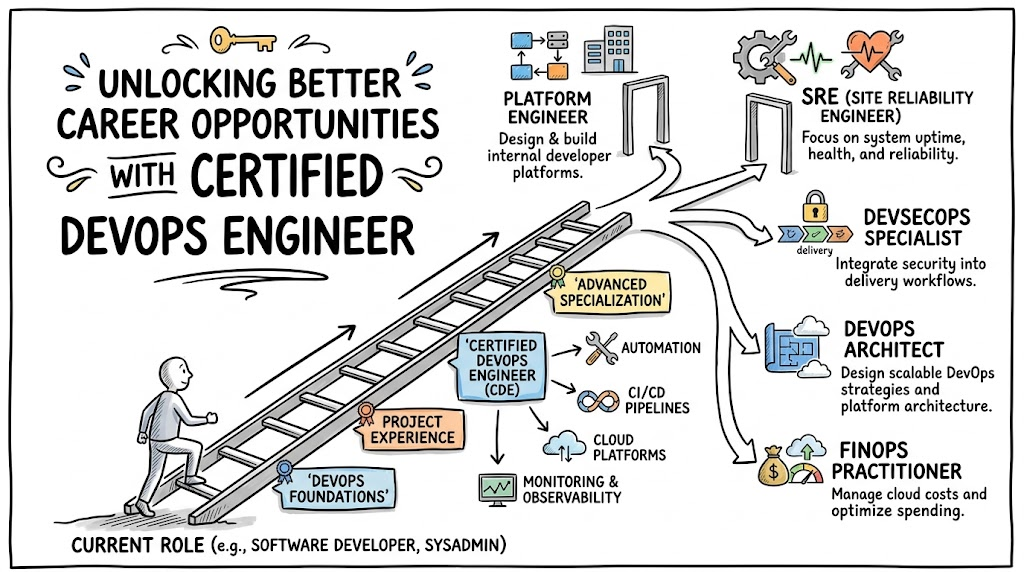
It also matters because it can open later career paths. DevOpsSchool’s wider certification listings and Gurukul Galaxy’s certification articles both point to adjacent tracks such as DevSecOps, SRE, MLOps, DataOps, and related growth areas.
Certified DevOps Professional
What it is
Certified DevOps Professional is an advanced DevOps certification designed for experienced professionals who want stronger delivery capability. According to the official page, it focuses on continuous integration, continuous delivery, monitoring and logging, automation, cloud platform management, microservices, and container orchestration.
It is best understood as a certification for delivery maturity rather than entry-level exposure.
Who should take it
- DevOps Engineers
- Build Engineers
- Release Engineers
- Platform Engineers
- Cloud Engineers
- Automation Specialists
- Senior software engineers involved in release and deployment
- Operations professionals moving into DevOps
- Technical leads
- Engineering managers with delivery responsibility
The official page directly identifies DevOps practitioners, build and release engineers, and automation specialists among the intended audience.
Skills you’ll gain
- stronger CI/CD understanding
- better automation thinking
- clearer release workflow awareness
- monitoring and logging integration knowledge
- cloud platform management concepts
- microservices deployment understanding
- container orchestration familiarity
- stronger view of delivery from end to end
- better collaboration awareness across development and operations
- improved readiness for scalable deployment models
These areas align with the scope listed on the official certification page.
Real-world projects you should be able to do after it
- build or improve a CI/CD pipeline
- automate build, test, and deployment stages
- support release flow across environments
- help containerize delivery workflows
- work with orchestration-driven deployments
- connect monitoring and logging with live services
- support microservices delivery practices
- improve deployment consistency across teams
- help define DevOps workflow standards
- contribute to cloud-native delivery efforts
Preparation plan
7–14 days
This plan works best for professionals who already use DevOps practices regularly.
- revise DevOps lifecycle concepts
- review CI/CD and automation flow
- refresh containers, monitoring, logging, and cloud basics
- spend extra time on weak areas
- do quick scenario-based revision daily
30 days
This is the most balanced plan for most working professionals.
- Week 1: DevOps concepts, SDLC flow, collaboration mindset
- Week 2: CI/CD, automation, build and release practices
- Week 3: cloud, containers, microservices, orchestration
- Week 4: monitoring, logging, revision, self-checks
60 days
This plan works well for people moving into DevOps from development, support, or administration.
- Days 1–15: DevOps foundations and delivery lifecycle
- Days 16–30: automation and CI/CD understanding
- Days 31–45: cloud, Docker, orchestration, deployment flow
- Days 46–60: observability, revision, and practice scenarios
Common mistakes
- treating DevOps as only a tool topic
- focusing on one tool and ignoring the full workflow
- skipping monitoring and logging
- weak understanding of cloud’s role in delivery
- learning containers without learning release flow
- memorizing terms without practical context
- ignoring rollback and production-readiness thinking
- forgetting that collaboration is central to DevOps
Best next certification after this
The next step depends on your goal.
- Same track: Certified DevOps Architect
- Cross-track: DevSecOps Certified Professional or an SRE path
- Leadership: Certified DevOps Manager
These kinds of adjacent paths fit the broader DevOpsSchool ecosystem and the wider software-certification landscape reflected in Gurukul Galaxy’s certification articles.
Choose Your Path
1. DevOps Path
This path is best for professionals who want to go deeper into CI/CD, automation, release improvement, platform enablement, and delivery quality. A practical sequence is fundamentals first, then project work, then Certified DevOps Professional, followed by architect-level growth.
2. DevSecOps Path
This path is for professionals who want security to become part of software delivery. After a DevOps base, the next focus is usually secure pipelines, secrets handling, compliance-aware automation, and safer releases. DevOpsSchool publicly lists DevSecOps as a related certification area.
3. SRE Path
This path is for professionals who care most about uptime, system health, alerting, incident response, and production stability. DevOps gives the delivery base, while SRE strengthens reliability thinking. SRE appears in DevOpsSchool’s broader certification lineup.
4. AIOps / MLOps Path
This path fits engineers who want to move toward intelligent operations or model delivery. Once automation and deployment fundamentals are strong, it becomes easier to branch into MLOps or AIOps. DevOpsSchool’s public site highlights MLOps among its popular certifications.
5. DataOps Path
This path is useful for data engineers and analytics teams that need repeatable pipelines, quality checks, governance, and operational discipline in data systems. Gurukul Galaxy’s certification content includes DataOps-related learning among broader technology certification tracks.
6. FinOps Path
This path suits cloud and platform professionals who want to connect delivery operations with cost awareness, cloud optimization, and financial governance. The broader certification ecosystem described in Gurukul Galaxy also reflects cross-functional certification growth beyond core DevOps.
Role → Recommended Certifications
| Role | Recommended certifications |
|---|---|
| DevOps Engineer | DevOps foundation → Certified DevOps Professional → Certified DevOps Architect |
| SRE | Certified DevOps Professional → SRE specialization |
| Platform Engineer | Certified DevOps Professional → Certified DevOps Architect |
| Cloud Engineer | Certified DevOps Professional → cloud-focused specialization or FinOps |
| Security Engineer | Certified DevOps Professional → DevSecOps Certified Professional |
| Data Engineer | Certified DevOps Professional → DataOps specialization |
| FinOps Practitioner | Certified DevOps Professional → FinOps specialization |
| Engineering Manager | Certified DevOps Professional → Certified DevOps Manager |
This mapping is a practical interpretation based on the CDP scope and the broader certification families surfaced across DevOpsSchool and Gurukul Galaxy references.
Next Certifications to Take
Same track option
Certified DevOps Architect
This is the strongest next move for professionals who want to work on platform design, delivery standards, tooling strategy, and large-scale DevOps architecture.
Cross-track option
DevSecOps Certified Professional
A strong next step for professionals who want to make security a larger part of release and automation work. DevOpsSchool publicly offers DevSecOps certification and training.
SRE specialization
A better fit for professionals who want stronger depth in service reliability, observability, and operational excellence. SRE appears in DevOpsSchool’s certification family.
Leadership option
Certified DevOps Manager
Useful for people moving toward governance, mentoring, process ownership, and team enablement. Gurukul Galaxy’s certification coverage also supports leadership-oriented progression beyond purely technical tracks.
List of Top Institutions Which Provide Help in Training cum Certifications for Certified DevOps Professional
DevOpsSchool
DevOpsSchool is the official provider of Certified DevOps Professional. It is the most directly aligned option for learners who want training and certification preparation closely tied to the actual program. Its public site also presents a wider ecosystem that includes DevOps, DevSecOps, SRE, and MLOps-related tracks.
Cotocus
Cotocus is often treated as an industry-oriented learning and consulting name. It can be useful for professionals who want technical learning with stronger business and implementation context.
ScmGalaxy
ScmGalaxy is widely associated with software configuration management, build processes, and CI/CD learning support. It is often useful for professionals who want stronger release-process maturity.
BestDevOps
BestDevOps is commonly considered by professionals seeking practical training in DevOps and related technical areas. It is often seen as a career-focused learning option.
devsecopsschool.com
This is relevant for learners who want to move from DevOps into secure delivery, secure automation, and policy-aware pipelines after building a strong foundation.
sreschool.com
This is useful for professionals interested in reliability engineering, observability, incident response, and service stability.
aiopsschool.com
This is helpful for professionals who want to move toward intelligent operations and AI-assisted operational analysis.
dataopsschool.com
This is useful for data teams that want stronger governance, repeatability, and operational discipline in data delivery.
finopsschool.com
This is valuable for cloud professionals who want better understanding of cost optimization, usage governance, and finance-aware engineering.
The wider DevOpsSchool and Gurukul Galaxy sources support these adjacent learning families and certification tracks.
FAQs on Certified DevOps Professional
1. Is Certified DevOps Professional a beginner certification?
No. The official page presents it as an advanced certification for experienced professionals.
2. How difficult is this certification?
It is moderate to advanced. It becomes much easier if you already understand CI/CD, cloud basics, containers, and monitoring.
3. How much time should I prepare?
Some experienced professionals may revise in 7 to 14 days, but most working professionals benefit from a 30-day plan.
4. Do I need prior DevOps experience?
Some hands-on exposure is strongly helpful because the certification is aimed at experienced professionals rather than complete beginners.
5. Is Linux knowledge important?
Yes. Basic Linux familiarity helps because many DevOps environments and automation tasks rely on command-line work.
6. Is it useful for software developers?
Yes. Developers can benefit because it improves understanding of deployment, release flow, automation, and production-facing delivery.
7. Can cloud engineers use it to move into DevOps roles?
Yes. It is a strong bridge for cloud professionals who want broader delivery and automation ownership.
8. Is Kubernetes mandatory?
Not necessarily at expert level, but orchestration and container-related understanding is very useful because those areas are part of the official scope.
Additional FAQs for Career Growth
9. What should I do after this certification?
Choose the next step based on your goal: Architect for deeper design, DevSecOps for security, SRE for reliability, or Manager for leadership.
10. Is this certification useful outside India?
Yes. The DevOps skills it covers are relevant across global software teams and delivery environments.
11. Can operations professionals move into DevOps with this?
Yes. It can be a practical transition path for administrators and operations professionals who want to move toward automation-led delivery work.
12. Is it useful for platform engineering?
Yes. Platform engineering depends on automation, repeatability, observability, and delivery consistency, which align closely with DevOps.
Conclusion
Certified DevOps Professional is a strong certification for professionals who want to move from scattered DevOps knowledge to a more complete delivery mindset. It is especially useful for engineers and managers who already know the basics and now want stronger capability in CI/CD, automation, cloud operations, monitoring, microservices, and orchestration. The official DevOpsSchool page positions it as an advanced certification for experienced professionals, which makes it more suitable for serious career growth than beginner exploration.
For software engineers, platform engineers, cloud professionals, release teams, and technical managers, this certification can serve as both a learning milestone and a career signal. It can also support future growth into architecture, DevSecOps, SRE, MLOps, DataOps, FinOps, or leadership. If your goal is to become more structured, more dependable, and more effective in modern software delivery, Certified DevOps Professional is a practical next step.
Leave a Reply