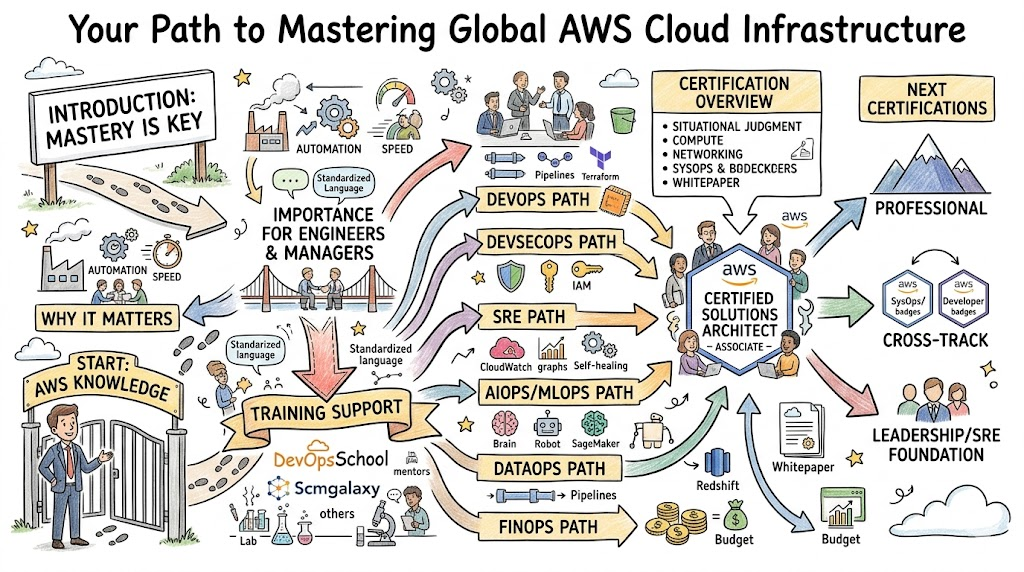
Introduction
The AWS Certified Solutions Architect – Associate is the essential benchmark for engineers tasked with maintaining “always-on” availability in an unpredictable digital world. This guide is written for software engineers and managers who must ensure their applications can withstand anything from a simple server crash to a full-scale regional disaster. As a Site Reliability Engineer or Infrastructure Lead, your ability to define Recovery Time Objectives (RTO) and Recovery Point Objectives (RPO) is what protects the business from data loss and downtime. This roadmap explores the SAA-C03 domains through the lens of fault tolerance and business continuity. By mastering these architectural patterns, technical professionals can build systems that are truly resilient, ensuring that global enterprise operations remain uninterrupted regardless of infrastructure failures.
What is the AWS Certified Solutions Architect – Associate?
The AWS Certified Solutions Architect – Associate is a professional credential that validates an individual’s technical expertise in designing and deploying systems on the AWS platform. It specifically evaluates your ability to use architectural design principles to meet reliability and availability requirements. The exam covers the core pillars of the Well-Architected Framework, focusing on how to distribute workloads across multiple Availability Zones and Regions. It serves as a rigorous standard for verifying that a professional can handle the architectural demands of high-stakes, production-grade cloud environments.
Why it Matters in Today’s Software, Cloud, and Automation Ecosystem
In today’s global economy, even a few minutes of downtime can result in massive financial losses and damage to brand reputation. The AWS ecosystem provides a variety of tools for automated failover and data replication, but implementing them correctly requires deep architectural understanding. This certification teaches engineers how to use automation to detect failures and redirect traffic without human intervention. By aligning disaster recovery strategies with modern DevOps tools, teams can achieve “self-healing” infrastructure that provides a seamless experience for users even during significant backend disruptions.
Why Certifications are Important for Engineers and Managers
For engineers, this certification serves as a validation of your ability to think critically about system failure modes and mitigate them proactively. It broadens your perspective from simply building features to ensuring those features remain accessible under stress. For managers, an AWS-certified team represents a high level of operational insurance, as they are trained to follow industry best practices for data durability and system uptime. it ensures the organization’s cloud strategy is resilient by design, reducing the likelihood of emergency fire-drills and unplanned outages.
Why Choose DevOpsSchool?
DevOpsSchool provides an education that focuses on the practical application of high availability and disaster recovery principles. Their training includes advanced labs where students simulate regional outages and practice restoring services under pressure. Through expert mentorship and a focus on real-world production scenarios, DevOpsSchool prepares candidates to solve the actual resilience challenges faced by global technology companies today.
Complete AWS Certified Solutions Architect – Associate Certification Table
| Track | Level | Who it’s for | Prerequisites | Skills Covered | Recommended Order |
| Resilience | Associate | SREs / Leads | IT Foundations | ASG, ELB, Multi-AZ | 1 |
| Architecting | Associate | SysAdmins | SAA Associate | Route 53, RDS DR | 2 |
| Operations | Associate | Cloud Admins | SAA Associate | Backup, CloudWatch | 3 |
| Security | Specialty | Security Leads | Associate Level | KMS, CloudTrail | 4 |
| Solutions Arch | Professional | Sr. Architects | Associate Level | Multi-Region Design | 5 |
Detailed Guide for Each AWS Certified Solutions Architect – Associate Certification
What it is
This certification validates your ability to design and deploy secure, robust, and resilient applications on AWS. It confirms that you can select the right services to meet high availability and disaster recovery requirements for complex workloads.
Who should take it
This is an essential credential for Systems Administrators, Developers, and SREs with at least one year of hands-on experience. It is perfect for those responsible for the uptime and data integrity of mission-critical cloud applications.
Skills you’ll gain
- Designing for fault tolerance using Auto Scaling and Elastic Load Balancing.
- Implementing disaster recovery strategies like Pilot Light and Warm Standby.
- Mastering data replication across multiple regions for S3 and RDS.
- Using Amazon Route 53 for health checks and automated DNS failover.
Real-world projects you should be able to do
- Architecture of a Multi-AZ, three-tier web application with automated database failover.
- Implementation of a cross-region disaster recovery plan using AWS Backup and S3 replication.
- Design of a self-healing infrastructure that automatically replaces failed instances in minutes.
Preparation plan
- 7–14 days: Intensive review of Route 53 routing policies and RDS multi-AZ versus read replicas for experienced users.
- 30 days: Daily study including a full video course, focusing on the Reliability and Performance pillars of the SAA-C03 blueprint.
- 60 days: Comprehensive learning path for beginners, featuring dozens of hands-on labs and deep dives into AWS’s global infrastructure.
Common mistakes
- Confusing “High Availability” (Multi-AZ) with “Disaster Recovery” (Multi-Region).
- Failing to test the disaster recovery plan regularly to ensure it still works as expected.
- Underestimating the data transfer costs associated with cross-region replication.
Best next certification after this
- Same-track option: AWS Certified Solutions Architect – Professional.
- Cross-track option: AWS Certified SysOps Administrator – Associate.
- Leadership option: Certified Site Reliability Engineer – Foundation.
Choose Your Learning Path
1. DevOps Path
The DevOps path utilizes the Associate certification to build the automated foundation required for resilient CI/CD pipelines. You will learn how to use AWS CloudFormation to provision highly available stacks across multiple Availability Zones. This path focuses on creating “Infrastructure as Code” that can be rapidly redeployed in a different region if a disaster occurs. By mastering the architectural layer, DevOps engineers ensure that their automated deployments are built on a rock-solid, failure-resistant cloud foundation.
2. DevSecOps Path
In the DevSecOps path, the focus is on the integration of automated security controls within a resilient architecture. You will learn how to use AWS IAM to ensure that security persists even during a failover event. This track focuses on building architectures that maintain compliance and data protection standards across multiple regions. The Associate certification provides the necessary networking and identity foundation to implement these “resilient-by-design” security layers in the cloud.
3. SRE Path
For SREs, the focus is on the reliability, observability, and uptime of cloud systems. You will learn to design architectures that utilize comprehensive health checks and automated recovery procedures. This track emphasizes the use of CloudWatch and Service Quotas to ensure that the infrastructure can scale and recover under extreme conditions. The Associate certification validates the technical depth needed to manage large-scale cloud operations and meet strict Service Level Objectives (SLOs).
4. AIOps / MLOps Path
The AIOps and MLOps path focuses on the specialized infrastructure required to maintain AI model availability. You will learn how to architect high-performance compute and storage that can fail over across regions without losing model progress. This path focuses on the orchestration of ML pipelines that are resilient to underlying infrastructure hiccups. Understanding core AWS reliability architecture is essential for building AI systems that are both scalable and dependable.
5. DataOps Path
The DataOps path focuses on the durability and security of data pipelines in the face of outages. Professionals learn how to architect data lakes that use cross-region replication to ensure that critical information is never lost. By mastering the Associate certification, you gain the skills to design data systems that are highly available and strictly governed, even during a primary site failure. It is a critical path for modern data-driven enterprises.
6. FinOps Path
The FinOps path centers on the financial optimization of resilience. You will learn how to balance the cost of high availability against the potential loss from downtime. This involves making informed decisions about which disaster recovery strategy (Backup/Restore vs. Active-Active) is most cost-effective for a given workload. The Associate level provides the foundational knowledge needed to manage “resilience budgets” effectively.
Role → Recommended AWS Certified Solutions Architect – Associate Certifications
| Role | Recommended Certifications |
| DevOps Engineer | SAA-Associate, Certified DevOps Engineer – Professional |
| SRE | SAA-Associate, Certified Site Reliability Engineer – Foundation |
| Platform Engineer | SAA-Associate, Certified SysOps – Associate |
| Cloud Engineer | SAA-Associate, Certified Developer – Associate |
| Security Engineer | SAA-Associate, Security – Specialty |
| Data Engineer | SAA-Associate, Data Engineering – Associate |
| FinOps Practitioner | SAA-Associate, AWS Cloud Practitioner |
| Engineering Manager | SAA-Associate, Certified Site Reliability Engineer – Foundation |
Next Certifications to Take After AWS Certified Solutions Architect – Associate
Same Track Progression
Moving to the AWS Certified Solutions Architect – Professional is the natural next step for those aiming for the highest level of cloud resilience. This certification covers complex scenarios like multi-region global traffic management and cross-account disaster recovery, providing the ultimate validation of your skills as a senior technical leader.
Cross-Track Expansion
The AWS Certified SysOps Administrator – Associate is an excellent choice for architects who want to specialize in the operational aspects of reliability. It focuses on deployment, management, and monitoring, complementing your design skills with a deep dive into the day-to-day maintenance of high-uptime cloud environments.
Leadership & Management Track
For those transitioning into technical leadership, the Certified Site Reliability Engineer – Foundation is highly recommended. It moves the focus from “how it breaks” to “how we prevent it from breaking,” teaching leaders how to manage error budgets, post-mortems, and the culture of reliability required for modern cloud teams.
Training & Certification Support Providers for AWS Certified Solutions Architect – Associate
- DevOpsSchool offers a robust, lab-heavy training program that ensures students are fully prepared for the challenges of resilient cloud architecture and the SAA-C03 exam.
- Cotocus provides specialized cloud consulting and mentorship, helping technical professionals master the intricacies of AWS high availability design through expert-led sessions.
- Scmgalaxy is a massive community-driven hub that provides the latest documentation and resources for AWS certification and SRE practitioners.
- BestDevOps focuses on delivering high-impact training that bridges the gap between basic cloud skills and professional-level architectural expertise.
- Devsecopsschool integrates security best practices into all its AWS training, ensuring that architects are prepared to build and manage secure, resilient cloud environments.
- Sreschool provides targeted education for engineers focused on the reliability, observability, and operational excellence of the AWS platform.
- Aiopsschool teaches the next generation of architects how to leverage AI and machine learning services on AWS to build intelligent and automated cloud systems.
- Dataopsschool offers specialized courses on data engineering and analytics architecture, ensuring that data flows securely and efficiently across the cloud.
- Finopsschool helps cloud professionals master the art of financial management and cost optimization within the AWS ecosystem.
Frequently Asked Questions (General)
1. How long is the AWS Solutions Architect Associate exam?
The exam is 130 minutes long.
2. What is the passing score for the Associate level?
You need a scaled score of 720 out of 1000 to pass.
3. Does this certification expire?
Yes, it is valid for three years.
4. How many questions are in the SAA-C03 exam?
The exam contains 65 multiple-choice or multiple-response questions.
5. Is the exam available in India?
Yes, it can be taken at testing centers across India or from home via online proctoring.
6. What is the exam fee?
The registration cost is 150 USD plus applicable taxes.
7. Do I need to know how to code to be a Solutions Architect?
Extensive coding is not required, but understanding technical logic and configuration (JSON/YAML) is essential.
8. Can I take the exam from home?
Yes, online proctoring is available through Pearson VUE.
9. Is the Cloud Practitioner exam a prerequisite?
No, you can go directly to the Associate level if you have the necessary experience.
10. How soon will I receive my results?
Official results are usually delivered via email within 5 business days.
11. Can I retake the exam?
Yes, you can schedule a retake after a 14-day waiting period.
12. Is this certification recognized globally?
Yes, it is one of the most respected and recognized cloud certifications in the global IT industry.
FAQs on AWS Certified Solutions Architect – Associate
1. What is the difference between RTO and RPO?
RTO (Recovery Time Objective) is how long it takes to restore service; RPO (Recovery Point Objective) is how much data you can afford to lose.
2. How does an AWS Multi-AZ deployment improve resilience?
It automatically replicates your data and application across physically separate data centers to protect against a single center failure.
3. What is the purpose of Amazon Route 53 Health Checks?
They monitor the health of your endpoints and automatically route traffic away from unhealthy instances to prevent user-facing errors.
4. When should I use Amazon S3 Cross-Region Replication (CRR)?
Use CRR when you need to store copies of your data in a geographically distant region to protect against a full regional disaster.
5. What is the “Pilot Light” disaster recovery strategy?
It involves keeping a minimal version of your environment always running in a second region, which can be quickly scaled up during a disaster.
6. How does an Auto Scaling Group (ASG) help with resilience?
It ensures you have the correct number of EC2 instances running and automatically replaces any instances that fail health checks.
7. What is the role of AWS Backup?
It provides a centralized, automated way to manage and monitor backups across various AWS services like EBS, RDS, and EFS.
8. Why use an Elastic Load Balancer (ELB) for resilience?
It distributes incoming application traffic across multiple targets (like EC2 instances) in multiple AZs, ensuring no single instance is a point of failure.
Conclusion
The AWS Certified Solutions Architect – Associate remains the most strategic milestone for any professional aiming to master the cloud. It provides the essential architectural framework required to move beyond basic configurations and into the design of complex, enterprise-grade systems. In an industry where technical requirements evolve rapidly, the core principles of the Well-Architected Framework offer a timeless foundation for building secure, scalable, and cost-effective infrastructure. This certification serves as a powerful validation of technical maturity, proving that an engineer can align cloud capabilities with specific business outcomes. For those looking to bridge the gap between technical execution and strategic leadership, the investment in this certification delivers immediate credibility and long-term professional value in the global market.
Leave a Reply