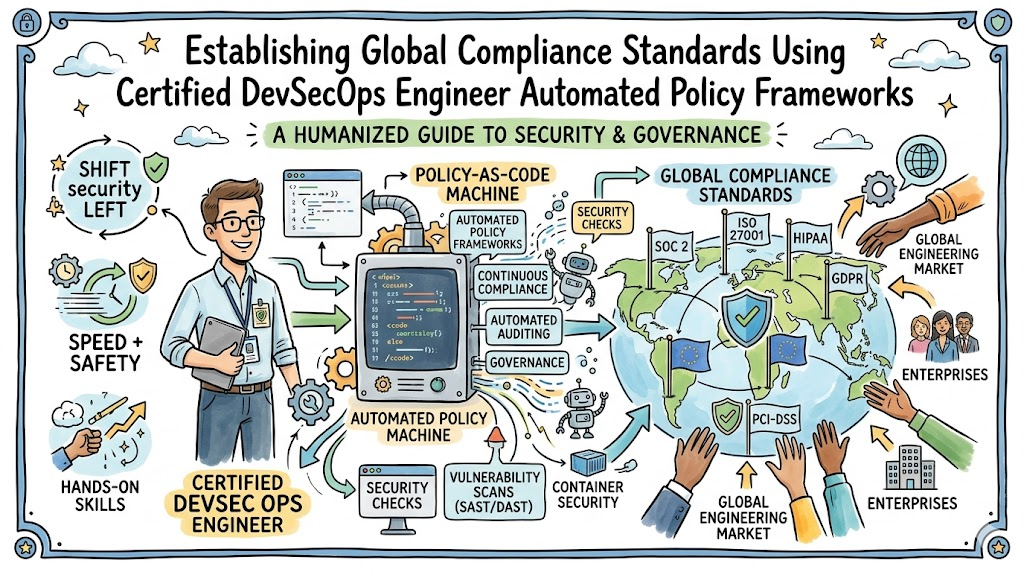
Introduction
Security-first engineering defines the current era of software development, where developers no longer treat protection as an afterthought. The Certified DevSecOps Engineer credential validates a professional’s ability to weave security into the very fabric of the automated delivery pipeline. This guide provides a strategic roadmap for technical practitioners who want to master the art of shifting security to the left. I recommend visiting DevSecOpsSchool to explore how this program transforms traditional workflows into resilient, high-speed operations. Professionals who earn this certification gain the technical authority to defend complex cloud environments against sophisticated modern threats.
What is the Certified DevSecOps Engineer?
The Certified DevSecOps Engineer program serves as a rigorous technical crucible that bridges the gap between rapid code deployment and robust infrastructure defense. It forces engineers to move beyond manual checklists and instead embrace security as code, ensuring that every deployment undergoes automated scrutiny. This certification focuses on real-world implementation, requiring students to configure scanners, manage secrets, and harden containers in production-like settings.
Rather than focusing on theoretical frameworks, this program emphasizes the practical application of defense mechanisms within a CI/CD environment. It ensures that security becomes an enabler of speed rather than a bottleneck by utilizing automation to detect vulnerabilities instantly. Engineers who complete this program possess the skills to transform a standard DevOps cycle into a fortress of continuous protection and compliance.
Who Should Pursue Certified DevSecOps Engineer?
Software developers who aspire to build inherently secure applications find immense value in this specialized training. DevOps practitioners, SREs, and Platform Engineers also benefit significantly, as they learn to automate security audits across vast cloud infrastructures. Security professionals looking to gain deep technical coding and automation skills use this certification to integrate effectively with modern engineering squads.
The program caters to both the Indian tech market and the global engineering community, where demand for hybrid security-automation talent continues to soar. Junior engineers use this path to differentiate themselves in a competitive job market, while senior leaders use it to validate their ability to architect secure digital transformations. Engineering managers also find this knowledge vital for making informed decisions regarding resource allocation and risk management within their organizations.
Why Certified DevSecOps Engineer is Valuable
Holding a Certified DevSecOps Engineer designation significantly boosts your professional credibility in an era defined by frequent data breaches and supply chain attacks. Enterprises prioritize hiring engineers who can proactively mitigate risks without slowing down the development team’s velocity. This certification proves that you understand how to navigate the complex intersection of code, infrastructure, and compliance.
From a career perspective, this credential acts as an insurance policy against technical obsolescence. As automation replaces manual operational tasks, the ability to build and maintain secure delivery systems remains a premium skill set. You will likely see a significant return on your time investment through access to high-impact projects, leadership opportunities, and more competitive compensation packages globally.
Certified DevSecOps Engineer Certification Overview
This certification prioritizes practical competence over the simple memorization of security terms or definitions. The assessment process requires candidates to demonstrate their ability to fix security flaws within a live, automated pipeline environment.
The program structure allows for a flexible learning journey, providing modular content that covers the entire spectrum of DevSecOps. Each module includes hands-on laboratories where you configure industry-standard tools to protect web applications and microservices. By the time you reach the final assessment, you will have built a portfolio of secure automation scripts that solve actual production challenges.
Certified DevSecOps Engineer Certification Tracks & Levels
The certification pathways follow a logical progression through Foundational, Professional, and Advanced tiers to match your growing expertise. The Foundational level establishes a core understanding of the DevSecOps mindset and the basic mechanics of pipeline security. The Professional tier dives deep into the technical configuration of security scanners, secret management systems, and container hardening strategies.
Finally, the Advanced tier focuses on enterprise-level governance and the implementation of Compliance as Code across multi-cloud architectures. These levels align with standard career milestones, allowing you to prove your proficiency as you move from an individual contributor to a technical architect. Specialty tracks also exist for those who want to focus on niche areas like Kubernetes security or cloud-native defense.
Complete Certified DevSecOps Engineer Certification Table
| Track | Level | Who it’s for | Prerequisites | Skills Covered | Recommended Order |
| Core Security | Foundational | Aspiring Engineers | Basic Linux | Culture, Git, Scanning | 1 |
| Implementation | Associate | DevOps Engineers | CI/CD Basics | SAST, DAST, SCA | 2 |
| Technical Lead | Professional | Senior SREs | 3+ Years Experience | Hardening, Policy as Code | 3 |
| Strategic Lead | Advanced | Architects | Professional Cert | Governance, Compliance | 4 |
| Platform Sec | Specialty | Cloud Engineers | Cloud Literacy | K8s Security, IAM | Optional |
Detailed Guide for Each Certified DevSecOps Engineer Certification
Certified DevSecOps Engineer – Foundational Level
What it is
This introductory certification validates a professional’s grasp of the core cultural and technical shifts required for DevSecOps. It confirms that the learner understands how to integrate security into the Agile development lifecycle.
Who should take it
Manual QA testers, project managers, and entry-level developers should pursue this to build a solid technical foundation in automated security.
Skills you’ll gain
- Understanding the DevSecOps maturity model.
- Using Git for secure version control.
- Identifying basic OWASP vulnerabilities in code.
- Navigating the phases of a secure CI/CD pipeline.
Real-world projects you should be able to do
- Document a security-first workflow for a small development team.
- Perform a basic vulnerability scan on a web application repository.
Preparation plan
- 7–14 days: Study the core principles of the DevSecOps manifesto.
- 30 days: Practice basic Linux commands and Git security features.
- 60 days: Not required; most technical candidates finish earlier.
Common mistakes
- Skipping the cultural transition to focus solely on tool syntax.
- Failing to understand how developers actually write and commit code.
Best next certification after this
- Same-track option: Associate Level Certified DevSecOps Engineer.
- Cross-track option: AWS Cloud Practitioner.
- Leadership option: Technical Project Management.
Certified DevSecOps Engineer – Associate Level
What it is
The Associate level certification focuses on the technical mastery of automated security tools within the pipeline. It proves that the engineer can actually build and maintain automated defense mechanisms.
Who should take it
Active DevOps Engineers and junior Security Analysts who handle the daily operation of deployment pipelines find this level most useful.
Skills you’ll gain
- Configuring SAST and DAST scanners for multiple languages.
- Implementing automated Software Composition Analysis (SCA).
- Orchestrating secret management solutions like HashiCorp Vault.
- Automating the generation of security compliance reports.
Real-world projects you should be able to do
- Integrate a vulnerability scanner into a Jenkins or GitLab pipeline.
- Create a script that automatically fails builds containing critical security flaws.
Preparation plan
- 7–14 days: Review CI/CD pipeline architecture and YAML configuration.
- 30 days: Spend significant time in the lab configuring at least three security tools.
- 60 days: Optimize scans to reduce false positives in a production-like setting.
Common mistakes
- Neglecting the developer experience by creating slow, intrusive security scans.
- Ignoring the importance of managing secrets outside of source code.
Best next certification after this
- Same-track option: Professional Certified DevSecOps Engineer.
- Cross-track option: Certified Kubernetes Administrator (CKA).
- Leadership option: DevSecOps Team Lead.
Certified DevSecOps Engineer – Professional Level
What it is
This certification marks the pinnacle of technical expertise in secure pipeline architecture. It validates your ability to protect complex, distributed systems and large-scale cloud environments.
Who should take it
Senior Engineers, SREs, and Solutions Architects who define the security standards for their entire engineering organization.
Skills you’ll gain
- Writing custom policies using Open Policy Agent (OPA).
- Hardening Kubernetes clusters and container runtimes.
- Implementing runtime security and threat detection systems.
- Managing multi-cloud security and cross-platform IAM.
Real-world projects you should be able to do
- Design a zero-trust architecture for a microservices-based application.
- Build an automated “Compliance as Code” framework for SOC2 or HIPAA.
Preparation plan
- 7–14 days: Deep dive into Rego language and Policy as Code concepts.
- 30 days: Focus heavily on Kubernetes security and network policies.
- 60 days: Conduct a comprehensive security audit of a multi-service environment.
Common mistakes
- Over-complicating the security architecture until it becomes unmanageable.
- Failing to align technical security controls with business compliance requirements.
Best next certification after this
- Same-track option: Advanced Enterprise Governance.
- Cross-track option: MLOps or DataOps specialty.
- Leadership option: Technical Director of Platform Security.
Choose Your Learning Path
DevOps Path
Engineers on this path focus on adding security to their existing CI/CD and automation skills. You start by learning how to inject automated scans into your pipelines without sacrificing deployment speed. This ensures that every line of code you deploy remains protected by default.
DevSecOps Path
This specialist path takes you from the foundational concepts straight through to advanced security architecture. You will spend your career designing and maintaining the defense systems that protect an organization’s digital assets. It requires a deep obsession with vulnerability research and automated remediation.
SRE Path
Reliability engineers focus on the security of the production environment and the underlying infrastructure. This path emphasizes runtime protection, incident response, and hardening the systems that keep applications running. You learn to treat security as a vital component of overall system stability.
AIOps Path
You use machine learning and artificial intelligence to predict and prevent security incidents in this track. You learn to analyze vast amounts of log data to find patterns that indicate a breach. This path prepares you for the future of automated, intelligent defense.
MLOps Path
Machine learning operations require unique security measures for data pipelines and model integrity. You will learn how to secure the training data and protect the models from poisoning or unauthorized access. This ensures that AI-driven applications remain reliable and secure.
DataOps Path
Data pipelines often move sensitive information that requires strict encryption and access control. This path focuses on automating data privacy and ensuring that your analytics pipelines meet global regulatory standards. You learn to protect data at rest, in transit, and during processing.
FinOps Path
This path teaches you how to balance the cost of security tools with the financial goals of the business. You learn to optimize your security posture while ensuring that cloud costs remain within budget. It bridges the gap between technical defense and corporate financial management.
Role → Recommended Certified DevSecOps Engineer Certifications
| Role | Recommended Certifications |
| DevOps Engineer | Associate, Professional |
| SRE | Professional, Specialty |
| Platform Engineer | Associate, Professional, Advanced |
| Cloud Engineer | Associate, Specialty |
| Security Engineer | Professional, Advanced |
| Data Engineer | Foundational, Specialty |
| FinOps Practitioner | Foundational, Specialty |
| Engineering Manager | Foundational, Advanced |
Next Certifications to Take After Certified DevSecOps Engineer
Same Track Progression
You should aim for the Advanced Enterprise Architecture tier to master the governance side of security. This involves moving beyond individual pipelines and designing security standards that apply to thousands of engineers. You will learn to navigate complex legal and regulatory environments while maintaining technical agility.
Cross-Track Expansion
Diversify your skills by pursuing cloud-specific security certifications from AWS, Azure, or Google Cloud. Mastering Kubernetes security through the CKS program also adds immense value to your professional profile. You might also explore the AIOps or FinOps domains to understand how AI and finance impact modern engineering.
Leadership & Management Track
Professionals who want to move into executive roles should pursue certifications in IT management and strategic leadership. These programs help you translate technical risks into business impact, allowing you to lead entire departments. You will learn how to build a culture of security that extends from the boardroom to the development floor.
Training & Certification Support Providers for Certified DevSecOps Engineer
- DevOpsSchool: This provider leads the industry by offering a deeply technical curriculum that emphasizes hands-on mastery. Their instructors bring decades of production experience to the classroom, ensuring that you learn the nuances of real-world security implementation. They provide an extensive library of labs and 24/7 support to help you conquer even the most complex technical challenges.
- Cotocus: This organization specializes in providing high-end technical training for corporate teams and individual engineers. They focus on the latest industry trends, ensuring that your skills remain relevant in a rapidly changing market. Their programs emphasize the practical integration of security tools, helping you become a valuable asset to any modern engineering team immediately.
- Scmgalaxy: Known for its vibrant community and vast repository of technical resources, this platform offers excellent support for DevSecOps learners. They provide thousands of articles, video tutorials, and forum discussions to supplement your formal training. Their focus on the community ensures that you always have access to peer support and industry best practices throughout your journey.
- BestDevOps: This platform provides a streamlined and efficient learning experience for busy technical professionals. They focus on the most important tools and methodologies used in the industry today, cutting through the noise to deliver high-impact training. Their curriculum helps you gain the specific skills you need to advance your career without wasting time on outdated concepts.
- devsecopsschool.com: As the official certification host, this site provides the most direct and comprehensive path to earning your credentials. It houses all the official learning materials, lab environments, and examination portals in one centralized location. The platform ensures that you have everything you need to progress from a beginner to an expert in the field of DevSecOps.
- sreschool.com: This provider bridges the gap between system reliability and security, making it the perfect choice for SREs. They teach you how to build systems that are not only stable and scalable but also resistant to external attacks. Their training modules focus on the runtime security and infrastructure hardening skills required in modern cloud-native environments.
- aiopsschool.com: You will learn how to use artificial intelligence to enhance your security operations through this specialized provider. Their curriculum focuses on the next generation of automated defense, where AI models detect and remediate threats in real-time. This training positions you at the forefront of the technological curve in the engineering world.
- dataopsschool.com: This platform focuses on the secure management of data pipelines and the automation of data privacy. They teach you how to integrate security into every stage of the data lifecycle, from collection to analysis. This is an essential resource for engineers who handle sensitive data and must ensure compliance with global privacy laws.
- finopsschool.com: This organization provides the knowledge you need to manage the financial aspects of cloud security. They teach you how to build cost-effective security architectures that provide maximum protection for the business. This is a critical skill for engineers who need to justify their security investments to corporate leadership and finance departments.
Frequently Asked Questions
1. Does this program require prior coding experience?
While you don’t need to be a senior developer, you should possess a working knowledge of scripting languages like Python or Bash to automate security tasks.
2. How do I access the laboratory environments?
The training providers grant you access to cloud-based labs through a standard web browser, so you don’t need to install any heavy software locally.
3. Is this certification valid in the international job market?
Yes, the certification follows global industry standards, making it highly respected by tech companies in the US, Europe, and Asia.
4. Can I retake the exam if I fail on my first attempt?
Most providers allow for exam retakes, although you should check the specific terms and conditions of your chosen training support provider.
5. How much time should I dedicate to the professional level?
I recommend spending at least 10 to 15 hours per week over a two-month period to fully master the technical labs and configurations.
6. Does the curriculum include cloud-specific security tools?
Yes, the program covers a mix of open-source tools and native security services from major cloud providers like AWS and Azure.
7. Is there a focus on container security like Docker and Kubernetes?
A massive portion of the professional and advanced tracks focuses on hardening containers and securing Kubernetes orchestration layers against modern attacks.
8. Will this help me transition from a QA role to DevOps?
Absolutely, as this certification provides the specific automation and security skills that current DevOps and SRE roles demand.
9. Are the certifications recognized by Indian IT service firms?
Major Indian IT giants recognize this credential as a benchmark for engineers working on high-security international projects and digital transformations.
10. Do I get a digital badge for my LinkedIn profile?
Successful candidates receive a digital badge and a verifiable certificate to showcase their expertise to recruiters and professional networks globally.
11. Is threat modeling part of the training?
Yes, you will learn how to perform proactive threat modeling to identify potential vulnerabilities before your team writes any code.
12. Does the course cover secret management?
The curriculum includes detailed modules on using dedicated tools to manage API keys, passwords, and certificates securely without exposing them in code.
FAQs on Certified DevSecOps Engineer
1. Does this program prepare me for a Chief Information Security Officer (CISO) role?
While the program is highly technical, the advanced tier provides the governance and compliance foundation needed to move toward executive security leadership roles.
2. Can I skip the foundational level if I already work in DevOps?
Experienced DevOps engineers often move straight to the associate or professional levels, provided they understand the core cultural principles of DevSecOps.
3. How does this differ from a traditional cybersecurity certification?
Traditional certs focus on network defense and forensics, while this program focuses specifically on the automation of security within the software delivery pipeline.
4. What kind of hands-on projects will I complete?
You will build fully automated, secure pipelines that include static analysis, dynamic testing, container scanning, and automated compliance checks.
5. Is the certification exam proctored?
The exam typically involves a proctored environment or a practical, time-bound lab challenge to ensure the integrity of the certification process.
6. Does the training cover the legal aspects of data security?
The advanced modules cover the technical implementation of legal requirements like GDPR and CCPA, helping you bridge the gap between law and engineering.
7. Will I learn how to use “Policy as Code” tools?
Yes, you will gain hands-on experience with tools like Open Policy Agent (OPA) to enforce security standards across your entire infrastructure automatically.
8. Are there any community forums for students?
Most providers offer access to private forums or Slack channels where you can collaborate with other students and industry experts during your studies.
Final Thoughts: Is Certified DevSecOps Engineer Worth It?
Technical mastery requires more than just attending lectures; it demands a commitment to solving real production problems through automation. The Certified DevSecOps Engineer path offers a high-value journey for anyone who recognizes that security is the most critical pillar of modern software engineering. By earning this credential, you move beyond the role of a generalist and become a specialist in one of the most stable and high-paying sectors of the technology industry.
You should view this certification as a strategic investment in your technical future. As the industry continues to integrate security deeper into the development cycle, those who possess these skills will lead the next generation of engineering teams. The work is demanding, but the ability to build systems that are both fast and impenetrable provides a level of career security that few other paths can match. Take the first step toward becoming a leader in the DevSecOps community today.
Leave a Reply