Introduction
Modern software delivery demands a radical shift where security acts as an accelerator rather than a roadblock. Achieving the status of a Certified DevSecOps Architect empowers professionals to design resilient systems that survive the complexities of cloud-native environments. This guide serves engineers and leaders who seek to move beyond manual security audits toward fully automated, self-healing infrastructures. By mastering these principles, you ensure that every line of code meets rigorous safety standards before it ever reaches production. As you navigate this path, DevSecOpsSchool offers the technical depth and industry-aligned training necessary to transform your career and secure the enterprise future.
What is the Certified DevSecOps Architect?
The Certified DevSecOps Architect designation represents the pinnacle of secure automation and infrastructure design. This program validates an engineer’s ability to embed security protocols directly into the continuous integration and delivery pipeline. It moves the focus from reactive patching to proactive architectural planning, ensuring that security remains a core component of the initial system design.
Enterprises today operate at a velocity that traditional security models cannot support. This certification fills that void by teaching professionals how to build automated “guardrails” that protect data without slowing down development teams. It emphasizes a production-first approach where you learn to handle real-world threats, manage vulnerabilities at scale, and implement security orchestration across distributed cloud environments.
Who Should Pursue Certified DevSecOps Architect?
Cloud architects, senior developers, and system administrators find the most immediate value in this architectural track. SREs and platform engineers who manage complex Kubernetes clusters or serverless environments use these skills to harden their infrastructure against evolving cyber threats. The curriculum provides a clear roadmap for anyone responsible for the integrity of the software supply chain.
Security professionals who want to transition from traditional roles into high-speed engineering environments will find this certification indispensable. It provides the technical vocabulary and hands-on skills required to collaborate effectively with development teams. Whether you operate in the Indian tech hubs or lead global remote teams, this certification proves you possess the specialized knowledge to protect modern enterprise assets.
Why Certified DevSecOps Architect is Valuable
The tech industry prioritizes architects who can demonstrate a mastery of secure automation because data breaches now carry catastrophic financial and reputational costs. Holding this certification ensures you remain highly employable even as the tool landscape shifts. You gain a fundamental understanding of security logic that applies across AWS, Azure, Google Cloud, and on-premises systems.
Beyond personal career growth, this certification delivers significant value to the organization by reducing the “time to remediate” vulnerabilities. You learn to automate compliance, which simplifies the audit process and frees up team members for high-value innovation. Ultimately, this path offers a massive return on investment by positioning you as a critical stakeholder in the company’s digital transformation and risk management strategy.
Certified DevSecOps Architect Certification Overview
This certification stands out because it mandates technical proficiency through rigorous assessments and hands-on laboratory exercises. It avoids shallow theory and instead requires candidates to demonstrate their ability to build and secure complex pipelines.
The structure encompasses various domains including application security, infrastructure hardening, and automated compliance. Ownership of the certification rests with industry experts who continuously update the modules to reflect the latest threat vectors and technological advancements. This ensures that every professional who completes the program possesses a toolkit that is relevant to current enterprise challenges and production environments.
Certified DevSecOps Architect Certification Tracks & Levels
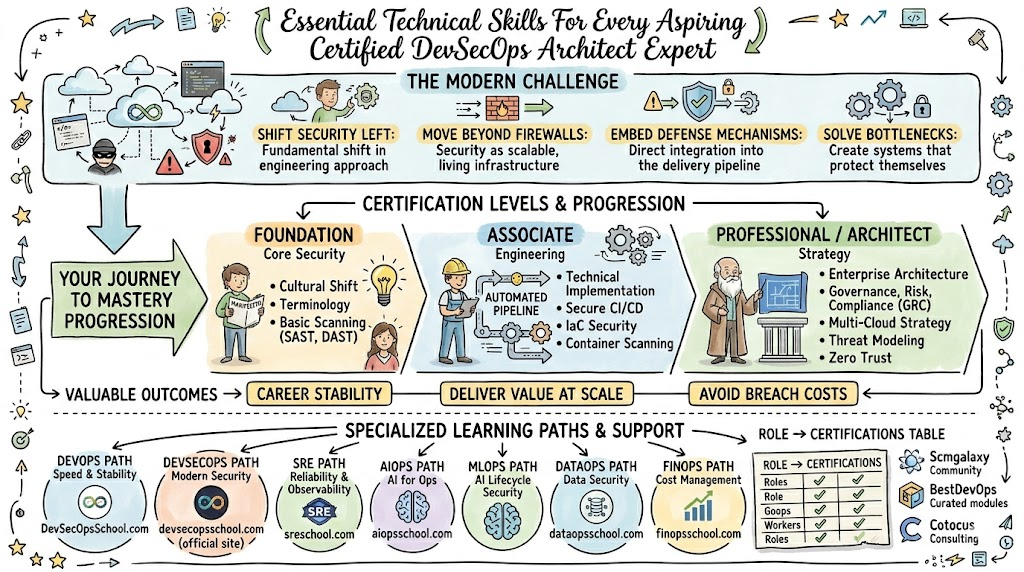
The curriculum follows a logical progression through three distinct stages of expertise. The Foundation level establishes the core principles of the DevSecOps mindset, teaching you how to break down silos between development and security teams. It serves as the essential entry point for anyone new to automated security workflows.
The Associate and Professional levels dive deeper into specific execution and high-level design. These tracks allow you to specialize in areas like SRE security or enterprise-wide policy enforcement. By offering these levels, the program aligns perfectly with a long-term career growth plan, allowing you to gradually take on more responsibility as a technical leader or security architect.
Complete Certified DevSecOps Architect Certification Table
| Track | Level | Who it’s for | Prerequisites | Skills Covered | Recommended Order |
| Security Fundamentals | Foundational | Career Switchers | IT Basics | CI/CD, Risk Intro | 1 |
| Infrastructure Defense | Associate | Cloud Engineers | Linux & Cloud | IaC Security, Vault | 2 |
| Software Integrity | Associate | Devs & Testers | Basic Coding | SAST, DAST, SCA | 3 |
| Strategic Architect | Professional | Tech Leads | 4+ Years DevOps | Policy as Code, GRC | 4 |
| Chaos & Resilience | Specialty | Senior Architects | Professional Cert | Chaos Engineering | 5 |
Detailed Guide for Each Certified DevSecOps Architect Certification
Foundational Level
Certified DevSecOps Architect – Foundation
What it is
This certification confirms that you understand the cultural shift required for DevSecOps and the basic mechanisms of automated security. It proves you can identify where security fits within the standard DevOps lifecycle.
Who should take it
Aspiring engineers, quality analysts, and project managers should pursue this to build a solid foundation. It is the perfect starting point for those who need to manage or participate in secure development projects.
Skills you’ll gain
- Mastery of DevSecOps terminology and lifecycle phases.
- Ability to identify common pipeline security vulnerabilities.
- Knowledge of how to select the right security tools for a project.
- Understanding the role of automation in reducing human error.
Real-world projects you should be able to do
- Document a secure workflow for a small software project.
- Set up a basic static analysis tool on a local codebase.
- Create a risk assessment map for a standard CI/CD pipeline.
Preparation plan
- 7–14 days: Study the core DevSecOps principles and watch introductory webinars.
- 30 days: Familiarize yourself with open-source security tools like SonarQube.
- 60 days: Complete the foundation modules and participate in community study groups.
Common mistakes
- Ignoring the cultural aspect of DevSecOps in favor of only learning tools.
- Skipping the basics of Git and Linux before attempting the security modules.
Best next certification after this
- Same-track option: Associate Level Software Integrity.
- Cross-track option: Basic Cloud Certification.
- Leadership option: Certified Scrum Master.
Associate Level
Certified DevSecOps Architect – Associate
What it is
This level focuses on the practical execution of security tasks within a live environment. It validates your ability to configure, manage, and troubleshoot automated security tools in a professional setting.
Who should take it
Middle-level engineers who work daily with deployment pipelines and cloud infrastructure will find this level most relevant. It targets those ready to take on hands-on security implementation tasks.
Skills you’ll gain
- Configuring advanced SAST and DAST tools in Jenkins or GitLab.
- Hardening Docker images and managing container registries securely.
- Implementing automated secret management and encryption.
- Setting up real-time security alerts and monitoring dashboards.
Real-world projects you should be able to do
- Integrate a container scanning tool into a production-grade pipeline.
- Build an automated secrets rotation system for a multi-cloud environment.
- Implement a “break-the-build” policy based on specific security thresholds.
Preparation plan
- 7–14 days: Deep dive into container security and image layering.
- 30 days: Spend significant time in the lab environment configuring CI/CD tools.
- 60 days: Complete all associate-level coursework and pass the practical labs.
Common mistakes
- Failing to test security tools against false positives.
- Neglecting the performance impact that security scans have on build times.
Best next certification after this
- Same-track option: Professional Level Strategic Architect.
- Cross-track option: Kubernetes Security Specialist (CKS).
- Leadership option: Technical Lead roles.
Professional/Specialty Level
Certified DevSecOps Architect – Professional
What it is
This certification marks you as an expert capable of designing enterprise-wide security frameworks. It focuses on the strategic implementation of security as code and large-scale compliance automation.
Who should take it
Senior leads and architects who must maintain security across hundreds of microservices and diverse teams should aim for this professional designation.
Skills you’ll gain
- Designing complex Policy as Code frameworks using Rego and OPA.
- Orchestrating global compliance audits through automated reporting.
- Architecting resilient systems using security chaos engineering principles.
- Leading incident response strategies for large-scale cloud breaches.
Real-world projects you should be able to do
- Create a centralized governance model for a multi-account cloud strategy.
- Design an automated remediation system that fixes common misconfigurations.
- Lead a migration from legacy security practices to a modern DevSecOps model.
Preparation plan
- 7–14 days: Review global regulatory standards like GDPR and SOC2.
- 30 days: Master advanced policy writing and infrastructure orchestration.
- 60 days: Design a full-scale secure architecture for a hypothetical enterprise.
Common mistakes
- Creating overly restrictive policies that hinder the development team’s speed.
- Focusing exclusively on technical tools while ignoring business risk factors.
Best next certification after this
- Same-track option: Advanced Research in Security Automation.
- Cross-track option: AI-driven Security Specialist.
- Leadership option: Chief Technology Officer (CTO) track.
Choose Your Learning Path
DevOps Path
This path serves engineers who prioritize delivery speed and want to make security a natural part of their workflow. You learn how to automate security checks so they occur silently in the background of every code commit. The goal is to empower developers to own the security of their code without requiring them to become full-time security experts.
DevSecOps Path
Security-focused professionals choose this track to learn the engineering side of the house. You dive deep into the mechanics of exploits and how to build automated defenses that can block them in real-time. This path creates specialists who can build the tools and platforms that the rest of the organization uses to stay safe.
SRE Path
The Site Reliability Engineering path treats security as a core component of system availability. You learn that a secure system is a reliable system, focusing on how to maintain uptime even during a targeted attack. This track emphasizes logging, monitoring, and automated incident response to ensure that the infrastructure remains resilient under pressure.
AIOps Path
This path explores the use of machine learning to identify security anomalies at a scale that humans cannot monitor. You learn to build systems that analyze millions of log entries to find the “needle in the haystack” that indicates a breach. It is the ideal track for those working in massive, high-traffic environments.
MLOps Path
The Machine Learning Operations path focuses on the unique security challenges of the AI lifecycle. You learn to protect model data, prevent adversarial attacks on your algorithms, and secure the pipelines that deploy AI to production. As organizations rely more on AI, this path becomes critical for protecting intellectual property and data integrity.
DataOps Path
Data security architects follow this path to ensure that sensitive information remains protected as it moves through various analytical pipelines. You focus on data masking, encryption, and fine-grained access control to meet privacy regulations. This track ensures that your organization can derive value from data without risking a major leak.
FinOps Path
The Financial Operations path links cloud spending with security governance. You learn how unauthorized resource usage often signals a security breach, such as crypto-jacking. This path teaches you to monitor cloud billing as a security signal and ensure that every dollar spent on infrastructure is authorized and secure.
Role → Recommended Certified DevSecOps Architect Certifications
| Role | Recommended Certifications |
| DevOps Engineer | Associate Software Integrity, Infrastructure Defense |
| SRE | Professional Strategic Architect, SRE Specialty |
| Platform Engineer | Associate Infrastructure Defense, Policy as Code Specialist |
| Cloud Engineer | Associate Infrastructure Defense, Cloud Security |
| Security Engineer | Security Fundamentals, Professional Strategic Architect |
| Data Engineer | DataOps Specialty, Security Fundamentals |
| FinOps Practitioner | FinOps Specialty, Security Fundamentals |
| Engineering Manager | Security Fundamentals, GRC and Compliance |
Next Certifications to Take After Certified DevSecOps Architect
Same Track Progression
Deepening your expertise within the DevSecOps domain allows you to become a subject matter expert in specific tools or methodologies. You might pursue advanced specialties in container orchestration or serverless security. This continuous learning ensures that you stay at the forefront of the field and can handle the most complex architectural challenges.
Cross-Track Expansion
Broadening your knowledge into areas like AIOps or DataOps makes you a more versatile leader. It allows you to see the interconnected nature of security, data, and machine learning. Professionals who can architect secure systems across these diverse domains are in high demand and often lead large-scale digital transformation projects.
Leadership & Management Track
If you wish to move into executive roles, your next steps should focus on business strategy and risk management. Transitioning from a technical architect to a manager requires a shift in focus toward budgets, hiring, and organizational culture. Certifications in management and governance will prepare you for roles like Director of Security or CISO.
Training & Certification Support Providers for Certified DevSecOps Architect
- DevOpsSchool
DevOpsSchool leads the market by providing immersive training experiences that prioritize hands-on learning over simple lectures. Their instructors bring years of production experience to the classroom, ensuring that you learn how to solve real problems. They offer a robust support system and a curriculum that evolves alongside the industry, making them a top choice for professionals in India and beyond. - Cotocus
Cotocus excels at providing high-level consulting and training for enterprises that need to upskill their entire workforce simultaneously. They focus on the architectural side of DevSecOps, helping organizations design secure frameworks that can scale. Their programs are highly customizable and designed to align with the specific technical needs of modern corporate environments, ensuring a high return on investment. - Scmgalaxy
Scmgalaxy serves as a vital community hub and training provider for those who want to master the software supply chain. They provide a unique blend of formal certification training and free community resources that help engineers stay updated on the latest trends. Their focus on configuration management and automated delivery makes them an essential partner for anyone pursuing a DevSecOps career. - BestDevOps
BestDevOps offers streamlined and efficient certification paths for professionals who need to learn quickly without sacrificing depth. Their courses focus on the most high-impact skills, providing a direct route to mastery for those with limited time. They offer flexible scheduling and modern learning tools that cater to the needs of busy engineers working in fast-paced environments. - devsecopsschool.com
devsecopsschool.com acts as the primary authority and official host for the Certified DevSecOps Architect program. It provides the most direct and comprehensive path to achieving this certification, featuring advanced labs and a modular learning system. Their platform is the gold standard for security engineering education, offering resources that are vetted by industry leaders and practitioners worldwide. - sreschool.com
sreschool.com provides specialized training that bridges the gap between system reliability and security. They teach SREs how to build resilient infrastructures that can withstand both technical failures and malicious attacks. Their curriculum is highly technical and focuses on the intersection of uptime, performance, and security, making it a niche but powerful choice for engineers. - aiopsschool.com
aiopsschool.com prepares the next generation of architects for an AI-driven world. Their training focuses on using artificial intelligence to automate security operations and threat detection. They offer a forward-looking curriculum that is essential for anyone who wants to stay ahead of the curve in the rapidly evolving field of automated infrastructure management. - dataopsschool.com
dataopsschool.com focuses exclusively on the security and integrity of data pipelines. They provide the specialized knowledge required to manage large data sets while remaining compliant with global privacy laws. Their training is indispensable for data engineers who must ensure that their organization’s data assets remain secure from end to end. - finopsschool.com
finopsschool.com teaches the critical link between cloud cost management and security governance. They provide a unique perspective on how to secure cloud billing and prevent unauthorized resource provisioning. This training is vital for financial leads and architects who need to maintain a secure and cost-effective cloud presence.
Frequently Asked Questions
1. Does the exam focus more on theory or practical application?
The exam prioritizes practical application, requiring you to demonstrate your skills in a lab environment rather than just answering multiple-choice questions.
2. Can I skip the Foundation level if I have prior experience?
While you can challenge the higher-level exams, the Foundation level ensures you have the specific technical vocabulary and mindset required for this particular certification track.
3. How much time do I have to complete the certification once I start?
Most students complete the program within three to six months, though the self-paced nature allows you to move faster or slower depending on your schedule.
4. Are the labs accessible 24/7 during my training?
Yes, the online platforms typically provide round-the-clock access to the virtual lab environments so you can practice whenever it is convenient for you.
5. What happens if I fail the exam on my first attempt?
Most providers offer a retake policy, allowing you to review the areas where you struggled and attempt the exam again after a brief waiting period.
6. Does this certification cover specific cloud providers like AWS or Azure?
The curriculum focuses on cloud-agnostic principles and tools that work across all major providers, ensuring your skills are portable.
7. Is there a community forum for students to discuss the course material?
Yes, platforms like Scmgalaxy and DevSecOpsSchool provide active community forums where you can ask questions and share insights with other students.
8. Will this certification help me transition into a management role?
The Professional level specifically focuses on architectural design and governance, which are the primary technical skills required for engineering leadership.
9. How often is the course content updated?
Experts review and update the curriculum at least twice a year to ensure it includes the latest security threats and tool advancements.
10. Do I need to be a coding expert to succeed in this program?
You do not need to be a software developer, but a solid understanding of scripting and basic programming logic is essential for the automation components.
11. Are there any live instructor-led sessions available?
Many providers offer a hybrid model that includes both self-paced modules and live sessions with experienced instructors to clarify complex topics.
12. What kind of certificate do I receive upon completion?
You receive a digital, industry-recognized certificate that you can display on your professional profiles and share with potential employers.
FAQs on Certified DevSecOps Architect
1. How does this certification specifically address the “Shift Left” philosophy?
The program teaches you how to integrate security testing tools directly into the developer’s local environment and the initial stages of the CI pipeline. By catching vulnerabilities during the coding phase, you reduce the cost and complexity of fixing them later in the lifecycle, which is the core goal of shifting left.
2. Does the architect track include training on threat modeling?
Yes, threat modeling is a critical component of the curriculum. You learn how to analyze a system’s architecture to identify potential entry points for attackers and design automated defenses to mitigate those risks before the first line of code is even written.
3. What role does Policy as Code play in the professional level?
Policy as Code is central to the advanced modules, where you learn to use tools like Open Policy Agent (OPA) to enforce security rules automatically. This ensures that no infrastructure can be provisioned unless it meets the organization’s pre-defined security and compliance standards.
4. Are there hands-on labs for Kubernetes security in this course?
Absolutely. The curriculum includes extensive labs on securing containerized workloads, managing network policies, and hardening the Kubernetes API. You will learn to build a secure container platform from the ground up, ensuring that every layer of the stack is protected.
5. How does the certification prepare me for automated compliance audits?
You will learn to use tools that continuously monitor your environment against compliance frameworks like CIS benchmarks or SOC2. The program teaches you how to generate real-time reports that prove your infrastructure remains in a compliant state, drastically reducing the effort required for manual audits.
6. Is secret management covered in the Associate level?
Yes, the course includes deep dives into secret management using enterprise tools like HashiCorp Vault. You will learn how to automate the injection of secrets into your applications and how to manage secret rotation without disrupting your production services.
7. Can this certification help me secure the software supply chain?
The program focuses heavily on Software Composition Analysis (SCA) and securing third-party dependencies. You will learn how to identify and block vulnerable libraries from entering your codebase, ensuring that your final product is built on a secure foundation.
8. What is the final assessment like for the Architect level?
The final assessment usually involves a comprehensive project where you must design and implement a secure, automated pipeline for a complex application. You are graded on the effectiveness of your security controls and the overall resilience of your architectural design.
Final Thoughts: Is Certified DevSecOps Architect Worth It?
Deciding to pursue the Certified DevSecOps Architect designation is a strategic move that aligns your career with the most critical needs of the modern enterprise. As organizations continue to move their operations to the cloud and accelerate their delivery cycles, the demand for professionals who can secure these systems will only grow. This certification provides more than just a credential; it gives you the technical confidence to lead major projects and influence the security posture of your entire organization. The effort required to master these skills is significant, but the rewards are equally substantial. You will find yourself at the center of the most important technical conversations in your company, bridging the gap between development, operations, and security. If you want a career that offers both technical challenge and long-term stability, becoming a certified architect in this field is an excellent and highly recommended path. It is a commitment to excellence that marks you as a leader in the next generation of secure software engineering.
Leave a Reply