Introduction
Modern software engineering requires a deep understanding of container orchestration to maintain a competitive edge. The Certified Kubernetes Application Developer (CKAD) stands as the gold standard for professionals who build and deploy cloud-native applications. This guide provides a strategic roadmap for developers and managers to understand the certification’s impact on technical growth and operational efficiency. By mastering these skills, you ensure your applications run reliably across any cloud environment. DevOpsSchool provides the necessary training and resources to help you clear this rigorous exam and implement Kubernetes in production-grade environments.
What is the Certified Kubernetes Application Developer (CKAD)?
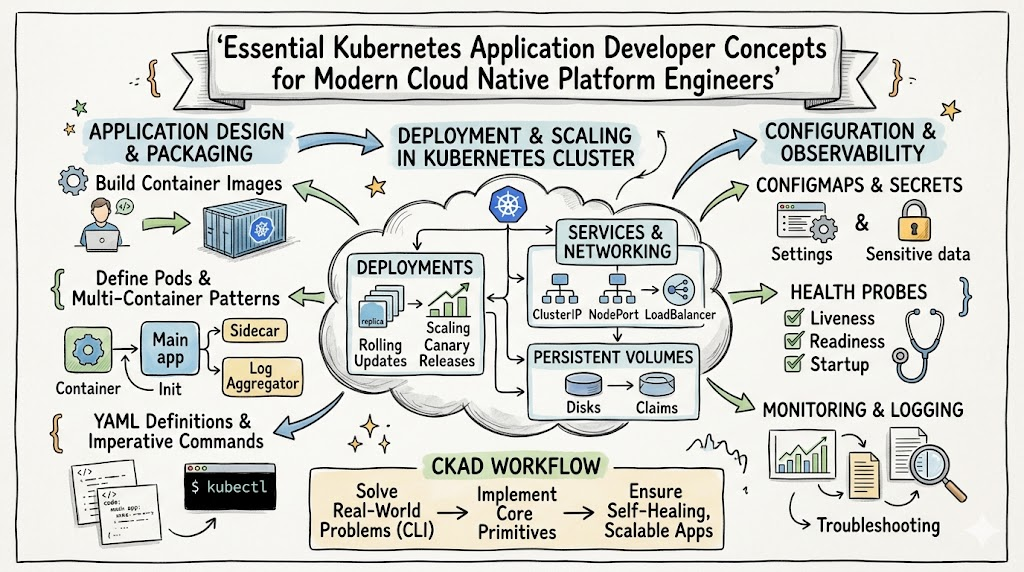
The Certified Kubernetes Application Developer (CKAD) program proves an engineer’s ability to design, build, and configure applications for Kubernetes. The Cloud Native Computing Foundation (CNCF) created this performance-based exam to move away from theoretical testing and toward practical application. It requires you to solve real-world problems in a command-line interface under a strict time limit. This certification validates that you understand the core primitives of Kubernetes and can use them to create scalable, self-healing systems.
Enterprises worldwide value this credential because it ensures that developers can handle the complexities of a live cluster. The program focuses on the specific responsibilities of an application developer rather than a cluster administrator. You will learn how to define application resources and use core primitives to build, monitor, and troubleshoot applications. This focus on hands-on competence makes the CKAD one of the most respected certifications in the DevOps and cloud-native landscape today.
Who Should Pursue Certified Kubernetes Application Developer (CKAD)?
Software engineers who want to specialize in cloud-native development find this certification extremely beneficial for their career progression. It serves as a bridge for developers who are comfortable writing code but lack the operational knowledge to run that code in a distributed system. Site Reliability Engineers (SREs) and Platform Engineers also pursue the CKAD to gain a deeper perspective on how developers interact with the infrastructure they manage. This cross-functional knowledge improves collaboration between teams and speeds up the delivery lifecycle.
Technical managers and team leads in India and global markets should also consider this path to better understand the technical hurdles their teams face. Even if a manager does not write YAML files daily, knowing the capabilities of Kubernetes allows for better architectural decisions. Data scientists and security professionals who work with containerized workloads also benefit significantly. They gain the ability to manage their own environments and troubleshoot deployment issues without always relying on the operations team.
Why Certified Kubernetes Application Developer (CKAD) is Valuable
The massive industry shift toward microservices has made Kubernetes the primary platform for modern application hosting. Earning the CKAD demonstrates that you possess the skills to thrive in this environment, making you a highly attractive candidate for top-tier tech companies. This certification provides a clear signal to employers that you can deliver production-ready software without extensive hand-holding. It drastically reduces the learning curve when you join a new team that utilizes cloud-native technologies.
Beyond immediate job prospects, the CKAD offers significant long-term value by teaching you vendor-neutral skills. Whether your organization uses AWS, Azure, Google Cloud, or on-premises servers, the Kubernetes knowledge you gain remains applicable. This portability protects your career against the changing tides of the cloud provider market. Furthermore, the rigorous preparation required for the exam forces you to learn best practices that prevent common production failures, such as resource exhaustion or misconfigured network policies.
Certified Kubernetes Application Developer (CKAD) Certification Overview
The CNCF delivers the program through the official site at the provided Course URL and hosts the exam on the Website name platform. Candidates face a two-hour proctored session where they must complete a series of tasks in a Linux environment. The exam does not include multiple-choice questions, which forces you to rely on your actual technical proficiency. You must achieve a passing score of 66% or higher to earn the credential, reflecting a high bar for excellence.
The certification structure emphasizes agility and speed with the kubectl command-line tool. You will manage pod designs, deployments, services, and persistent volumes while ensuring application health. The proctors monitor your session via webcam and screen sharing to maintain the integrity of the process. Because the curriculum updates frequently to stay current with Kubernetes releases, the certification remains relevant to the latest industry standards and practices.
Certified Kubernetes Application Developer (CKAD) Certification Tracks & Levels
The Kubernetes certification ecosystem offers a clear path from foundational concepts to expert-level specializations. Most professionals start with the Kubernetes and Cloud Native Associate (KCNA) to grasp the high-level architecture and terminology. Once they understand the basics, they move to the Associate level, which includes the CKAD for developers and the CKA for administrators. These certifications form the core of a professional’s technical portfolio and demonstrate mastery of daily operational tasks.
Advanced practitioners can then move into professional levels like the Certified Kubernetes Security Specialist (CKS). These tracks allow you to specialize in niches like DevSecOps, FinOps, or specialized platform engineering. Following this logical progression ensures that you build a solid foundation before tackling complex security or architectural challenges. This structured approach helps you align your learning with your specific career goals and the needs of your organization.
Complete Certified Kubernetes Application Developer (CKAD) Certification Table
| Track | Level | Who it’s for | Prerequisites | Skills Covered | Recommended Order |
| Cloud Native | Foundational | Aspiring Developers | Basic Linux | Architecture, Containers | 1 |
| App Development | Associate | Software Engineers | YAML, Docker | Pods, Deployments, Probes | 2 |
| Administration | Associate | SysAdmins, SREs | Networking | Installation, Backup | 3 |
| Security | Professional | Security Experts | CKA Holder | Hardening, Auditing | 4 |
| Data Operations | Specialty | Data Engineers | CKAD/CKA | StatefulSets, Storage | 5 |
Detailed Guide for Each Certified Kubernetes Application Developer (CKAD) Certification
Certified Kubernetes Application Developer (CKAD) – Associate Level
What it is
This certification measures a candidate’s ability to design, build, and troubleshoot cloud-native applications on Kubernetes. It confirms that the holder can utilize core primitives to create robust and scalable software deployments.
Who should take it
Application developers, cloud engineers, and SREs who actively manage containerized workloads should pursue this. It fits professionals who have hands-on experience with Linux terminals and container runtimes like Docker or containerd.
Skills you’ll gain
- Building container images and managing multi-container pod patterns.
- Implementing deployment strategies like rolling updates and canary releases.
- Managing application configuration through ConfigMaps and Secrets.
- Setting up liveness, readiness, and startup probes for application health.
- Designing network policies to secure traffic between application components.
Real-world projects you should be able to do
- Migrating a traditional web application to a Kubernetes-native deployment.
- Creating a self-healing microservice with automated scaling and resource limits.
- Implementing a sidecar container for log aggregation and monitoring.
- Troubleshooting connectivity issues between frontend and backend services.
Preparation plan
- 7-14 Days: Focus on the official Kubernetes documentation and practice imperative commands. Learn how to generate YAML templates quickly using the kubectl dry-run flag.
- 30 Days: Work through hands-on labs that cover all domains of the CKAD curriculum. Build speed by timing yourself while creating deployments, services, and ingress rules.
- 60 Days: Review complex scenarios like persistent storage and network policies. Take multiple mock exams to ensure you can navigate the official documentation under pressure.
Common mistakes
- Spending too much time writing YAML files from scratch instead of using imperative commands.
- Failing to switch between different cluster contexts during the multi-cluster exam.
- Ignoring resource limits and quotas, which leads to pod scheduling failures.
- Forgetting to verify the final state of a resource after applying a configuration.
Best next certification after this
- Same-track option: Certified Kubernetes Administrator (CKA)
- Cross-track option: Certified Kubernetes Security Specialist (CKS)
- Leadership option: Cloud Native Professional Architect
Choose Your Learning Path
DevOps Path
The DevOps path emphasizes the integration of development and operations through automation. Professionals in this track use Kubernetes to build robust CI/CD pipelines that deploy code frequently and reliably. Mastering the CKAD allows them to create deployment manifests that developers can easily maintain while ensuring the platform remains stable and scalable.
DevSecOps Path
The DevSecOps path prioritizes security by injecting it into the earliest stages of the development lifecycle. Practitioners focus on securing container images, managing secrets properly, and implementing network-level isolation within Kubernetes. They use the CKAD foundation to understand how developers build applications so they can apply security controls without hindering productivity.
SRE Path
Site Reliability Engineering focuses on the intersection of software engineering and systems administration to ensure high availability. SREs use Kubernetes to automate recovery processes and manage large-scale distributed systems. The CKAD provides them with the developer’s perspective, enabling them to build better platforms that support developer self-service and application reliability.
AIOps Path
The AIOps path leverages artificial intelligence to enhance IT operations and automate incident management. Engineers in this field deploy AI models on Kubernetes to analyze telemetry data and predict system failures. They focus on using Kubernetes to manage the high-compute workloads required for real-time data processing and automated remediation.
MLOps Path
MLOps focuses on the end-to-end lifecycle of machine learning models, from development to production deployment. Professionals use Kubernetes to orchestrate training pipelines and serve models via scalable APIs. This path requires a deep understanding of how to manage specialized resources like GPUs and persistent data storage within a cluster.
DataOps Path
The DataOps path applies DevOps principles to data management to improve the speed and quality of analytics. Data engineers use Kubernetes to run containerized data processing engines like Spark and Flink. They focus on managing complex data dependencies and ensuring that data pipelines remain resilient and performant under heavy load.
FinOps Path
The FinOps path combines cloud engineering with financial accountability to optimize cloud spending. Practitioners use Kubernetes to implement resource quotas, monitor usage, and attribute costs back to specific teams or projects. They use the knowledge from the CKAD to help developers write more resource-efficient applications that lower the organization’s cloud bill.
Role → Recommended Certified Kubernetes Application Developer (CKAD) Certifications
| Role | Recommended Certifications |
| DevOps Engineer | CKAD, CKA |
| SRE | CKAD, CKA, CKS |
| Platform Engineer | CKA, CKS |
| Cloud Engineer | KCNA, CKAD |
| Security Engineer | CKAD, CKS |
| Data Engineer | CKAD |
| FinOps Practitioner | KCNA, CKAD |
| Engineering Manager | KCNA, CKAD |
Next Certifications to Take After Certified Kubernetes Application Developer (CKAD)
Same Track Progression
Once you master application development, you should pursue the Certified Kubernetes Administrator (CKA) to gain a holistic view of the cluster. This allows you to understand the underlying infrastructure, networking, and storage that support your applications. Moving from the developer role to the administrator role makes you a more versatile engineer who can solve problems at every level of the stack.
Cross-Track Expansion
Broadening your skills into the security domain via the Certified Kubernetes Security Specialist (CKS) provides a significant competitive advantage. You can also explore cloud-specific certifications for AWS or Azure to learn how Kubernetes integrates with managed services like EKS or AKS. This cross-training ensures you can design hybrid cloud solutions that leverage the best features of both Kubernetes and cloud providers.
Leadership & Management Track
For those aiming for leadership roles, focusing on architectural and strategic certifications is essential. Look for programs that emphasize cloud-native architecture patterns and business-driven technology decisions. Combining your technical CKAD skills with management or FinOps training allows you to lead digital transformation projects that are both technically sound and financially responsible.
Training & Certification Support Providers for Certified Kubernetes Application Developer (CKAD)
- DevOpsSchool offers a comprehensive training program that focuses on real-world Kubernetes implementation and exam preparation. Their instructors bring years of industry experience to the classroom, providing students with practical insights that go beyond the official curriculum. By offering extensive hands-on labs and lifetime access to course materials, they ensure that every learner gains the confidence to tackle production challenges. Their supportive community and dedicated mentors make them a top choice for professionals in India and beyond.
- Cotocus provides specialized consulting and training services designed to help enterprises adopt cloud-native technologies effectively. They offer customized Kubernetes workshops that align with the specific needs of an organization’s engineering team. Their focus on high-quality delivery and practical problem-solving helps candidates master the CKAD domains quickly. By emphasizing best practices and security, they ensure that their students build applications that are both performant and resilient in the face of modern threats.
- Scmgalaxy serves as a vital knowledge hub for the DevOps community, offering a wide range of tutorials and study guides for Kubernetes. They focus on the practical aspects of software configuration management and how container orchestration fits into the modern delivery pipeline. Their training programs are designed for engineers who want to understand the “why” behind the tools, providing a deep dive into the logic of Kubernetes primitives. This approach helps students develop a long-term understanding of cloud-native systems.
- BestDevOps delivers high-impact training sessions that prioritize the most critical skills required for the CKAD exam. They use a results-oriented methodology that includes intensive bootcamps and simulated mock exams to prepare candidates for the performance-based environment. Their curriculum is streamlined to remove unnecessary fluff, focusing instead on the core competencies that developers use every day. This makes them an ideal choice for busy professionals who need to upskill efficiently and effectively.
- devsecopsschool.com focuses on the critical intersection of security and DevOps, providing the specialized knowledge needed to secure Kubernetes deployments. Their courses cover essential topics like image scanning, network security, and compliance as code. By integrating security into the CKAD learning path, they help developers build applications that are secure by design. This specialized focus is increasingly important as organizations face more sophisticated cyber attacks and stricter regulatory requirements.
- sreschool.com caters to the specific needs of Site Reliability Engineers by offering advanced training in system stability and performance. Their Kubernetes courses emphasize observability, automated scaling, and disaster recovery strategies. By teaching students how to build self-healing infrastructures, they empower them to meet aggressive service level agreements. Their focus on reliability makes them a key resource for engineers who manage large-scale, high-traffic applications in the cloud.
- aiopsschool.com bridges the gap between artificial intelligence and IT operations by offering cutting-edge training on automated system management. They teach students how to deploy and scale AI workloads on Kubernetes, focusing on the unique resource requirements of machine learning models. Their programs are perfect for forward-thinking engineers who want to use data-driven insights to optimize their infrastructure. This training ensures you remain relevant as AI continues to transform the landscape of IT operations.
- dataopsschool.com provides targeted training for data professionals who need to manage large-scale analytics platforms on Kubernetes. They focus on the specific challenges of running stateful applications and data pipelines in a containerized environment. Their courses teach students how to ensure data integrity and performance while leveraging the agility of the cloud. This specialized knowledge is essential for data engineers who want to build modern, scalable data architectures that support business intelligence.
- finopsschool.com addresses the growing demand for cloud cost management by teaching engineers how to optimize Kubernetes resources. Their curriculum covers resource attribution, rightsizing, and cost-visibility tools that help organizations control their cloud spend. By teaching the financial side of Kubernetes, they help engineers and managers make more informed decisions about resource allocation. This skill set is vital for any organization looking to scale its cloud usage without seeing a corresponding spike in costs.
Frequently Asked Questions
1. How do I start preparing for the CKAD exam?
Begin by mastering basic Linux commands and familiarizing yourself with the official Kubernetes documentation website.
2. Is the CKAD exam harder than the CKA exam?
Many find the CKAD more intense because it requires faster YAML editing and a deep focus on application-level primitives.
3. What resources can I use during the actual exam?
You can access one tab of the official Kubernetes documentation, but you cannot use external search engines or blogs.
4. How long should I study to pass the CKAD?
Most candidates spend 4 to 8 weeks in dedicated study, depending on their previous experience with containers and YAML.
5. Do I need to learn Docker before taking the CKAD?
Yes, you need a solid understanding of how container images work and how to build them using a Dockerfile or similar tool.
6. Can I take the exam from my home?
Yes, the exam is an online proctored session that you can take from any quiet location with a reliable internet connection.
7. Does the CKAD certification expire?
The certification remains valid for two years, after which you must retake the current version of the exam to stay certified.
8. What happens if my internet disconnects during the test?
The proctoring software usually allows you to reconnect and resume, but you may lose some time if the outage is prolonged.
9. Is Vim the only text editor available in the exam?
Vim and Nano are typically available in the terminal environment provided during the certification session.
10. How many questions are on the CKAD exam?
The exam usually consists of 15 to 20 performance-based tasks that you must complete within the two-hour window.
11. Is the CKAD recognized globally by major tech companies?
Yes, the CNCF manages the program, making it a globally recognized standard for Kubernetes developers across all industries.
12. Can I get a refund if I decide not to take the exam?
Refund policies depend on the platform where you purchased the exam, so check the specific terms of the Linux Foundation or your provider.
FAQs on Certified Kubernetes Application Developer (CKAD)
1. Does the CKAD exam cover the use of Helm charts?
Yes, the current curriculum includes tasks related to searching, installing, and managing applications using the Helm package manager.
2. Are there any prerequisites for the CKAD?
No formal prerequisites exist, but you should have a strong grasp of the command line and basic networking concepts.
3. How much weight does the CKAD carry for job seekers in India?
The CKAD is highly valued in the Indian IT market as companies rapidly transition their legacy systems to cloud-native architectures.
4. Can I use imperative commands for every question?
You can use imperative commands for many tasks, but complex objects like Network Policies often require manual YAML editing.
5. How quickly are the exam results released?
You will typically receive your official results via email within 24 hours of completing the proctored session.
6. Is the CKAD worth it if I already have the CKA?
Yes, the CKAD provides a different focus that helps you understand the specific challenges and best practices for application developers.
7. What is the best way to build speed for the exam?
Practice creating resources without looking at templates and learn how to use the kubectl explain command to find field names quickly.
8. Do I need to be a professional programmer to pass?
You do not need to write complex application code, but you must understand application configuration, ports, and environment variables.
Final Thoughts: Is Certified Kubernetes Application Developer (CKAD) Worth It?
Navigating the transition to a cloud-native career requires more than just knowing the names of popular tools. Earning the CKAD proves that you have the hands-on expertise to solve real problems in a live environment. The certification process challenges you to think critically about application architecture, security, and scalability. This deep level of understanding is what separates a standard developer from a true cloud-native professional who can lead high-impact projects. Deciding to pursue this credential marks a significant commitment to your technical growth and professional future. While the exam is demanding, the skills you gain will serve as the foundation for your career for years to come. In an industry where technology changes daily, the core principles of Kubernetes provide a stable framework for innovation. If you want to demonstrate your value to employers and gain the confidence to lead production deployments, the CKAD is an investment that will pay dividends throughout your career.
Leave a Reply