Introduction
Navigating the complexities of modern cloud infrastructure requires more than just basic scripting skills; it demands a deep understanding of orchestration. The Certified Kubernetes Administrator (CKA) stands as the definitive credential for engineers who want to prove their expertise in managing containerized environments. This guide breaks down everything you need to know about the certification and how it integrates with professional growth at DevOpsSchool.
Engineers who master Kubernetes gain a significant advantage in the job market, as organizations continue to shift toward microservices. By following this roadmap, you will discover how the CKA validates your ability to build and maintain production-ready clusters. We focus on providing actionable insights that help technical professionals move from theoretical knowledge to hands-on mastery of the cloud-native ecosystem.
What is the Certified Kubernetes Administrator (CKA)?
The Certified Kubernetes Administrator (CKA) acts as a performance-based validation of an engineer’s ability to manage the Kubernetes API. It differs from standard exams because it requires candidates to solve complex infrastructure problems within a live command-line interface. The Cloud Native Computing Foundation (CNCF) created this program to ensure that administrators possess the practical skills needed to support enterprise-grade container deployments.
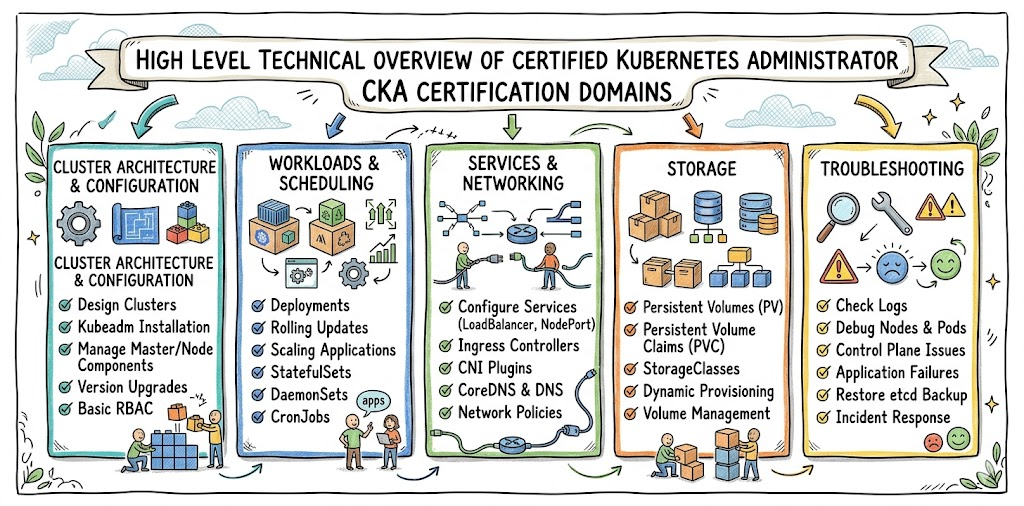
Real-world production environments demand engineers who can do more than just follow a manual; they need experts who understand cluster internals. The CKA focuses on core competencies such as cluster installation, networking configuration, and persistent storage management. It aligns perfectly with modern engineering workflows where automation and reliability are the primary goals of the infrastructure team.
Who Should Pursue Certified Kubernetes Administrator (CKA)?
System administrators who are transitioning from legacy virtualization to container-based stacks find the CKA particularly beneficial. Site Reliability Engineers (SREs) also gain immense value, as the exam’s focus on cluster health and troubleshooting mirrors their daily responsibilities. Cloud architects use the CKA to deepen their technical foundation, ensuring the designs they propose are actually implementable.
Junior engineers looking to enter the DevOps field should treat the CKA as a core milestone in their learning journey. Experienced professionals often pursue the certification to validate their years of hands-on experience and to stay current with the latest Kubernetes features. Engineering managers also benefit from understanding the technical depth required to maintain the platforms their teams build.
Why Certified Kubernetes Administrator (CKA) is Valuable
The CKA offers long-term career stability because Kubernetes has become the standard operating system for modern data centers. While specific cloud providers might gain or lose popularity, the underlying orchestration logic remains consistent across the industry. Earning this certification ensures that your skills remain relevant even as specific tools or cloud vendors evolve.
Enterprise organizations prioritize CKA holders because the certification process guarantees a high level of technical competency. It reduces the risk for employers, knowing that a certified professional can manage critical infrastructure during high-pressure situations. The vendor-neutral nature of the CKA allows you to work across different cloud ecosystems, increasing your flexibility and market value.
Certified Kubernetes Administrator (CKA) Certification Overview
The CNCF delivers the program via the official training path at Certified Kubernetes Administrator (CKA) Certification and DevOpsSchool hosts the comprehensive learning modules. The program focuses entirely on hands-on labs, requiring candidates to demonstrate their skills in a monitored, live environment. This structure ensures that every certified administrator has a proven track record of solving real-world infrastructure problems.
The certification follows a strict practical approach, where candidates interact with multiple Kubernetes clusters to complete various tasks. You must navigate the CLI to fix broken deployments, configure ingress controllers, and manage cluster backups. This rigorous assessment ensures that the CKA badge maintains its reputation as one of the most difficult and respected credentials in IT.
Certified Kubernetes Administrator (CKA) Certification Tracks & Levels
The Kubernetes certification ecosystem provides a clear path for progression, starting with foundational concepts and moving toward advanced security. The KCNA serves as the entry point, focusing on the terminology and architecture of the cloud-native landscape. The CKA and CKAD represent the associate-level certifications for administrators and developers who work with Kubernetes daily.
Specialization tracks allow you to tailor your career according to your specific interests, such as platform security or developer experience. As you move through these levels, the complexity of the tasks increases, shifting from pod management to cluster-wide security hardening. This logical progression helps you build a specialized skillset that matches the needs of senior-level roles.
Complete Certified Kubernetes Administrator (CKA) Certification Table
| Track | Level | Who it’s for | Prerequisites | Skills Covered | Recommended Order |
| Cloud Native | Foundational | Aspiring Engineers | Basic Computing | Ecosystem, Concepts | First |
| Administration | Associate | Admins/Ops | Linux Knowledge | Setup, Ops, Networking | Second |
| Development | Associate | App Developers | Coding Basics | App Deployment, Resources | Optional |
| Security | Professional | Security Pros | Active CKA | Hardening, Auditing | Third |
Detailed Guide for Each Certified Kubernetes Administrator (CKA) Certification
Foundational Level
Certified Kubernetes Administrator (CKA) – KCNA (Cloud Native Associate)
What it is
The KCNA validates that a professional understands the basic principles of container orchestration and the CNCF landscape. It serves as a conceptual foundation, ensuring you speak the same language as the rest of the cloud-native community.
Who should take it
This exam suits technical recruiters, project managers, and students who need to understand what Kubernetes is without necessarily managing a cluster. It provides a low-stakes entry point into the world of cloud-native computing.
Skills you’ll gain
- Understanding microservices architecture and container benefits.
- Knowledge of various CNCF projects like Prometheus, Helm, and Envoy.
- Familiarity with the basic components of a Kubernetes cluster.
- Awareness of serverless, service mesh, and observability concepts.
Real-world projects you should be able to do
- Explain the benefits of moving from VMs to containers to stakeholders.
- Navigate the CNCF landscape to identify tools for specific problems.
- Communicate effectively with DevOps teams regarding infrastructure needs.
Preparation plan
- 7–14 days: Review the official CNCF glossary and read introductory blogs on containers.
- 30 days: Take a foundational course that covers the history and architecture of Kubernetes.
- 60 days: This level rarely requires two months of study if you have a technical background.
Common mistakes
- Ignoring the wider CNCF ecosystem to focus only on Kubernetes commands.
- Underestimating the exam because it is multiple-choice rather than hands-on.
Best next certification after this
- Same-track option: CKA
- Cross-track option: AWS Cloud Practitioner
- Leadership option: DevOps Leader
Associate Level
Certified Kubernetes Administrator (CKA) – CKA (Administrator)
What it is
The CKA validates your ability to install, configure, and troubleshoot production-grade clusters. It is the primary credential for anyone responsible for maintaining the health and performance of a Kubernetes environment.
Who should take it
DevOps engineers and system administrators who handle the infrastructure layer of the stack should prioritize this. It requires significant experience with the Linux terminal and a strong understanding of networking protocols.
Skills you’ll gain
- Configuring highly available clusters using kubeadm.
- Managing cluster networking, including CNI plugins and DNS.
- Troubleshooting control plane components and worker node failures.
- Implementing persistent storage solutions for stateful applications.
Real-world projects you should be able to do
- Perform a full cluster upgrade from one minor version to the next.
- Restore a cluster from an etcd backup during a simulated disaster.
- Configure RBAC rules to restrict access to sensitive cluster resources.
Preparation plan
- 7–14 days: Intensive practice with imperative commands and YAML editing.
- 30 days: Working through comprehensive labs and mock exams multiple times.
- 60 days: Starting from scratch with Linux and networking before diving into Kubernetes.
Common mistakes
- Failing to manage time effectively during the two-hour lab exam.
- Depending too much on the documentation instead of memorizing core commands.
Best next certification after this
- Same-track option: CKS
- Cross-track option: Terraform Associate
- Leadership option: Platform Engineering Lead
Professional/Specialty Level
Certified Kubernetes Administrator (CKA) – CKS (Security Specialist)
What it is
The CKS validates that you can secure the entire container lifecycle, from build to runtime. It is an advanced certification that requires a deep understanding of security best practices and external auditing tools.
Who should take it
Security engineers and senior platform architects who have already earned their CKA. This is for professionals who must meet strict compliance standards in regulated industries like finance or healthcare.
Skills you’ll gain
- Hardening cluster components and the host operating system.
- Securing the container supply chain and image repositories.
- Implementing runtime security monitoring and threat detection.
- Configuring admission controllers to enforce cluster-wide policies.
Real-world projects you should be able to do
- Setup Falco to detect suspicious activity inside a running container.
- Configure gVisor to provide kernel-level isolation for untrusted workloads.
- Audit the API server logs to identify potential unauthorized access attempts.
Preparation plan
- 7–14 days: Reviewing the documentation for third-party tools like Trivy and AppArmor.
- 30 days: Deep dive into NetworkPolicies and restrictive RBAC configurations.
- 60 days: Mastering the integration of multiple security tools into a single cluster.
Common mistakes
- Attempting the exam without a solid foundation in basic CKA administration.
- Forgetting to study the non-Kubernetes security tools like Seccomp and Linux capabilities.
Best next certification after this
- Same-track option: Advanced Cloud Security Engineer
- Cross-track option: CISSP
- Leadership option: CISO
Choose Your Learning Path
DevOps Path
The DevOps path focuses on bridging the gap between code and infrastructure through constant automation. In this journey, the CKA provides the underlying platform where your CI/CD pipelines will deploy applications. You will learn how to use Kubernetes to create a consistent, scalable, and self-healing environment for your software development lifecycle.
DevSecOps Path
DevSecOps professionals integrate security directly into the automation process rather than treating it as a final step. This path uses the CKA for foundational infrastructure knowledge and the CKS for advanced hardening techniques. You will focus on building “secure-by-default” clusters that can withstand modern cyber threats while maintaining developer velocity.
SRE Path
Site Reliability Engineering applies software principles to operational challenges to ensure high system availability. The CKA helps SREs understand how to manage cluster resources, handle failovers, and monitor system health effectively. This path emphasizes using Kubernetes to achieve reliability targets and manage complex distributed systems at scale.
AIOps Path
AIOps leverages artificial intelligence to automate the management of complex IT environments. By understanding the CKA fundamentals, you can implement AI-driven tools that predict cluster outages and automate capacity management. This path focuses on using data-driven insights to improve the operational efficiency of large-scale Kubernetes deployments.
MLOps Path
MLOps streamlines the deployment and management of machine learning models in production environments. In this path, the CKA is essential for managing the high-performance compute resources, like GPUs, that ML workloads require. You will learn how to orchestrate the complex data pipelines and model training jobs that run on Kubernetes.
DataOps Path
DataOps focuses on improving the quality and delivery rate of data analytics across the enterprise. Kubernetes provides the scalable infrastructure needed to run large-scale data processing engines like Spark. The CKA helps you manage the persistent storage and high-throughput networking requirements that data-intensive applications demand.
FinOps Path
FinOps brings financial accountability to the variable spending world of the cloud. This path uses Kubernetes concepts like resource limits and namespaces to track and optimize cloud costs. By understanding the CKA, you can ensure that your clusters are sized correctly to avoid overspending while maintaining performance.
Role → Recommended Certified Kubernetes Administrator (CKA) Certifications
| Role | Recommended Certifications |
| DevOps Engineer | CKA, CKAD, Jenkins Engineer |
| SRE | CKA, Prometheus Certified, CKS |
| Platform Engineer | CKA, Terraform Associate, CKS |
| Cloud Engineer | CKA, AWS Solution Architect |
| Security Engineer | CKA, CKS, Certified Ethical Hacker |
| Data Engineer | CKA, DataOps Professional |
| FinOps Practitioner | KCNA, FinOps Certified Practitioner |
| Engineering Manager | KCNA, DevOps Leader |
Next Certifications to Take After Certified Kubernetes Administrator (CKA)
Same Track Progression
After you master the CKA, moving toward the CKS (Security Specialist) is the most logical step for an infrastructure professional. This allows you to specialize in the security layer of the stack, which is a high-demand skill in the enterprise. You can also explore specific tool certifications for Service Meshes like Istio or monitoring platforms like Prometheus.
Cross-Track Expansion
To broaden your expertise, consider earning certifications in Infrastructure as Code (IaC) or specific cloud providers. A Terraform Associate certification perfectly complements the CKA, as it allows you to automate the creation of the virtual machines that host your clusters. Similarly, an AWS or Azure Architect credential helps you understand the broader cloud ecosystem surrounding Kubernetes.
Leadership & Management Track
If you aim for leadership roles, look into certifications that focus on process, culture, and team management. The DevOps Leader (DOL) or ITIL certifications provide the frameworks needed to manage large technical organizations. Having the technical foundation of a CKA ensures that you remain a credible leader who understands the challenges your engineers face.
Training & Certification Support Providers for Certified Kubernetes Administrator (CKA)
- DevOpsSchool
DevOpsSchool provides a robust and hands-on learning environment for professionals seeking to master Kubernetes administration. They offer a curriculum that focuses on practical labs, ensuring that students can handle real-world production scenarios. Their instructors bring decades of experience to the table, helping students navigate the complexities of the CKA exam with confidence. The platform is highly regarded for its comprehensive support and deep library of technical resources that aid in long-term career development. - Cotocus
Cotocus specializes in high-end technical training for corporate teams and individual engineers who want to excel in the cloud-native space. Their CKA preparation programs emphasize architectural best practices and deep-dive troubleshooting sessions. They provide a simulated exam environment that helps candidates build the speed and accuracy required to pass the performance-based test. The training is tailored to help teams transition smoothly to containerized infrastructures while maintaining high operational standards. - Scmgalaxy
- Scmgalaxy has built a massive community-driven platform that offers extensive tutorials and guides for Kubernetes enthusiasts. Their training programs focus heavily on the intersection of configuration management and container orchestration. They provide a unique perspective on the CKA by exploring how Kubernetes integrates with older legacy systems and modern CI/CD tools. This provider is an excellent choice for engineers who want a well-rounded understanding of the entire software delivery pipeline.
- BestDevOps
BestDevOps delivers intensive bootcamps and focused training modules designed for quick and effective certification preparation. Their approach strips away the fluff and focuses on the core competencies required to clear the CKA exam on the first attempt. They provide students with a variety of mock exams and practical exercises that mirror the actual testing environment. This provider is ideal for busy professionals who need a structured and efficient path to achieving their certification goals. - devsecopsschool.com
devsecopsschool.com leads the industry in providing security-focused training for the modern DevOps professional. While they cover the CKA essentials, their primary focus remains on securing the Kubernetes ecosystem through advanced hardening techniques. They teach students how to build secure clusters from the ground up, preparing them for both the CKA and the subsequent CKS certification. This provider is perfect for those who want to specialize in the high-stakes world of cloud-native security. - sreschool.com
sreschool.com focuses on the principles of site reliability and high availability within the Kubernetes landscape. Their training modules teach students how to manage massive clusters while maintaining strict service level objectives. They provide deep insights into observability, automated failover, and performance tuning for Kubernetes environments. Engineers who want to move into SRE roles will find their CKA-aligned curriculum to be an invaluable asset for their career progression. - aiopsschool.com
aiopsschool.com offers specialized training that integrates artificial intelligence with traditional infrastructure operations. Their courses show students how to use AI models to monitor Kubernetes clusters and predict potential failures before they occur. By mastering CKA skills through this platform, engineers learn how to build smarter, more autonomous infrastructure systems. This provider is at the cutting edge of the industry, helping professionals prepare for the future of automated IT operations. - dataopsschool.com
dataopsschool.com caters to the needs of data engineers and architects who are moving their workloads to Kubernetes. Their training focuses on the specific challenges of managing stateful applications, persistent storage, and high-performance data pipelines. They help students understand how to orchestrate complex data engines within the Kubernetes framework. This platform is the go-to resource for anyone looking to bridge the gap between data science and infrastructure administration. - finopsschool.com
finopsschool.com provides the essential training needed to manage the financial aspects of cloud-native infrastructure. They teach engineers how to use Kubernetes resource management features to drive cost efficiency across the organization. Students learn how to translate technical cluster performance into business-friendly financial reports. This provider is vital for professionals who want to demonstrate their ability to manage both the technical and financial health of a cloud environment.
Frequently Asked Questions
1. Does the CKA exam use multiple-choice questions?
No, the CKA is a performance-based exam where you solve technical tasks in a live Kubernetes cluster via a terminal.
2. How much time do I have to complete the CKA exam?
Candidates have exactly two hours to complete all the tasks assigned in the exam environment.
3. What is the typical passing score for the certification?
You generally need a score of 66% or higher to earn your Certified Kubernetes Administrator credential.
4. Can I retake the exam if I fail my first attempt?
Most exam vouchers purchased through the Linux Foundation include one free retake, providing a second chance to pass.
5. Which operating system do I use during the exam?
The exam environment typically runs on a modern Linux distribution like Ubuntu, requiring familiarity with the bash shell.
6. Is the CKA certification recognized by major cloud providers?
Yes, companies like AWS, Google, and Microsoft recognize the CKA as a standard for Kubernetes expertise.
7. Do I need to be a programmer to pass the CKA?
You do not need to be a software developer, but you must be able to read and edit YAML files and write basic shell commands.
8. How long does it take for the results to arrive?
The results are usually sent via email within 24 to 36 hours after you finish the exam session.
9. Can I use a second monitor during the test?
The proctoring rules usually restrict you to a single monitor to ensure the integrity of the testing environment.
10. What version of Kubernetes should I study?
The exam usually tracks the most recent stable versions, so you should check the CNCF website for the specific version currently being tested.
11. Is the CKA harder than the CKAD?
Most professionals find the CKA harder because it covers cluster-wide administration and troubleshooting, whereas the CKAD focuses only on application deployment.
12. Does the certification expire?
Yes, the CKA is valid for three years, and you must renew it by retaking the exam or passing the CKS.
FAQs on Certified Kubernetes Administrator (CKA)
1. Which area should I prioritize during my study sessions?
Troubleshooting and cluster maintenance typically carry the most weight and require the most practical practice.
2. Is it possible to use the documentation during the test?
Yes, you may access the official Kubernetes documentation in one browser tab to look up syntax and examples.
3. What happens if my internet disconnects during the exam?
The proctoring software usually allows you to reconnect, but you should have a stable connection to avoid losing valuable time.
4. How do I practice for the performance-based format?
Setting up your own clusters using kubeadm on local virtual machines is the most effective way to build the necessary skills.
5. Are there any specific terminal tools I should master?
Mastering Vim or Nano for file editing and becoming fast with kubectl commands will significantly improve your chances of passing.
6. Does the exam include questions on Helm or Service Meshes?
The CKA focuses primarily on core Kubernetes components, though basic knowledge of Helm is helpful for certain tasks.
7. Can I take the exam from my home?
Yes, the CKA is a remotely proctored exam that you can take from any quiet room with a stable internet connection.
8. Is the CKA worth the effort for a Windows administrator?
Absolutely, as most modern enterprise applications run on Linux containers, the CKA is the best way to transition into the modern cloud world.
Final Thoughts: Is Certified Kubernetes Administrator (CKA) Worth It?
Deciding to invest your time in a certification often comes down to the practical utility of the skills you acquire. The CKA provides more than just a certificate; it gives you the confidence to manage complex, mission-critical systems that power the modern world. It forces you to look under the hood of the most important infrastructure technology of the decade.
Professionals who earn the CKA often find that they approach infrastructure problems with a more disciplined and structured mindset. The difficulty of the exam is exactly what makes the credential so valuable in the eyes of peers and employers. It separates the hobbyists from the true experts who can maintain system stability under pressure.
Leave a Reply