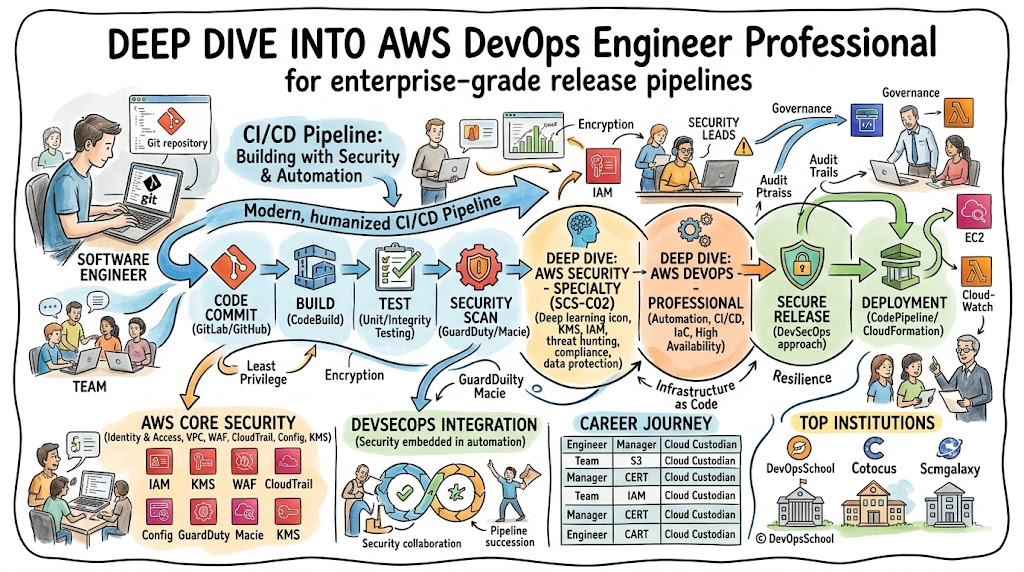
Introduction
The landscape of professional engineering has undergone a tectonic shift. In the early days of cloud computing, the primary objective was simply to “get it working.” We celebrated when an application successfully scaled to a thousand users. But today, the stakes have changed. We are no longer just developers or administrators; we are the architects of digital trust.
In global tech hubs—from the bustling corridors of Bengaluru to the high-stakes financial centers of New York—the “Security-First” mindset is the new gold standard. It is no longer enough to build a fast pipeline if that pipeline is a gateway for intruders. This guide is designed for those ready to bridge the gap between “working” and “secure,” focusing on the cornerstone of modern cloud integrity: the AWS Certified Security – Specialty.
What is AWS Certified Security – Specialty
The AWS Certified Security – Specialty certification is meant for professionals who take end‑to‑end responsibility for securing AWS environments. It demonstrates that you can design safe cloud architectures, craft tight access controls, and keep sensitive information protected through strong encryption and disciplined key practices. The exam also looks at how you secure networks across multiple AWS accounts, structure useful logging and monitoring, and use AWS security services to uncover and contain threats. When you earn this certification, you signal that you are ready to support and defend important, compliance‑sensitive workloads on AWS with practical, hands‑on security skills.
The Vital Role of Security in the Modern Software and Automation Ecosystem
We live in an age of “Infinite Surface Area.” Every new microservice, every API endpoint, and every automated script is a potential entry point for a threat. As we move toward more autonomous systems—driven by AIOps and MLOps—the speed of deployment has outpaced the speed of manual security checks.
This is where the paradigm of DevSecOps comes into play. Security must be an invisible thread woven into the fabric of every deployment. It is the silent engine that allows organizations to innovate without fear. For an engineer, mastering security means you are no longer just a “resource”; you are a protector of the business’s most valuable asset: its reputation. For a manager, it means creating a culture where resilience is valued as highly as features.
Why DevOpsSchool is Your Ideal Training Partner?
DevOpsSchool has built a legacy by focusing on the “Practitioner’s Reality.” They understand that a certification is a doorway, but hands-on skill is what keeps you inside the room.
The training at DevOpsSchool isn’t just about passing a test; it’s about surviving a production outage. Their mentors are veterans who have seen the worst-case scenarios and lived to build better systems. By choosing DevOpsSchool, you gain access to high-end labs, real-world project simulations, and a community of professionals who are all striving for the same goal: technical mastery.
AWS Certified Security – Specialty Overview
To navigate the complex world of professional growth, you need a clear map of the terrain.
| Track | Level | Who it’s for | Prerequisites | Skills Covered | Recommended Order |
| Security | Specialty | Security Ops, Cloud Engineers | Associate knowledge | IAM, Encryption, Forensics | 3rd or 4th |
| DevOps | Professional | DevOps Leads, SREs | 2+ years AWS exp | CI/CD, SDLC, Automation | 4th |
| Architect | Professional | Solutions Architects | Architect Assoc. | Multi-tier Design, Cost | 4th |
| SysOps | Associate | Systems Admins, SREs | Cloud Practitioner | Operations, Monitoring | 2nd |
| Developer | Associate | Software Developers | Cloud Practitioner | Serverless, SDKs, Lambda | 2nd |
Spotlight: AWS Certified Security – Specialty (SCS-C02)
What is it
The AWS Certified Security – Specialty is an advanced technical badge that proves your ability to design and implement secure AWS environments. It moves beyond basic configurations to explore deep-dive cryptography, automated incident response, and complex identity governance across multi-account structures.
Who should take it
This certification is tailor-made for Security Analysts, Lead Cloud Engineers, and senior architects who are responsible for maintaining the “Fortress” of their company’s digital infrastructure. It is also highly beneficial for engineering managers who need to oversee high-compliance migrations.
Skills you’ll gain
- Identity Mastery: Designing surgical IAM policies and cross-account access controls.
- Encryption Architecture: Implementing and managing KMS, CloudHSM, and Secrets Manager.
- Infrastructure Defense: Setting up VPC Flow Logs, WAF, and Shield for advanced protection.
- Intelligent Monitoring: Leveraging GuardDuty, Macie, and Security Hub for threat hunting.
- Forensic Readiness: Building automated logging and auditing trails using CloudTrail and AWS Config.
Real-world projects you should be able to do after it
- The “Zero-Trust” Pipeline: Building a CI/CD process where security checks are automated and no human has persistent access to production.
- Automated Threat Remediation: Designing a Lambda-based “Self-Healing” system that isolates compromised EC2 instances the moment a threat is detected.
- Global Data Sovereignty: Implementing a multi-region encryption strategy that complies with local data laws automatically.
- The “Compliance Bot”: Setting up a continuous auditing system that alerts the team if any S3 bucket or database falls out of compliance.
Preparation Plan
- 14-Day “The Sprint”: Aimed at experts. 4 hours a day focusing exclusively on the AWS Security Pillars and high-stakes mock exams.
- 30-Day “The Standard”: 2 hours a day. Spend weeks 1-2 on Labs (Identity and Encryption). Week 3 on Monitoring. Week 4 on scenario-based exam prep.
- 60-Day “The Foundation”: Recommended for those coming from a non-cloud background. Spend the first 30 days mastering the “Associate” level basics before touching the specialty domains.
Common Mistakes
- Underestimating IAM Logic: Many fail because they don’t understand the “Explicit Deny” hierarchy in AWS policies.
- Thinking Theory is Enough: You must know the console. The exam will ask questions that require you to have “clicked the buttons” in a lab.
- Ignoring Hybrid Scenarios: Don’t forget how AWS connects to physical offices; VPN and Direct Connect security are major topics.
Best next certification after this
After achieving this milestone, you should broaden your horizon based on your career goals:
- Same-Track Option: AWS Certified Solutions Architect – Professional (To apply security to high-level system design).
- Cross-Track Option: Certified Kubernetes Security Specialist (CKS) (To master container-level defense).
- Leadership Option: CISM (Certified Information Security Manager) (To transition into the C-Suite as a CISO).
The Six Pillars of Professional Evolution
- The DevOps Path: Focus on the “Velocity.” You are the master of the pipeline, ensuring code moves from laptop to cloud with maximum efficiency.
- The DevSecOps Path: Focus on the “Integrity.” You bridge the gap between the speed of DevOps and the safety of Security.
- The SRE Path: Focus on “Resilience.” You treat operations as a software problem, building systems that are unbreakable and self-healing.
- The AIOps/MLOps Path: Focus on “Intelligence.” You use AI to manage the massive scale of modern logs and predict failures before they happen.
- The DataOps Path: Focus on the “Pipeline.” You ensure that the flow of big data is secure, clean, and reliable for the business.
- The FinOps Path: Focus on “Efficiency.” You are the bridge between engineering and finance, ensuring every cloud dollar is spent wisely.
Mapping Roles to Recommended Certifications
| If your role is… | Start with this… | Your target should be… |
| DevOps Engineer | AWS SysOps Associate | AWS DevOps Professional |
| SRE | AWS Developer Associate | AWS Security Specialty |
| Platform Engineer | Solutions Architect Assoc. | Certified Kubernetes Admin (CKA) |
| Cloud Engineer | Solutions Architect Assoc. | AWS Security Specialty |
| Security Engineer | AWS Security Specialty | AWS Solutions Architect Prof. |
| Data Engineer | AWS Data Engineer Assoc. | AWS Security Specialty |
| FinOps Practitioner | AWS Cloud Practitioner | AWS Solutions Architect Assoc. |
| Engineering Manager | AWS Cloud Practitioner | AWS Security Specialty |
The Leaders in Learning: Institutions Providing Certification Support
To truly master the AWS Security – Specialty, you need a training partner that understands the high-velocity world of cloud automation. Here are the top providers:
- DevOpsSchool: A premier destination for technical professionals. They offer deep-dive training that focuses on the practical application of AWS tools, ensuring students are ready for the complexities of the modern workplace. Their 24/7 lab access and mentor support are industry-leading.
- Cotocus: Specializes in high-end technical consulting and corporate training. They are the go-to for teams looking to master advanced cloud-native architectures and customized security workshops.
- Scmgalaxy: Known for its massive library of technical resources and community-driven blogs. It is an essential stop for anyone looking for technical tutorials, troubleshooting guides, and exam preparation scripts.
- BestDevOps: Offers vocational training that bridges the gap between traditional IT and modern cloud practices, focusing on the latest tools and methodologies that employers demand.
- devsecopsschool.com: A dedicated platform for those looking to specialize in the intersection of security and operations, providing deep expertise in automated defense and threat hunting.
- sreschool.com: Focused on the art of reliability, helping engineers build systems that are both scalable and unbreakable, with a heavy emphasis on incident response.
- aiopsschool.com: Leading the charge in teaching engineers how to leverage AI to manage the next generation of cloud scale and predictive operations.
- dataopsschool.com: A specialized training hub for data professionals who need to secure and optimize the data lifecycle, from ingestion to archival.
- finopsschool.com: Providing the financial and technical training needed to master the emerging world of cloud financial management and cost optimization.
Frequently Asked Questions
1. I don’t know much about the cloud. Is it too late to start?
Not at all. The cloud is still growing. In fact, starting now means you get to learn the most modern tools from day one.
2. Do I need to be a “Coder” to work in the cloud?
Not necessarily a professional developer, but you must be comfortable reading code and writing scripts. Logic is more important than memorizing syntax.
3. Is there a difference between “IT” and “The Cloud”?
Think of IT as owning a car and maintaining it yourself. The Cloud is like using an elite car service where you just pay for the ride.
4. How much do these exams cost?
The Specialty exams are generally $300 USD. Associate exams are $150 USD. Most companies see this as an investment and will pay for you.
5. How long do I have to study?
It depends on your experience. For a beginner, 60 days of focused study is a healthy target. For a pro, 14–30 days is enough.
6. Can I take the exam from home in India?
Yes. AWS offers online proctored exams. You just need a quiet room and a good internet connection.
7. Does the certificate expire?
Yes, every three years. This is because the technology changes so fast that AWS wants to make sure you are still an expert.
8. What is the “Free Tier” everyone talks about?
AWS gives you a free account for 12 months to practice. It’s the best way to learn without spending a rupee.
9. Will this certification get me a remote job?
Cloud and Security roles are some of the most remote-friendly jobs in the world. Companies hire talent based on skills, regardless of location.
10. What is the hardest part of the exam?
Usually, it’s the “Scenario Questions” where they give you a problem and four “correct” answers, but only one is the “Best AWS Practice.”
11. Is English the only language for the exam?
No, but for global and Indian tech markets, taking it in English is highly recommended as all documentation is in English.
12. Should I learn more than one cloud (like Azure)?
Master AWS first. Once you are an expert in one, learning the others becomes much easier as the concepts are very similar.
Technical Deep Dive: AWS Certified Security – Specialty (SCS-C02) FAQs
1. What is the “Golden Rule” of the security exam?
The “Principle of Least Privilege.” Always choose the answer that gives the user the minimum amount of access they need to do their job.
2. How much networking knowledge is required?
A significant amount. You must understand VPCs, Subnets, Security Groups, and NACLs inside and out.
3. What is the difference between GuardDuty and Inspector?
GuardDuty is a threat detection service that watches for “bad guys.” Inspector is a vulnerability scanner that looks for “weak spots” in your own code.
4. How does AWS help with encryption?
AWS KMS (Key Management Service) is the heart of the exam. You must understand how to manage, rotate, and control access to encryption keys.
5. Do I need to know about “On-Premise” connections?
Yes. You need to know how to secure a connection from a physical office to AWS using VPNs or Direct Connect.
6. Is AWS WAF the same as a firewall?
It is a “Web Application Firewall.” It protects your website from common attacks like SQL injection and cross-site scripting.
7. What is “CloudTrail” and why do I need it?
CloudTrail is the digital diary of your AWS account. It records every action taken by every user, which is essential for security audits.
8. Can I automate security fixes?
Yes! By using EventBridge and Lambda, you can write code that automatically fixes security problems the moment they are detected.
Conclusion
In the professional landscape, the gap between those who “work in IT” and those who “architect the future” is defined by a commitment to security. Earning the AWS Certified Security – Specialty is not just about adding a badge to your resume; it is about adopting a mindset of resilience and integrity.
Whether you are an engineer looking for your next promotion or a manager aiming to secure your organization’s future, the path is clear. Lean on the mentorship of experts like Rajesh Kumar and the resources at DevOpsSchool, build your hands-on experience, and take the first step toward becoming a leader in the global automation ecosystem. The cloud is your canvas—secure it well.
Leave a Reply