Category: Uncategorized

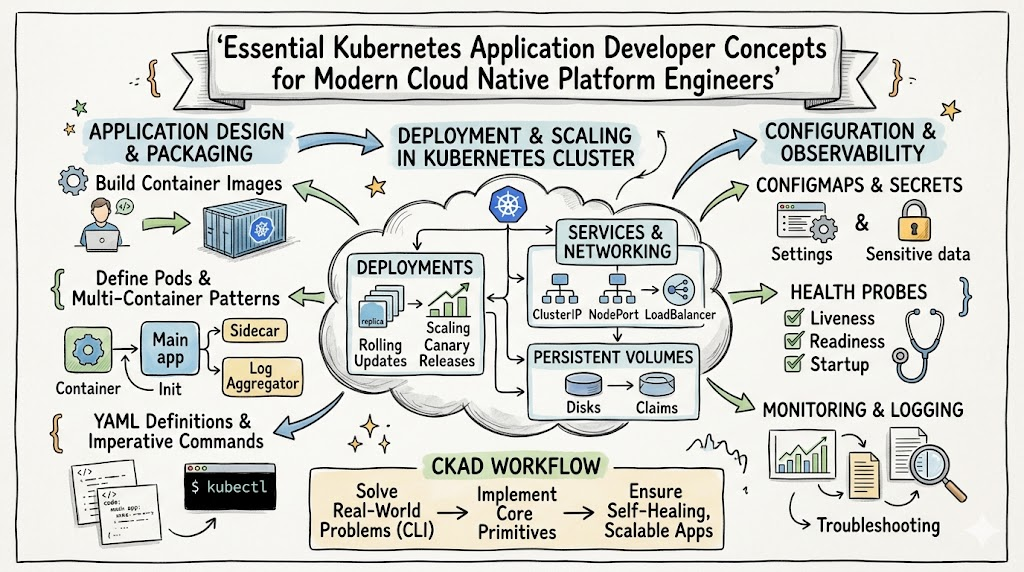
  • Essential Kubernetes Application Developer Concepts for Modern Cloud Native Platform Engineers

    Introduction

    Modern software engineering requires a deep understanding of container orchestration to maintain a competitive edge. The Certified Kubernetes Application Developer (CKAD) stands as the gold standard for professionals who build and deploy cloud-native applications. This guide provides a strategic roadmap for developers and managers to understand the certification’s impact on technical growth and operational efficiency. By mastering these skills, you ensure your applications run reliably across any cloud environment. DevOpsSchool provides the necessary training and resources to help you clear this rigorous exam and implement Kubernetes in production-grade environments.

    What is the Certified Kubernetes Application Developer (CKAD)?

    The Certified Kubernetes Application Developer (CKAD) program proves an engineer’s ability to design, build, and configure applications for Kubernetes. The Cloud Native Computing Foundation (CNCF) created this performance-based exam to move away from theoretical testing and toward practical application. It requires you to solve real-world problems in a command-line interface under a strict time limit. This certification validates that you understand the core primitives of Kubernetes and can use them to create scalable, self-healing systems.

    Enterprises worldwide value this credential because it ensures that developers can handle the complexities of a live cluster. The program focuses on the specific responsibilities of an application developer rather than a cluster administrator. You will learn how to define application resources and use core primitives to build, monitor, and troubleshoot applications. This focus on hands-on competence makes the CKAD one of the most respected certifications in the DevOps and cloud-native landscape today.

    Who Should Pursue Certified Kubernetes Application Developer (CKAD)?

    Software engineers who want to specialize in cloud-native development find this certification extremely beneficial for their career progression. It serves as a bridge for developers who are comfortable writing code but lack the operational knowledge to run that code in a distributed system. Site Reliability Engineers (SREs) and Platform Engineers also pursue the CKAD to gain a deeper perspective on how developers interact with the infrastructure they manage. This cross-functional knowledge improves collaboration between teams and speeds up the delivery lifecycle.

    Technical managers and team leads in India and global markets should also consider this path to better understand the technical hurdles their teams face. Even if a manager does not write YAML files daily, knowing the capabilities of Kubernetes allows for better architectural decisions. Data scientists and security professionals who work with containerized workloads also benefit significantly. They gain the ability to manage their own environments and troubleshoot deployment issues without always relying on the operations team.

    Why Certified Kubernetes Application Developer (CKAD) is Valuable

    The massive industry shift toward microservices has made Kubernetes the primary platform for modern application hosting. Earning the CKAD demonstrates that you possess the skills to thrive in this environment, making you a highly attractive candidate for top-tier tech companies. This certification provides a clear signal to employers that you can deliver production-ready software without extensive hand-holding. It drastically reduces the learning curve when you join a new team that utilizes cloud-native technologies.

    Beyond immediate job prospects, the CKAD offers significant long-term value by teaching you vendor-neutral skills. Whether your organization uses AWS, Azure, Google Cloud, or on-premises servers, the Kubernetes knowledge you gain remains applicable. This portability protects your career against the changing tides of the cloud provider market. Furthermore, the rigorous preparation required for the exam forces you to learn best practices that prevent common production failures, such as resource exhaustion or misconfigured network policies.

    Certified Kubernetes Application Developer (CKAD) Certification Overview

    The CNCF delivers the program through the official site at the provided Course URL and hosts the exam on the Website name platform. Candidates face a two-hour proctored session where they must complete a series of tasks in a Linux environment. The exam does not include multiple-choice questions, which forces you to rely on your actual technical proficiency. You must achieve a passing score of 66% or higher to earn the credential, reflecting a high bar for excellence.

    The certification structure emphasizes agility and speed with the kubectl command-line tool. You will manage pod designs, deployments, services, and persistent volumes while ensuring application health. The proctors monitor your session via webcam and screen sharing to maintain the integrity of the process. Because the curriculum updates frequently to stay current with Kubernetes releases, the certification remains relevant to the latest industry standards and practices.

    Certified Kubernetes Application Developer (CKAD) Certification Tracks & Levels

    The Kubernetes certification ecosystem offers a clear path from foundational concepts to expert-level specializations. Most professionals start with the Kubernetes and Cloud Native Associate (KCNA) to grasp the high-level architecture and terminology. Once they understand the basics, they move to the Associate level, which includes the CKAD for developers and the CKA for administrators. These certifications form the core of a professional’s technical portfolio and demonstrate mastery of daily operational tasks.

    Advanced practitioners can then move into professional levels like the Certified Kubernetes Security Specialist (CKS). These tracks allow you to specialize in niches like DevSecOps, FinOps, or specialized platform engineering. Following this logical progression ensures that you build a solid foundation before tackling complex security or architectural challenges. This structured approach helps you align your learning with your specific career goals and the needs of your organization.

    Complete Certified Kubernetes Application Developer (CKAD) Certification Table

    TrackLevelWho it’s forPrerequisitesSkills CoveredRecommended Order
    Cloud NativeFoundationalAspiring DevelopersBasic LinuxArchitecture, Containers1
    App DevelopmentAssociateSoftware EngineersYAML, DockerPods, Deployments, Probes2
    AdministrationAssociateSysAdmins, SREsNetworkingInstallation, Backup3
    SecurityProfessionalSecurity ExpertsCKA HolderHardening, Auditing4
    Data OperationsSpecialtyData EngineersCKAD/CKAStatefulSets, Storage5

    Detailed Guide for Each Certified Kubernetes Application Developer (CKAD) Certification

    Certified Kubernetes Application Developer (CKAD) – Associate Level

    What it is

    This certification measures a candidate’s ability to design, build, and troubleshoot cloud-native applications on Kubernetes. It confirms that the holder can utilize core primitives to create robust and scalable software deployments.

    Who should take it

    Application developers, cloud engineers, and SREs who actively manage containerized workloads should pursue this. It fits professionals who have hands-on experience with Linux terminals and container runtimes like Docker or containerd.

    Skills you’ll gain

    • Building container images and managing multi-container pod patterns.
    • Implementing deployment strategies like rolling updates and canary releases.
    • Managing application configuration through ConfigMaps and Secrets.
    • Setting up liveness, readiness, and startup probes for application health.
    • Designing network policies to secure traffic between application components.

    Real-world projects you should be able to do

    • Migrating a traditional web application to a Kubernetes-native deployment.
    • Creating a self-healing microservice with automated scaling and resource limits.
    • Implementing a sidecar container for log aggregation and monitoring.
    • Troubleshooting connectivity issues between frontend and backend services.

    Preparation plan

    • 7-14 Days: Focus on the official Kubernetes documentation and practice imperative commands. Learn how to generate YAML templates quickly using the kubectl dry-run flag.
    • 30 Days: Work through hands-on labs that cover all domains of the CKAD curriculum. Build speed by timing yourself while creating deployments, services, and ingress rules.
    • 60 Days: Review complex scenarios like persistent storage and network policies. Take multiple mock exams to ensure you can navigate the official documentation under pressure.

    Common mistakes

    • Spending too much time writing YAML files from scratch instead of using imperative commands.
    • Failing to switch between different cluster contexts during the multi-cluster exam.
    • Ignoring resource limits and quotas, which leads to pod scheduling failures.
    • Forgetting to verify the final state of a resource after applying a configuration.

    Best next certification after this

    • Same-track option: Certified Kubernetes Administrator (CKA)
    • Cross-track option: Certified Kubernetes Security Specialist (CKS)
    • Leadership option: Cloud Native Professional Architect

    Choose Your Learning Path

    DevOps Path

    The DevOps path emphasizes the integration of development and operations through automation. Professionals in this track use Kubernetes to build robust CI/CD pipelines that deploy code frequently and reliably. Mastering the CKAD allows them to create deployment manifests that developers can easily maintain while ensuring the platform remains stable and scalable.

    DevSecOps Path

    The DevSecOps path prioritizes security by injecting it into the earliest stages of the development lifecycle. Practitioners focus on securing container images, managing secrets properly, and implementing network-level isolation within Kubernetes. They use the CKAD foundation to understand how developers build applications so they can apply security controls without hindering productivity.

    SRE Path

    Site Reliability Engineering focuses on the intersection of software engineering and systems administration to ensure high availability. SREs use Kubernetes to automate recovery processes and manage large-scale distributed systems. The CKAD provides them with the developer’s perspective, enabling them to build better platforms that support developer self-service and application reliability.

    AIOps Path

    The AIOps path leverages artificial intelligence to enhance IT operations and automate incident management. Engineers in this field deploy AI models on Kubernetes to analyze telemetry data and predict system failures. They focus on using Kubernetes to manage the high-compute workloads required for real-time data processing and automated remediation.

    MLOps Path

    MLOps focuses on the end-to-end lifecycle of machine learning models, from development to production deployment. Professionals use Kubernetes to orchestrate training pipelines and serve models via scalable APIs. This path requires a deep understanding of how to manage specialized resources like GPUs and persistent data storage within a cluster.

    DataOps Path

    The DataOps path applies DevOps principles to data management to improve the speed and quality of analytics. Data engineers use Kubernetes to run containerized data processing engines like Spark and Flink. They focus on managing complex data dependencies and ensuring that data pipelines remain resilient and performant under heavy load.

    FinOps Path

    The FinOps path combines cloud engineering with financial accountability to optimize cloud spending. Practitioners use Kubernetes to implement resource quotas, monitor usage, and attribute costs back to specific teams or projects. They use the knowledge from the CKAD to help developers write more resource-efficient applications that lower the organization’s cloud bill.

    Role → Recommended Certified Kubernetes Application Developer (CKAD) Certifications

    RoleRecommended Certifications
    DevOps EngineerCKAD, CKA
    SRECKAD, CKA, CKS
    Platform EngineerCKA, CKS
    Cloud EngineerKCNA, CKAD
    Security EngineerCKAD, CKS
    Data EngineerCKAD
    FinOps PractitionerKCNA, CKAD
    Engineering ManagerKCNA, CKAD

    Next Certifications to Take After Certified Kubernetes Application Developer (CKAD)

    Same Track Progression

    Once you master application development, you should pursue the Certified Kubernetes Administrator (CKA) to gain a holistic view of the cluster. This allows you to understand the underlying infrastructure, networking, and storage that support your applications. Moving from the developer role to the administrator role makes you a more versatile engineer who can solve problems at every level of the stack.

    Cross-Track Expansion

    Broadening your skills into the security domain via the Certified Kubernetes Security Specialist (CKS) provides a significant competitive advantage. You can also explore cloud-specific certifications for AWS or Azure to learn how Kubernetes integrates with managed services like EKS or AKS. This cross-training ensures you can design hybrid cloud solutions that leverage the best features of both Kubernetes and cloud providers.

    Leadership & Management Track

    For those aiming for leadership roles, focusing on architectural and strategic certifications is essential. Look for programs that emphasize cloud-native architecture patterns and business-driven technology decisions. Combining your technical CKAD skills with management or FinOps training allows you to lead digital transformation projects that are both technically sound and financially responsible.

    Training & Certification Support Providers for Certified Kubernetes Application Developer (CKAD)

    • DevOpsSchool offers a comprehensive training program that focuses on real-world Kubernetes implementation and exam preparation. Their instructors bring years of industry experience to the classroom, providing students with practical insights that go beyond the official curriculum. By offering extensive hands-on labs and lifetime access to course materials, they ensure that every learner gains the confidence to tackle production challenges. Their supportive community and dedicated mentors make them a top choice for professionals in India and beyond.
    • Cotocus provides specialized consulting and training services designed to help enterprises adopt cloud-native technologies effectively. They offer customized Kubernetes workshops that align with the specific needs of an organization’s engineering team. Their focus on high-quality delivery and practical problem-solving helps candidates master the CKAD domains quickly. By emphasizing best practices and security, they ensure that their students build applications that are both performant and resilient in the face of modern threats.
    • Scmgalaxy serves as a vital knowledge hub for the DevOps community, offering a wide range of tutorials and study guides for Kubernetes. They focus on the practical aspects of software configuration management and how container orchestration fits into the modern delivery pipeline. Their training programs are designed for engineers who want to understand the “why” behind the tools, providing a deep dive into the logic of Kubernetes primitives. This approach helps students develop a long-term understanding of cloud-native systems.
    • BestDevOps delivers high-impact training sessions that prioritize the most critical skills required for the CKAD exam. They use a results-oriented methodology that includes intensive bootcamps and simulated mock exams to prepare candidates for the performance-based environment. Their curriculum is streamlined to remove unnecessary fluff, focusing instead on the core competencies that developers use every day. This makes them an ideal choice for busy professionals who need to upskill efficiently and effectively.
    • devsecopsschool.com focuses on the critical intersection of security and DevOps, providing the specialized knowledge needed to secure Kubernetes deployments. Their courses cover essential topics like image scanning, network security, and compliance as code. By integrating security into the CKAD learning path, they help developers build applications that are secure by design. This specialized focus is increasingly important as organizations face more sophisticated cyber attacks and stricter regulatory requirements.
    • sreschool.com caters to the specific needs of Site Reliability Engineers by offering advanced training in system stability and performance. Their Kubernetes courses emphasize observability, automated scaling, and disaster recovery strategies. By teaching students how to build self-healing infrastructures, they empower them to meet aggressive service level agreements. Their focus on reliability makes them a key resource for engineers who manage large-scale, high-traffic applications in the cloud.
    • aiopsschool.com bridges the gap between artificial intelligence and IT operations by offering cutting-edge training on automated system management. They teach students how to deploy and scale AI workloads on Kubernetes, focusing on the unique resource requirements of machine learning models. Their programs are perfect for forward-thinking engineers who want to use data-driven insights to optimize their infrastructure. This training ensures you remain relevant as AI continues to transform the landscape of IT operations.
    • dataopsschool.com provides targeted training for data professionals who need to manage large-scale analytics platforms on Kubernetes. They focus on the specific challenges of running stateful applications and data pipelines in a containerized environment. Their courses teach students how to ensure data integrity and performance while leveraging the agility of the cloud. This specialized knowledge is essential for data engineers who want to build modern, scalable data architectures that support business intelligence.
    • finopsschool.com addresses the growing demand for cloud cost management by teaching engineers how to optimize Kubernetes resources. Their curriculum covers resource attribution, rightsizing, and cost-visibility tools that help organizations control their cloud spend. By teaching the financial side of Kubernetes, they help engineers and managers make more informed decisions about resource allocation. This skill set is vital for any organization looking to scale its cloud usage without seeing a corresponding spike in costs.

    Frequently Asked Questions

    1. How do I start preparing for the CKAD exam?

    Begin by mastering basic Linux commands and familiarizing yourself with the official Kubernetes documentation website.

    2. Is the CKAD exam harder than the CKA exam?

    Many find the CKAD more intense because it requires faster YAML editing and a deep focus on application-level primitives.

    3. What resources can I use during the actual exam?

    You can access one tab of the official Kubernetes documentation, but you cannot use external search engines or blogs.

    4. How long should I study to pass the CKAD?

    Most candidates spend 4 to 8 weeks in dedicated study, depending on their previous experience with containers and YAML.

    5. Do I need to learn Docker before taking the CKAD?

    Yes, you need a solid understanding of how container images work and how to build them using a Dockerfile or similar tool.

    6. Can I take the exam from my home?

    Yes, the exam is an online proctored session that you can take from any quiet location with a reliable internet connection.

    7. Does the CKAD certification expire?

    The certification remains valid for two years, after which you must retake the current version of the exam to stay certified.

    8. What happens if my internet disconnects during the test?

    The proctoring software usually allows you to reconnect and resume, but you may lose some time if the outage is prolonged.

    9. Is Vim the only text editor available in the exam?

    Vim and Nano are typically available in the terminal environment provided during the certification session.

    10. How many questions are on the CKAD exam?

    The exam usually consists of 15 to 20 performance-based tasks that you must complete within the two-hour window.

    11. Is the CKAD recognized globally by major tech companies?

    Yes, the CNCF manages the program, making it a globally recognized standard for Kubernetes developers across all industries.

    12. Can I get a refund if I decide not to take the exam?

    Refund policies depend on the platform where you purchased the exam, so check the specific terms of the Linux Foundation or your provider.

    FAQs on Certified Kubernetes Application Developer (CKAD)

    1. Does the CKAD exam cover the use of Helm charts?

    Yes, the current curriculum includes tasks related to searching, installing, and managing applications using the Helm package manager.

    2. Are there any prerequisites for the CKAD?

    No formal prerequisites exist, but you should have a strong grasp of the command line and basic networking concepts.

    3. How much weight does the CKAD carry for job seekers in India?

    The CKAD is highly valued in the Indian IT market as companies rapidly transition their legacy systems to cloud-native architectures.

    4. Can I use imperative commands for every question?

    You can use imperative commands for many tasks, but complex objects like Network Policies often require manual YAML editing.

    5. How quickly are the exam results released?

    You will typically receive your official results via email within 24 hours of completing the proctored session.

    6. Is the CKAD worth it if I already have the CKA?

    Yes, the CKAD provides a different focus that helps you understand the specific challenges and best practices for application developers.

    7. What is the best way to build speed for the exam?

    Practice creating resources without looking at templates and learn how to use the kubectl explain command to find field names quickly.

    8. Do I need to be a professional programmer to pass?

    You do not need to write complex application code, but you must understand application configuration, ports, and environment variables.

    Final Thoughts: Is Certified Kubernetes Application Developer (CKAD) Worth It?

    Navigating the transition to a cloud-native career requires more than just knowing the names of popular tools. Earning the CKAD proves that you have the hands-on expertise to solve real problems in a live environment. The certification process challenges you to think critically about application architecture, security, and scalability. This deep level of understanding is what separates a standard developer from a true cloud-native professional who can lead high-impact projects. Deciding to pursue this credential marks a significant commitment to your technical growth and professional future. While the exam is demanding, the skills you gain will serve as the foundation for your career for years to come. In an industry where technology changes daily, the core principles of Kubernetes provide a stable framework for innovation. If you want to demonstrate your value to employers and gain the confidence to lead production deployments, the CKAD is an investment that will pay dividends throughout your career.
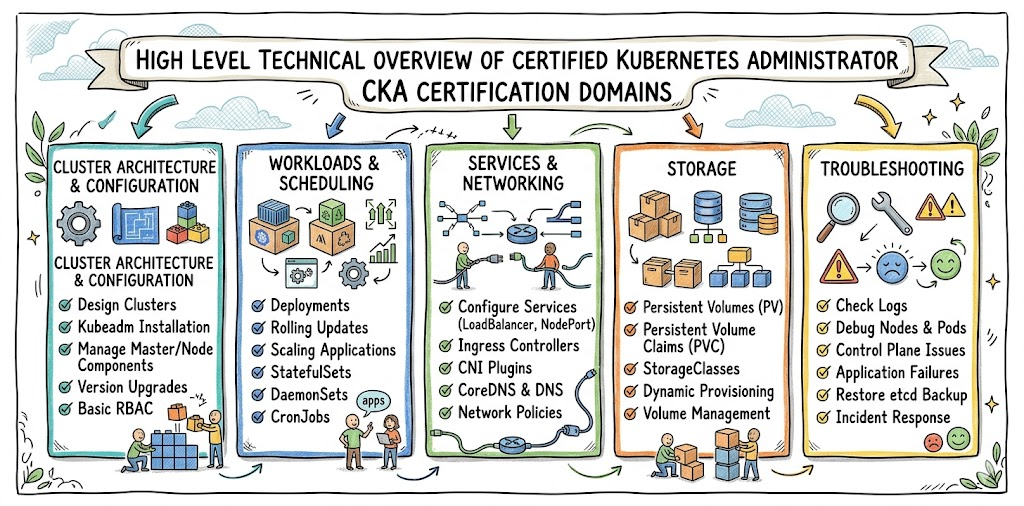
  • High Level Technical Overview Of Certified Kubernetes Administrator CKA Certification Domains

    Introduction

    Navigating the complexities of modern cloud infrastructure requires more than just basic scripting skills; it demands a deep understanding of orchestration. The Certified Kubernetes Administrator (CKA) stands as the definitive credential for engineers who want to prove their expertise in managing containerized environments. This guide breaks down everything you need to know about the certification and how it integrates with professional growth at DevOpsSchool.

    Engineers who master Kubernetes gain a significant advantage in the job market, as organizations continue to shift toward microservices. By following this roadmap, you will discover how the CKA validates your ability to build and maintain production-ready clusters. We focus on providing actionable insights that help technical professionals move from theoretical knowledge to hands-on mastery of the cloud-native ecosystem.

    What is the Certified Kubernetes Administrator (CKA)?

    The Certified Kubernetes Administrator (CKA) acts as a performance-based validation of an engineer’s ability to manage the Kubernetes API. It differs from standard exams because it requires candidates to solve complex infrastructure problems within a live command-line interface. The Cloud Native Computing Foundation (CNCF) created this program to ensure that administrators possess the practical skills needed to support enterprise-grade container deployments.

    Real-world production environments demand engineers who can do more than just follow a manual; they need experts who understand cluster internals. The CKA focuses on core competencies such as cluster installation, networking configuration, and persistent storage management. It aligns perfectly with modern engineering workflows where automation and reliability are the primary goals of the infrastructure team.

    Who Should Pursue Certified Kubernetes Administrator (CKA)?

    System administrators who are transitioning from legacy virtualization to container-based stacks find the CKA particularly beneficial. Site Reliability Engineers (SREs) also gain immense value, as the exam’s focus on cluster health and troubleshooting mirrors their daily responsibilities. Cloud architects use the CKA to deepen their technical foundation, ensuring the designs they propose are actually implementable.

    Junior engineers looking to enter the DevOps field should treat the CKA as a core milestone in their learning journey. Experienced professionals often pursue the certification to validate their years of hands-on experience and to stay current with the latest Kubernetes features. Engineering managers also benefit from understanding the technical depth required to maintain the platforms their teams build.

    Why Certified Kubernetes Administrator (CKA) is Valuable

    The CKA offers long-term career stability because Kubernetes has become the standard operating system for modern data centers. While specific cloud providers might gain or lose popularity, the underlying orchestration logic remains consistent across the industry. Earning this certification ensures that your skills remain relevant even as specific tools or cloud vendors evolve.

    Enterprise organizations prioritize CKA holders because the certification process guarantees a high level of technical competency. It reduces the risk for employers, knowing that a certified professional can manage critical infrastructure during high-pressure situations. The vendor-neutral nature of the CKA allows you to work across different cloud ecosystems, increasing your flexibility and market value.

    Certified Kubernetes Administrator (CKA) Certification Overview

    The CNCF delivers the program via the official training path at Certified Kubernetes Administrator (CKA) Certification and DevOpsSchool hosts the comprehensive learning modules. The program focuses entirely on hands-on labs, requiring candidates to demonstrate their skills in a monitored, live environment. This structure ensures that every certified administrator has a proven track record of solving real-world infrastructure problems.

    The certification follows a strict practical approach, where candidates interact with multiple Kubernetes clusters to complete various tasks. You must navigate the CLI to fix broken deployments, configure ingress controllers, and manage cluster backups. This rigorous assessment ensures that the CKA badge maintains its reputation as one of the most difficult and respected credentials in IT.

    Certified Kubernetes Administrator (CKA) Certification Tracks & Levels

    The Kubernetes certification ecosystem provides a clear path for progression, starting with foundational concepts and moving toward advanced security. The KCNA serves as the entry point, focusing on the terminology and architecture of the cloud-native landscape. The CKA and CKAD represent the associate-level certifications for administrators and developers who work with Kubernetes daily.

    Specialization tracks allow you to tailor your career according to your specific interests, such as platform security or developer experience. As you move through these levels, the complexity of the tasks increases, shifting from pod management to cluster-wide security hardening. This logical progression helps you build a specialized skillset that matches the needs of senior-level roles.

    Complete Certified Kubernetes Administrator (CKA) Certification Table

    TrackLevelWho it’s forPrerequisitesSkills CoveredRecommended Order
    Cloud NativeFoundationalAspiring EngineersBasic ComputingEcosystem, ConceptsFirst
    AdministrationAssociateAdmins/OpsLinux KnowledgeSetup, Ops, NetworkingSecond
    DevelopmentAssociateApp DevelopersCoding BasicsApp Deployment, ResourcesOptional
    SecurityProfessionalSecurity ProsActive CKAHardening, AuditingThird

    Detailed Guide for Each Certified Kubernetes Administrator (CKA) Certification

    Foundational Level

    Certified Kubernetes Administrator (CKA) – KCNA (Cloud Native Associate)

    What it is

    The KCNA validates that a professional understands the basic principles of container orchestration and the CNCF landscape. It serves as a conceptual foundation, ensuring you speak the same language as the rest of the cloud-native community.

    Who should take it

    This exam suits technical recruiters, project managers, and students who need to understand what Kubernetes is without necessarily managing a cluster. It provides a low-stakes entry point into the world of cloud-native computing.

    Skills you’ll gain

    • Understanding microservices architecture and container benefits.
    • Knowledge of various CNCF projects like Prometheus, Helm, and Envoy.
    • Familiarity with the basic components of a Kubernetes cluster.
    • Awareness of serverless, service mesh, and observability concepts.

    Real-world projects you should be able to do

    • Explain the benefits of moving from VMs to containers to stakeholders.
    • Navigate the CNCF landscape to identify tools for specific problems.
    • Communicate effectively with DevOps teams regarding infrastructure needs.

    Preparation plan

    • 7–14 days: Review the official CNCF glossary and read introductory blogs on containers.
    • 30 days: Take a foundational course that covers the history and architecture of Kubernetes.
    • 60 days: This level rarely requires two months of study if you have a technical background.

    Common mistakes

    • Ignoring the wider CNCF ecosystem to focus only on Kubernetes commands.
    • Underestimating the exam because it is multiple-choice rather than hands-on.

    Best next certification after this

    • Same-track option: CKA
    • Cross-track option: AWS Cloud Practitioner
    • Leadership option: DevOps Leader

    Associate Level

    Certified Kubernetes Administrator (CKA) – CKA (Administrator)

    What it is

    The CKA validates your ability to install, configure, and troubleshoot production-grade clusters. It is the primary credential for anyone responsible for maintaining the health and performance of a Kubernetes environment.

    Who should take it

    DevOps engineers and system administrators who handle the infrastructure layer of the stack should prioritize this. It requires significant experience with the Linux terminal and a strong understanding of networking protocols.

    Skills you’ll gain

    • Configuring highly available clusters using kubeadm.
    • Managing cluster networking, including CNI plugins and DNS.
    • Troubleshooting control plane components and worker node failures.
    • Implementing persistent storage solutions for stateful applications.

    Real-world projects you should be able to do

    • Perform a full cluster upgrade from one minor version to the next.
    • Restore a cluster from an etcd backup during a simulated disaster.
    • Configure RBAC rules to restrict access to sensitive cluster resources.

    Preparation plan

    • 7–14 days: Intensive practice with imperative commands and YAML editing.
    • 30 days: Working through comprehensive labs and mock exams multiple times.
    • 60 days: Starting from scratch with Linux and networking before diving into Kubernetes.

    Common mistakes

    • Failing to manage time effectively during the two-hour lab exam.
    • Depending too much on the documentation instead of memorizing core commands.

    Best next certification after this

    • Same-track option: CKS
    • Cross-track option: Terraform Associate
    • Leadership option: Platform Engineering Lead

    Professional/Specialty Level

    Certified Kubernetes Administrator (CKA) – CKS (Security Specialist)

    What it is

    The CKS validates that you can secure the entire container lifecycle, from build to runtime. It is an advanced certification that requires a deep understanding of security best practices and external auditing tools.

    Who should take it

    Security engineers and senior platform architects who have already earned their CKA. This is for professionals who must meet strict compliance standards in regulated industries like finance or healthcare.

    Skills you’ll gain

    • Hardening cluster components and the host operating system.
    • Securing the container supply chain and image repositories.
    • Implementing runtime security monitoring and threat detection.
    • Configuring admission controllers to enforce cluster-wide policies.

    Real-world projects you should be able to do

    • Setup Falco to detect suspicious activity inside a running container.
    • Configure gVisor to provide kernel-level isolation for untrusted workloads.
    • Audit the API server logs to identify potential unauthorized access attempts.

    Preparation plan

    • 7–14 days: Reviewing the documentation for third-party tools like Trivy and AppArmor.
    • 30 days: Deep dive into NetworkPolicies and restrictive RBAC configurations.
    • 60 days: Mastering the integration of multiple security tools into a single cluster.

    Common mistakes

    • Attempting the exam without a solid foundation in basic CKA administration.
    • Forgetting to study the non-Kubernetes security tools like Seccomp and Linux capabilities.

    Best next certification after this

    • Same-track option: Advanced Cloud Security Engineer
    • Cross-track option: CISSP
    • Leadership option: CISO

    Choose Your Learning Path

    DevOps Path

    The DevOps path focuses on bridging the gap between code and infrastructure through constant automation. In this journey, the CKA provides the underlying platform where your CI/CD pipelines will deploy applications. You will learn how to use Kubernetes to create a consistent, scalable, and self-healing environment for your software development lifecycle.

    DevSecOps Path

    DevSecOps professionals integrate security directly into the automation process rather than treating it as a final step. This path uses the CKA for foundational infrastructure knowledge and the CKS for advanced hardening techniques. You will focus on building “secure-by-default” clusters that can withstand modern cyber threats while maintaining developer velocity.

    SRE Path

    Site Reliability Engineering applies software principles to operational challenges to ensure high system availability. The CKA helps SREs understand how to manage cluster resources, handle failovers, and monitor system health effectively. This path emphasizes using Kubernetes to achieve reliability targets and manage complex distributed systems at scale.

    AIOps Path

    AIOps leverages artificial intelligence to automate the management of complex IT environments. By understanding the CKA fundamentals, you can implement AI-driven tools that predict cluster outages and automate capacity management. This path focuses on using data-driven insights to improve the operational efficiency of large-scale Kubernetes deployments.

    MLOps Path

    MLOps streamlines the deployment and management of machine learning models in production environments. In this path, the CKA is essential for managing the high-performance compute resources, like GPUs, that ML workloads require. You will learn how to orchestrate the complex data pipelines and model training jobs that run on Kubernetes.

    DataOps Path

    DataOps focuses on improving the quality and delivery rate of data analytics across the enterprise. Kubernetes provides the scalable infrastructure needed to run large-scale data processing engines like Spark. The CKA helps you manage the persistent storage and high-throughput networking requirements that data-intensive applications demand.

    FinOps Path

    FinOps brings financial accountability to the variable spending world of the cloud. This path uses Kubernetes concepts like resource limits and namespaces to track and optimize cloud costs. By understanding the CKA, you can ensure that your clusters are sized correctly to avoid overspending while maintaining performance.

    Role → Recommended Certified Kubernetes Administrator (CKA) Certifications

    RoleRecommended Certifications
    DevOps EngineerCKA, CKAD, Jenkins Engineer
    SRECKA, Prometheus Certified, CKS
    Platform EngineerCKA, Terraform Associate, CKS
    Cloud EngineerCKA, AWS Solution Architect
    Security EngineerCKA, CKS, Certified Ethical Hacker
    Data EngineerCKA, DataOps Professional
    FinOps PractitionerKCNA, FinOps Certified Practitioner
    Engineering ManagerKCNA, DevOps Leader

    Next Certifications to Take After Certified Kubernetes Administrator (CKA)

    Same Track Progression

    After you master the CKA, moving toward the CKS (Security Specialist) is the most logical step for an infrastructure professional. This allows you to specialize in the security layer of the stack, which is a high-demand skill in the enterprise. You can also explore specific tool certifications for Service Meshes like Istio or monitoring platforms like Prometheus.

    Cross-Track Expansion

    To broaden your expertise, consider earning certifications in Infrastructure as Code (IaC) or specific cloud providers. A Terraform Associate certification perfectly complements the CKA, as it allows you to automate the creation of the virtual machines that host your clusters. Similarly, an AWS or Azure Architect credential helps you understand the broader cloud ecosystem surrounding Kubernetes.

    Leadership & Management Track

    If you aim for leadership roles, look into certifications that focus on process, culture, and team management. The DevOps Leader (DOL) or ITIL certifications provide the frameworks needed to manage large technical organizations. Having the technical foundation of a CKA ensures that you remain a credible leader who understands the challenges your engineers face.

    Training & Certification Support Providers for Certified Kubernetes Administrator (CKA)

    • DevOpsSchool
      DevOpsSchool provides a robust and hands-on learning environment for professionals seeking to master Kubernetes administration. They offer a curriculum that focuses on practical labs, ensuring that students can handle real-world production scenarios. Their instructors bring decades of experience to the table, helping students navigate the complexities of the CKA exam with confidence. The platform is highly regarded for its comprehensive support and deep library of technical resources that aid in long-term career development.
    • Cotocus
      Cotocus specializes in high-end technical training for corporate teams and individual engineers who want to excel in the cloud-native space. Their CKA preparation programs emphasize architectural best practices and deep-dive troubleshooting sessions. They provide a simulated exam environment that helps candidates build the speed and accuracy required to pass the performance-based test. The training is tailored to help teams transition smoothly to containerized infrastructures while maintaining high operational standards.
    • Scmgalaxy
    • Scmgalaxy has built a massive community-driven platform that offers extensive tutorials and guides for Kubernetes enthusiasts. Their training programs focus heavily on the intersection of configuration management and container orchestration. They provide a unique perspective on the CKA by exploring how Kubernetes integrates with older legacy systems and modern CI/CD tools. This provider is an excellent choice for engineers who want a well-rounded understanding of the entire software delivery pipeline.
    • BestDevOps
      BestDevOps delivers intensive bootcamps and focused training modules designed for quick and effective certification preparation. Their approach strips away the fluff and focuses on the core competencies required to clear the CKA exam on the first attempt. They provide students with a variety of mock exams and practical exercises that mirror the actual testing environment. This provider is ideal for busy professionals who need a structured and efficient path to achieving their certification goals.
    • devsecopsschool.com
      devsecopsschool.com leads the industry in providing security-focused training for the modern DevOps professional. While they cover the CKA essentials, their primary focus remains on securing the Kubernetes ecosystem through advanced hardening techniques. They teach students how to build secure clusters from the ground up, preparing them for both the CKA and the subsequent CKS certification. This provider is perfect for those who want to specialize in the high-stakes world of cloud-native security.
    • sreschool.com
      sreschool.com focuses on the principles of site reliability and high availability within the Kubernetes landscape. Their training modules teach students how to manage massive clusters while maintaining strict service level objectives. They provide deep insights into observability, automated failover, and performance tuning for Kubernetes environments. Engineers who want to move into SRE roles will find their CKA-aligned curriculum to be an invaluable asset for their career progression.
    • aiopsschool.com
      aiopsschool.com offers specialized training that integrates artificial intelligence with traditional infrastructure operations. Their courses show students how to use AI models to monitor Kubernetes clusters and predict potential failures before they occur. By mastering CKA skills through this platform, engineers learn how to build smarter, more autonomous infrastructure systems. This provider is at the cutting edge of the industry, helping professionals prepare for the future of automated IT operations.
    • dataopsschool.com
      dataopsschool.com caters to the needs of data engineers and architects who are moving their workloads to Kubernetes. Their training focuses on the specific challenges of managing stateful applications, persistent storage, and high-performance data pipelines. They help students understand how to orchestrate complex data engines within the Kubernetes framework. This platform is the go-to resource for anyone looking to bridge the gap between data science and infrastructure administration.
    • finopsschool.com
      finopsschool.com provides the essential training needed to manage the financial aspects of cloud-native infrastructure. They teach engineers how to use Kubernetes resource management features to drive cost efficiency across the organization. Students learn how to translate technical cluster performance into business-friendly financial reports. This provider is vital for professionals who want to demonstrate their ability to manage both the technical and financial health of a cloud environment.

    Frequently Asked Questions

    1. Does the CKA exam use multiple-choice questions?

    No, the CKA is a performance-based exam where you solve technical tasks in a live Kubernetes cluster via a terminal.

    2. How much time do I have to complete the CKA exam?

    Candidates have exactly two hours to complete all the tasks assigned in the exam environment.

    3. What is the typical passing score for the certification?

    You generally need a score of 66% or higher to earn your Certified Kubernetes Administrator credential.

    4. Can I retake the exam if I fail my first attempt?

    Most exam vouchers purchased through the Linux Foundation include one free retake, providing a second chance to pass.

    5. Which operating system do I use during the exam?

    The exam environment typically runs on a modern Linux distribution like Ubuntu, requiring familiarity with the bash shell.

    6. Is the CKA certification recognized by major cloud providers?

    Yes, companies like AWS, Google, and Microsoft recognize the CKA as a standard for Kubernetes expertise.

    7. Do I need to be a programmer to pass the CKA?

    You do not need to be a software developer, but you must be able to read and edit YAML files and write basic shell commands.

    8. How long does it take for the results to arrive?

    The results are usually sent via email within 24 to 36 hours after you finish the exam session.

    9. Can I use a second monitor during the test?

    The proctoring rules usually restrict you to a single monitor to ensure the integrity of the testing environment.

    10. What version of Kubernetes should I study?

    The exam usually tracks the most recent stable versions, so you should check the CNCF website for the specific version currently being tested.

    11. Is the CKA harder than the CKAD?

    Most professionals find the CKA harder because it covers cluster-wide administration and troubleshooting, whereas the CKAD focuses only on application deployment.

    12. Does the certification expire?

    Yes, the CKA is valid for three years, and you must renew it by retaking the exam or passing the CKS.

    FAQs on Certified Kubernetes Administrator (CKA)

    1. Which area should I prioritize during my study sessions?

    Troubleshooting and cluster maintenance typically carry the most weight and require the most practical practice.

    2. Is it possible to use the documentation during the test?

    Yes, you may access the official Kubernetes documentation in one browser tab to look up syntax and examples.

    3. What happens if my internet disconnects during the exam?

    The proctoring software usually allows you to reconnect, but you should have a stable connection to avoid losing valuable time.

    4. How do I practice for the performance-based format?

    Setting up your own clusters using kubeadm on local virtual machines is the most effective way to build the necessary skills.

    5. Are there any specific terminal tools I should master?

    Mastering Vim or Nano for file editing and becoming fast with kubectl commands will significantly improve your chances of passing.

    6. Does the exam include questions on Helm or Service Meshes?

    The CKA focuses primarily on core Kubernetes components, though basic knowledge of Helm is helpful for certain tasks.

    7. Can I take the exam from my home?

    Yes, the CKA is a remotely proctored exam that you can take from any quiet room with a stable internet connection.

    8. Is the CKA worth the effort for a Windows administrator?

    Absolutely, as most modern enterprise applications run on Linux containers, the CKA is the best way to transition into the modern cloud world.

    Final Thoughts: Is Certified Kubernetes Administrator (CKA) Worth It?

    Deciding to invest your time in a certification often comes down to the practical utility of the skills you acquire. The CKA provides more than just a certificate; it gives you the confidence to manage complex, mission-critical systems that power the modern world. It forces you to look under the hood of the most important infrastructure technology of the decade.

    Professionals who earn the CKA often find that they approach infrastructure problems with a more disciplined and structured mindset. The difficulty of the exam is exactly what makes the credential so valuable in the eyes of peers and employers. It separates the hobbyists from the true experts who can maintain system stability under pressure.

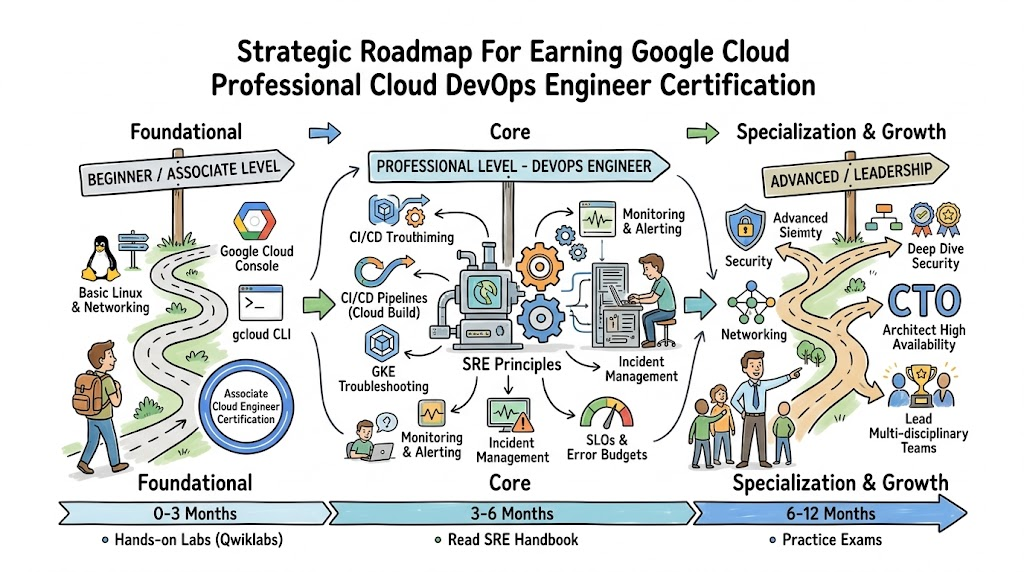
  • Strategic Roadmap For Earning Google Cloud Professional Cloud DevOps Engineer Certification

    Introduction

    Modern technology landscapes demand that engineers do more than just write code or manage servers. Companies now seek professionals who can integrate these two worlds using high-level automation and reliability strategies. This guide focuses on the Google Cloud Professional Cloud DevOps Engineer certification to help you bridge that gap. By following this roadmap, you will learn how to master Site Reliability Engineering (SRE) principles within the Google Cloud ecosystem.

    A solid training foundation remains critical for your success in this competitive field. DevOpsSchool provides the necessary tools and guidance to help you navigate these complex cloud environments effectively. This resource explains everything from basic prerequisites to advanced career paths in AIOps and FinOps. You will gain the clarity needed to make informed decisions about your professional growth and technical specialization.

    What is the Google Cloud Professional Cloud DevOps Engineer?

    The Google Cloud Professional Cloud DevOps Engineer certification sets a high standard for individuals managing cloud-native services. It moves beyond simple tool usage and requires a deep understanding of how to build scalable and reliable systems. Google created this program to validate an engineer’s ability to balance the speed of delivery with the stability of the production environment. This certification emphasizes practical skills over academic theory, making it highly relevant for today’s fast-moving tech teams.

    Engineers who earn this credential prove they can handle the rigors of modern enterprise environments. The curriculum focuses on the intersection of culture, process, and technology, specifically using Google Cloud Platform (GCP) tools. It ensures that you can implement continuous integration, continuous delivery, and comprehensive monitoring across distributed systems. Organizations rely on these professionals to maintain high uptime while constantly shipping new features to users.

    Who Should Pursue Google Cloud Professional Cloud DevOps Engineer?

    System administrators, software developers, and existing DevOps practitioners find the most value in this certification path. It offers a clear transition for those moving from traditional IT roles into modern platform engineering or SRE positions. Even experienced cloud architects use this program to sharpen their operational skills and master Google-specific automation tools. It serves as a bridge for anyone responsible for the lifecycle of a cloud-based application.

    Technical leaders and engineering managers also benefit from understanding the core concepts of this certification. It allows them to lead their teams with a better grasp of the technical constraints and possibilities within GCP. Whether you work in a startup in India or a global enterprise, this certification carries immense weight. It provides a universal language for technical excellence that recruiters and peers recognize across the industry.

    Why Google Cloud Professional Cloud DevOps Engineer is Valuable

    The shift toward microservices and containerized applications makes this certification more relevant than ever. Google Cloud continues to win market share due to its leadership in data, machine learning, and Kubernetes management. Holding this certification places you at the center of this growth, ensuring your skills remain in high demand. It provides long-term career security because it teaches foundational engineering principles that outlast any specific software version.

    Professionals who invest in this path see a strong return on their time and effort. As enterprises prioritize cost optimization and system reliability, they need experts who can manage complex cloud budgets and performance metrics. This certification equips you with those exact skills, allowing you to drive business value through technical efficiency. It keeps you competitive in a landscape where automation and cloud proficiency define the elite tier of engineering talent.

    Google Cloud Professional Cloud DevOps Engineer Certification Overview

    Candidates access the official training program through the Google Cloud Professional Cloud DevOps Engineer modules at devopsschool.com. The program uses a practical, hands-on approach to teach you how to manage the full service lifecycle. You will encounter scenario-based assessments that mirror the actual problems engineers face in production environments. This structure ensures that your learning translates directly into workplace performance.

    The certification path covers every critical aspect of a modern cloud operation, from initial setup to ongoing maintenance. You will explore infrastructure as code, service monitoring, and incident response frameworks. Because the program focuses on real-world application, it builds the confidence you need to take ownership of mission-critical systems. It provides a comprehensive framework for anyone serious about mastering the Google Cloud ecosystem.

    Google Cloud Professional Cloud DevOps Engineer Certification Tracks & Levels

    The learning journey begins with foundational levels that introduce the basics of cloud computing and Google Cloud services. These initial steps ensure that every candidate understands identity management, networking, and resource hierarchies. As you progress to the associate and professional levels, the training becomes more specialized and technical. This tiered approach allows you to build a strong base before tackling complex architectural challenges.

    Advanced levels allow you to branch into niche areas like security engineering or data operations. Each track aligns with specific career goals, helping you move from a generalist role to a specialized expert. By following these levels, you can systematically increase your technical depth and professional marketability. This progression mirrors the natural growth of a senior engineer, moving from basic tasks to high-level strategic oversight.

    Complete Google Cloud Professional Cloud DevOps Engineer Certification Table

    TrackLevelWho it’s forPrerequisitesSkills CoveredRecommended Order
    Cloud FoundationsFoundationBeginners / SalesNoneGCP Basics, Cloud Value1
    Cloud OperationsAssociateJunior Admins6 Months Cloud ExpCLI, GKE, IAM Basics2
    DevOps & SREProfessionalSenior Engineers3 Years IT ExpCI/CD, SRE, Monitoring3
    Cloud ArchitectProfessionalTech Leads3 Years Design ExpArchitecture, Migration4
    Cloud SecurityProfessionalSecurity Pros3 Years Sec ExpEncryption, Compliance5

    Detailed Guide for Each Google Cloud Professional Cloud DevOps Engineer Certification

    Google Cloud Professional Cloud DevOps Engineer – Associate Level

    What it is

    This certification confirms your ability to deploy and maintain cloud applications. It focuses on the day-to-day tasks required to keep a GCP environment running smoothly and securely.

    Who should take it

    Junior engineers or developers who want to prove their hands-on competency in Google Cloud should take this. It serves as an excellent starting point for those looking to specialize in cloud operations.

    Skills you’ll gain

    • Deploying applications on App Engine and GKE.
    • Managing cloud storage and database instances.
    • Configuring network firewalls and VPCs.
    • Using the gcloud CLI for resource management.

    Real-world projects you should be able to do

    • Launching a highly available web application on Compute Engine.
    • Setting up automated snapshots for persistent disks.
    • Building a basic monitoring dashboard for service health.

    Preparation plan

    • 7-14 Days: Explore the GCP console and complete the basic Qwiklabs.
    • 30 Days: Practice VPC configuration and IAM role assignments extensively.
    • 60 Days: Build and tear down a full three-tier application using the CLI.

    Common mistakes

    • Ignoring the differences between various storage classes.
    • Forgetting to set up proper billing alerts during practice.

    Best next certification after this

    • Same-track option: Professional Cloud DevOps Engineer.
    • Cross-track option: Professional Data Engineer.
    • Leadership option: Technical Team Lead Foundational.

    Google Cloud Professional Cloud DevOps Engineer – Professional Level

    What it is

    This level validates your expertise in automating delivery pipelines and ensuring service reliability. It emphasizes the application of SRE principles to manage large-scale cloud systems effectively.

    Who should take it

    Experienced DevOps engineers and SREs who want to lead cloud transformation projects should pursue this. You need a solid understanding of both software development and systems operations.

    Skills you’ll gain

    • Designing and implementing CI/CD pipelines.
    • Defining and tracking SLIs, SLOs, and error budgets.
    • Automating infrastructure with Terraform and Deployment Manager.
    • Performing root cause analysis and blameless post-mortems.

    Real-world projects you should be able to do

    • Creating a canary deployment workflow for a global service.
    • Designing a multi-region disaster recovery plan.
    • Automating service recovery using Cloud Run and Cloud Functions.

    Preparation plan

    • 7-14 Days: Study the Google SRE handbook and understand error budgets.
    • 30 Days: Build complex pipelines using Cloud Build and Artifact Registry.
    • 60 Days: Practice troubleshooting scenarios using Cloud Logging and Monitoring.

    Common mistakes

    • Failing to understand the cultural aspects of SRE.
    • Over-complicating the monitoring setup for simple services.

    Best next certification after this

    • Same-track option: Professional Cloud Security Engineer.
    • Cross-track option: Professional Cloud Network Engineer.
    • Leadership option: Certified Engineering Manager.

    Choose Your Learning Path

    DevOps Path

    This path focuses on speed and automation throughout the development lifecycle. You will learn to use tools like Jenkins and Cloud Build to automate code integration and deployment. The goal involves reducing the time between writing code and seeing it run in production.

    DevSecOps Path

    The DevSecOps path integrates security checks directly into the automation pipeline. You will learn to scan containers for vulnerabilities and manage cloud identities strictly. This ensures that every deployment meets the organization’s security standards without slowing down the team.

    SRE Path

    Engineers on the SRE path focus on making systems as reliable as possible. You will master the art of setting error budgets and managing incidents with minimal manual intervention. This path treats operations as a software engineering task rather than a manual chore.

    AIOps Path

    This path uses artificial intelligence to improve how you manage cloud operations. You will learn to apply machine learning models to telemetry data to find patterns and predict failures. It helps teams manage the massive scale of modern cloud environments more intelligently.

    MLOps Path

    The MLOps path bridges the gap between data science and production engineering. You will learn how to deploy machine learning models and monitor their performance over time. This ensures that AI applications remain accurate and scalable in a live environment.

    DataOps Path

    DataOps focuses on the reliable delivery of data for analytics and applications. You will learn to build automated pipelines that move and transform data while maintaining high quality. This path is essential for organizations that rely on real-time data to make decisions.

    FinOps Path

    The FinOps path helps you manage and optimize the cost of cloud services. You will learn to align cloud spending with business goals and identify areas for cost savings. This path makes you a valuable link between the engineering and finance departments.

    Role → Recommended Google Cloud Professional Cloud DevOps Engineer Certifications

    RoleRecommended Certifications
    DevOps EngineerAssociate Cloud Engineer, Professional Cloud DevOps Engineer
    SREProfessional Cloud DevOps Engineer, Professional Cloud Architect
    Platform EngineerProfessional Cloud DevOps Engineer, Professional Security Engineer
    Cloud EngineerAssociate Cloud Engineer, Professional Cloud Network Engineer
    Security EngineerProfessional Security Engineer, Associate Cloud Engineer
    Data EngineerProfessional Data Engineer, Professional Cloud DevOps Engineer
    FinOps PractitionerCloud Digital Leader, Professional Cloud Architect
    Engineering ManagerCloud Digital Leader, Professional Cloud DevOps Engineer

    Next Certifications to Take After Google Cloud Professional Cloud DevOps Engineer

    Same Track Progression

    Deepening your current expertise involves looking at specialized infrastructure roles. You might pursue the Professional Cloud Network Engineer certification to manage complex global connectivity. Alternatively, the Professional Cloud Security Engineer path allows you to focus exclusively on protecting cloud workloads and data from external threats.

    Cross-Track Expansion

    Broadening your skills into other cloud domains makes you a more versatile professional. Many engineers move into the Professional Data Engineer track to better support data-driven applications. You could also pursue the Professional Cloud Architect certification to gain a higher-level view of how business requirements translate into technical designs.

    Leadership & Management Track

    If you want to lead people and strategy, the Cloud Digital Leader certification provides an excellent overview of cloud business value. Moving into management requires you to understand how technology impacts the bottom line and how to guide teams through change. This track prepares you for roles like Engineering Manager or Director of Cloud Operations.

    Training & Certification Support Providers for Google Cloud Professional Cloud DevOps Engineer

    • DevOpsSchool
      DevOpsSchool offers a comprehensive and hands-on approach to mastering Google Cloud technologies. They focus on providing real-world scenarios and laboratory exercises that prepare students for actual production challenges. Their instructors bring years of industry experience to the classroom, ensuring that the curriculum remains relevant and practical. Professionals choose this provider to gain the technical depth needed for high-level DevOps and SRE roles.
    • Cotocus
      Cotocus specializes in enterprise cloud training and consulting services for large organizations. They provide customized learning paths that help teams transition to cloud-native architectures using Google Cloud. Their sessions often include deep dives into Kubernetes and infrastructure as code, making them a preferred choice for companies undergoing digital transformation. They bridge the gap between academic learning and corporate technical requirements effectively.
    • Scmgalaxy
      Scmgalaxy serves as a major hub for community-driven learning and technical resources. They offer extensive guides and tutorials on configuration management and continuous integration tools. Their platform helps engineers stay updated on the latest open-source integrations available for the Google Cloud ecosystem. It is an excellent resource for those who value community support and collaborative problem-solving.
    • BestDevOps
      BestDevOps provides focused bootcamps designed to accelerate your cloud career. They prioritize high-velocity learning and practical skill acquisition to help you pass certifications quickly. Their modules cover everything from basic cloud setup to advanced service monitoring and automation. Many students appreciate their direct and efficient teaching style, which targets the most critical exam topics.
    • devsecopsschool.com
      devsecopsschool.com focuses exclusively on the critical intersection of security and modern DevOps practices. They teach engineers how to build automated security gates and manage cloud identities with precision. Their training is essential for anyone looking to specialize in protecting cloud-native applications from modern cyber threats. They ensure that security remains a central part of the delivery process.
    • sreschool.com
      sreschool.com provides a dedicated curriculum for aspiring Site Reliability Engineers. They offer deep dives into Google’s SRE philosophy and the practical application of reliability metrics. Students learn how to manage error budgets, perform blameless post-mortems, and build resilient systems on GCP. This provider is ideal for those who want to master the art of high-availability operations.
    • aiopsschool.com
      aiopsschool.com explores how artificial intelligence can transform traditional IT operations. They provide training on using machine learning to monitor systems and predict potential downtime. This knowledge helps engineers manage complex microservices environments with greater ease and accuracy. It is a forward-looking choice for those who want to stay at the cutting edge of cloud technology.
    • dataopsschool.com
      dataopsschool.com focuses on the operational challenges of managing large-scale data pipelines. They teach you how to apply DevOps principles to ensure data quality and delivery speed. Their courses cover essential GCP data tools like BigQuery and Dataflow from an operational perspective. This training is vital for organizations that depend on reliable and timely data for their success.
    • finopsschool.com
      finopsschool.com addresses the growing importance of cloud financial management. They provide the framework needed to track and optimize cloud spending across a large organization. Students learn how to foster a culture of cost-accountability within their engineering teams. This provider helps you prove the business value of your cloud investments to senior stakeholders.

    Frequently Asked Questions

    1. Why should I choose the Google Cloud DevOps track?
      Google Cloud leads the industry in Kubernetes and SRE practices, making this track highly valuable for modern engineers.
    2. How long does it take to get certified?
      Most engineers require two to three months of consistent study and hands-on practice to pass the professional exam.
    3. What is the most difficult part of the exam?
      The scenario-based questions about SRE principles and incident management often prove the most challenging for candidates.
    4. Do I need to know how to code?
      You should be comfortable with basic scripting and YAML, as you will manage infrastructure and pipelines through code.
    5. Is the Associate Cloud Engineer exam a prerequisite?
    6. While not mandatory, Google highly recommends passing the associate exam before attempting the professional level.
    7. How does this certification help my salary?
      Cloud DevOps engineers consistently rank among the highest-paid professionals in the IT industry globally.
    8. Does the certification expire?
      Yes, you must recertify every two years to ensure your skills stay current with the latest GCP updates.
    9. Can I take the exam online?
      Google offers both remote proctored exams and in-person testing at authorized centers around the world.
    10. What tools should I focus on for the exam?
      Prioritize learning GKE, Cloud Build, Cloud Monitoring, Cloud Logging, and Terraform for infrastructure automation.
    11. How many questions are on the professional exam?
      The exam typically contains 50 to 60 multiple-choice and multiple-select questions.
    12. Is the SRE book required reading?
      While not required, reading Google’s SRE handbook will give you a significant advantage during the exam.
    13. Can this certification help me work abroad?
      Yes, Google Cloud certifications have global recognition, making them a great asset for international career moves.

    FAQs on Google Cloud Professional Cloud DevOps Engineer

    1. How much of the exam focuses specifically on SRE?
      Approximately 20 to 30 percent of the exam questions directly test your understanding of SRE concepts like error budgets and SLOs.
    2. Do I need to be an expert in Kubernetes?
      You must have a strong working knowledge of GKE, including how to deploy, scale, and monitor containerized applications.
    3. What is the best way to practice for the exam?
      Use hands-on labs and build your own projects in a GCP free-tier account to gain practical experience.
    4. Does the exam cover multi-cloud deployments?
      The focus remains on Google Cloud tools, but the principles of DevOps and SRE apply to any cloud environment.
    5. Are there any lab-based questions in the exam?
      The current format uses scenario-based multiple-choice questions rather than live terminal tasks.
    6. How does this certification address cost management?
      The exam tests your ability to monitor resource usage and choose cost-effective services without compromising reliability.
    7. What role does IAM play in the DevOps exam?
      You must understand how to apply the principle of least privilege across all your automated pipelines and cloud resources.
    8. Is Jenkins covered in the Google Cloud DevOps exam?
      While Google promotes its own tools like Cloud Build, the exam may ask about integrating third-party CI/CD tools.

    Final Thoughts: Is Google Cloud Professional Cloud DevOps Engineer Worth It?

    Investing in this certification represents a serious commitment to your professional growth. It separates those who merely use cloud tools from those who understand how to build and maintain world-class systems. As a veteran in this field, I have seen many certifications come and go, but the principles taught in this program remain timeless. You will gain a competitive edge that helps you command higher salaries and work on more interesting technical challenges.

    The demand for skilled DevOps engineers who truly understand reliability and automation shows no signs of slowing down. Companies need your expertise to navigate the complexities of modern cloud architectures. By mastering this curriculum, you are not just passing a test; you are building a foundation for the next decade of your career. Take the first step today, and you will see the impact on your career trajectory almost immediately.

  • Achieving Professional Excellence With Microsoft Azure Security Technologies (AZ-500) Certification Path

    Introduction

    Cybersecurity remains the highest priority for organizations navigating the complexities of the modern cloud. Professionals who master Microsoft Azure Security Technologies (AZ-500) possess the technical skills required to protect digital assets against sophisticated threats. This guide assists engineers and managers in choosing the right path toward technical excellence in cloud defense. By partnering with DevOpsSchool, you gain access to structured mentorship and hands-on labs that reflect real-world production environments. This document explains the strategic value of security certification and provides a clear roadmap for career advancement within the global technology sector.

    What is the Microsoft Azure Security Technologies (AZ-500)?

    Microsoft Azure Security Technologies (AZ-500) serves as the primary technical validation for cloud security implementation. This program moves beyond basic cloud administration and focuses on the actual construction of secure environments. It requires engineers to demonstrate mastery in managing identity, protecting networks, and securing data across the Azure ecosystem.

    The curriculum forces you to solve practical problems that arise in modern enterprise workflows. Instead of memorizing definitions, you learn how to automate threat responses and configure complex firewalls. Organizations rely on this certification to identify practitioners who can maintain a zero-trust architecture in live production settings. Achieving this status proves that you possess the technical depth to safeguard sensitive corporate information.

    Who Should Pursue Microsoft Azure Security Technologies (AZ-500)?

    Cloud administrators who wish to specialize in defensive strategies find this path most rewarding. Site Reliability Engineers (SREs) benefit by learning to balance system availability with rigorous security protocols. Even experienced developers who manage cloud-native applications use this knowledge to implement “security as code” within their delivery pipelines.

    Engineering managers in India and major global tech hubs prioritize this credential when hiring for senior infrastructure roles. Beginners with a firm grasp of cloud networking can use this as a direct route to becoming a specialized security analyst. Senior IT professionals also pursue this validation to modernize their skills and lead large-scale digital transformation projects. Every professional responsible for data privacy or platform integrity should consider this certification essential.

    Why Microsoft Azure Security Technologies (AZ-500) is Valuable

    Enterprise cloud adoption continues to accelerate, creating an urgent demand for verified security experts. Microsoft Azure Security Technologies (AZ-500) provides professional longevity because it teaches fundamental security principles that apply regardless of minor tool updates. You stay relevant in a competitive market by proving you can defend the identity perimeter and automate resource hardening.

    Investing time in this program yields a high return by qualifying you for specialized roles such as Cloud Security Engineer or DevSecOps Lead. Companies continue to increase security budgets, ensuring that skilled practitioners enjoy significant career stability and high salary potential. Mastering these technologies moves you from a generalist role into a strategic position where you guide critical organizational safety measures. You gain the confidence to lead security audits and influence long-term architectural decisions.

    Microsoft Azure Security Technologies (AZ-500) Certification Overview

    This associate-level certification requires you to demonstrate hands-on proficiency in the Azure portal and command-line interfaces. The assessment measures your ability to handle identity and access, platform protection, security operations, and data safety.

    Microsoft designs the exam to simulate the daily challenges that security engineers face in the field. You must successfully navigate case studies and technical scenarios to prove your implementation skills. The structure of the program ensures that you gain a balanced understanding of all four security pillars. Completing this certification indicates that you can manage the entire security lifecycle for a global enterprise cloud environment.

    Microsoft Azure Security Technologies (AZ-500) Certification Tracks & Levels

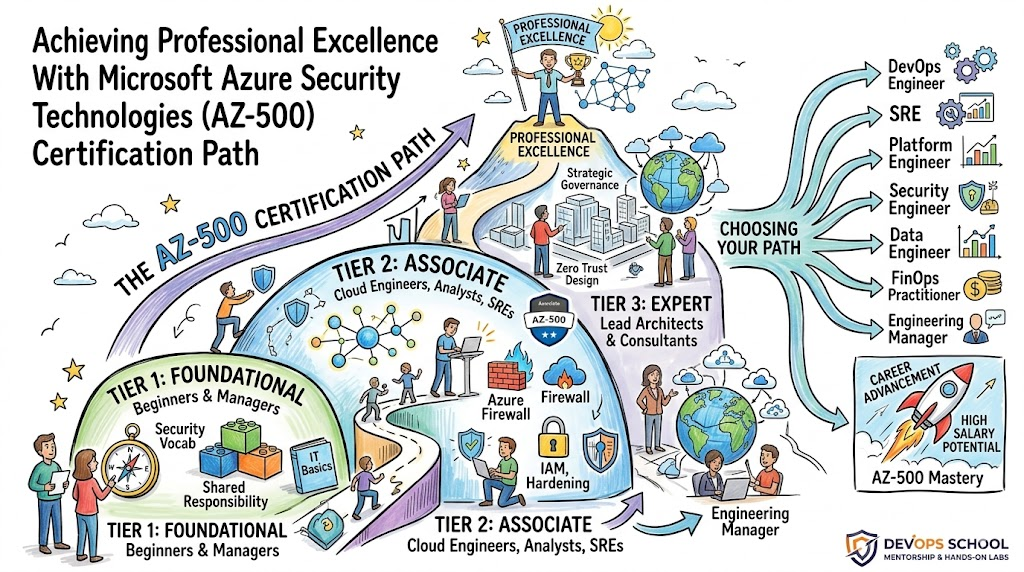
    The Azure security ecosystem guides professionals through three distinct tiers of technical mastery.

    1. Foundational Tier: This level establishes the basic vocabulary of security and compliance. It helps new entrants understand the shared responsibility model and fundamental identity concepts.
    2. Associate Tier (AZ-500): This is the core implementation level where you build and manage defensive systems. It serves as the primary technical benchmark for the industry.
    3. Advanced Tier: This tier targets lead architects who design holistic security strategies for hybrid environments. It focuses on strategic governance and complex risk management across the entire enterprise stack.

    Complete Microsoft Azure Security Technologies (AZ-500) Certification Table

    TrackLevelWho it’s forPrerequisitesSkills CoveredRecommended Order
    Cloud DefenseFoundationalBeginners/ManagersGeneral IT BasicsSecurity Vocab1
    ImplementationAssociateEngineers/SREsAzure Admin SkillsHardening, IAM2
    ArchitectureExpertLead ArchitectsAssociate CertZero Trust Design3
    Identity OpsSpecialistIAM EngineersEntra ID BasicsGovernance, PIMOptional
    ComplianceSpecialistAuditors/GMLsBasic GovernancePolicy, AuditOptional

    Detailed Guide for Each Microsoft Azure Security Technologies (AZ-500) Certification

    Microsoft Azure Security Technologies (AZ-500) – Foundational Level

    What it is

    This certification validates a baseline understanding of security, identity, and compliance. It confirms that you understand the terminology and the shared responsibility between the cloud provider and the customer.

    Who should take it

    Technical managers and students new to the cloud should start here. It provides a conceptual gateway for those who do not yet perform daily technical configurations.

    Skills you’ll gain

    • Understanding authentication and authorization principles.
    • Describing identity services like Microsoft Entra ID.
    • Defining data privacy and sovereign requirements.
    • Identifying core defensive tools within the Azure platform.

    Real-world projects you should be able to do

    • Perform a basic security audit on a testing environment.
    • Explain the benefits of cloud-native security to business stakeholders.

    Preparation plan

    • 7–14 days: Review official terminology and shared responsibility diagrams.
    • 30 days: Complete a foundational video course and practice quizzes.
    • 60 days: Most professionals finish this level in under a month.

    Common mistakes

    • Ignoring the legal definitions of compliance terms.
    • Skipping the study of identity basics.

    Best next certification after this

    • Same-track option: AZ-500 Associate
    • Cross-track option: AZ-900 Fundamentals
    • Leadership option: Cloud Business Management

    Microsoft Azure Security Technologies (AZ-500) – Associate Level

    What it is

    The core AZ-500 certification proves your technical ability to implement and monitor security. It serves as the standard for hands-on security engineers in the modern workplace.

    Who should take it

    Cloud engineers, security analysts, and SREs who manage infrastructure daily must pursue this. It validates that you can handle production-grade hardening tasks.

    Skills you’ll gain

    • Configuring Conditional Access and identity governance.
    • Implementing Azure Firewall and Network Security Groups.
    • Managing Key Vault, encryption, and data protection.
    • Setting up monitoring with Microsoft Sentinel and Defender.

    Real-world projects you should be able to do

    • Deploy a secure multi-tier virtual network with strict egress control.
    • Automate secret rotation using Azure Functions and Key Vault.

    Preparation plan

    • 7–14 days: Intensive lab review for current Azure administrators.
    • 30 days: Daily labs focusing on identity and networking domains.
    • 60 days: Comprehensive learning path for generalist IT professionals.

    Common mistakes

    • Focusing only on the portal and ignoring CLI commands.
    • Underestimating the complexity of networking rules.

    Best next certification after this

    • Same-track option: SC-100 Expert Architect
    • Cross-track option: AZ-400 DevOps Expert
    • Leadership option: Information Security Manager

    Microsoft Azure Security Technologies (AZ-500) – Expert Level

    What it is

    This tier targets senior professionals who design enterprise-wide security solutions. It shifts the focus from configuration to high-level strategic architecture.

    Who should take it

    Lead architects and senior security consultants who define organizational safety standards should take this. You must demonstrate a strategic vision for protecting hybrid clouds.

    Skills you’ll gain

    • Designing Zero Trust architectures for global firms.
    • Creating governance frameworks with Azure Policy.
    • Developing incident response plans for major breaches.
    • Integrating security across multi-cloud environments.

    Real-world projects you should be able to do

    • Architect a comprehensive compliance strategy for a regulated industry.
    • Design a disaster recovery plan that prioritizes data security.

    Preparation plan

    • 7–14 days: High-level review of architectural case studies.
    • 30 days: Focus on governance strategy and risk assessment.
    • 60 days: Deep research into multi-cloud and cross-platform security.

    Common mistakes

    • Focusing too much on individual service buttons rather than strategy.
    • Ignoring the cost implications of security architecture.

    Best next certification after this

    • Same-track option: Vendor-neutral certs like CISSP.
    • Cross-track option: AZ-305 Solutions Architect.
    • Leadership option: CISO Professional Path.

    Choose Your Learning Path

    DevOps Path

    Engineers on the DevOps track use the Microsoft Azure Security Technologies (AZ-500) curriculum to integrate safety into the build process. You learn to manage secrets without exposing them and enforce security policies using automation. This path ensures that security moves at the same speed as your development team, preventing organizational bottlenecks.

    DevSecOps Path

    This specialized path creates practitioners who live at the intersection of security and delivery. By mastering AZ-500, you gain the skills to automate vulnerability scanning and real-time threat detection. You focus on creating a “Security First” culture where automated audits provide continuous protection for all production workloads.

    SRE Path

    Site Reliability Engineers leverage security knowledge to prevent outages caused by unauthorized access or misconfigurations. You focus on building resilient perimeters and implementing robust identity controls to protect system uptime. This path ensures that security measures strengthen system availability rather than compromising overall performance.

    AIOps Path

    Professionals in AIOps apply Microsoft Azure Security Technologies (AZ-500) to protect the infrastructure hosting intelligent automation. You learn to secure the data feeds and processing units that drive AI-driven operational insights. This path focuses on maintaining the confidentiality and integrity of your automated operations center assets.

    MLOps Path

    This path focuses on securing the entire machine learning lifecycle, from training to model deployment. You learn to manage access to sensitive datasets and protect the API endpoints that serve your models. Securing the machine learning pipeline prevents data poisoning and protects valuable corporate intellectual property.

    DataOps Path

    Data practitioners utilize AZ-500 to master the art of data sovereignty and high-level encryption. You learn to secure storage accounts, SQL databases, and data lakes using advanced identity and key management. This path ensures that your organization meets global data privacy standards while maintaining high-speed delivery.

    FinOps Path

    FinOps practitioners learn to balance high-level security with cost-effective configurations in the Azure cloud. You will understand how security features like the Azure Firewall impact the budget and learn to optimize them. This path allows you to provide robust protection without causing unnecessary financial strain on the business.


    Role → Recommended Microsoft Azure Security Technologies (AZ-500) Certifications

    RoleRecommended Certifications
    DevOps EngineerAZ-500 + AZ-400
    SREAZ-500 + AZ-700
    Platform EngineerAZ-500 + AZ-104
    Cloud EngineerAZ-500 + AZ-104
    Security EngineerSC-900 + AZ-500 + SC-200
    Data EngineerAZ-500 + DP-203
    FinOps PractitionerAZ-500 + AZ-900
    Engineering ManagerSC-900 + AZ-500

    Next Certifications to Take After Microsoft Azure Security Technologies (AZ-500)

    Same Track Progression

    Once you master implementation at the associate level, move into the expert architecture domain. Focus on certifications that teach you how to design a unified cybersecurity vision across multiple platforms. This transition moves you from a doer to a designer, allowing you to lead major security transformations for global firms.

    Cross-Track Expansion

    Expand your professional reach by pursuing the Azure DevOps Engineer track after you secure your AZ-500 badge. This combination makes you a high-value DevSecOps expert who can both build and protect complex automated systems. Most top-tier engineering organizations seek this unique blend of skills when hiring for senior leadership roles.

    Leadership & Management Track

    For those aiming for technical leadership, the focus shifts toward risk management and corporate governance. Pursue certifications that emphasize the business impact of security decisions and how to lead technical teams. This path leads to roles like Security Director or CISO, where you manage both technology and human capital.


    Training & Certification Support Providers for Microsoft Azure Security Technologies (AZ-500)

    • DevOpsSchool
      The curriculum at DevOpsSchool provides an intensive, lab-focused environment that helps engineers master the Microsoft Azure Security Technologies (AZ-500) certification. Their expert mentors guide students through real-world scenarios, ensuring that every learner understands how to harden production infrastructures effectively. They prioritize hands-on mastery over simple exam preparation, giving you the skills to excel in global engineering roles. This institution offers extensive support, including updated course materials and project-based learning.
    • Cotocus
      Cotocus delivers specialized cloud security training designed for the modern IT professional. They offer interactive sessions and deep-dive workshops that clarify the complexities of identity management and network isolation within the Azure ecosystem. Their training methodology focuses on practical outcomes, helping you bridge the gap between theoretical knowledge and professional implementation. Students benefit from personalized feedback and a curriculum that reflects the latest industry trends. This provider serves as a premier choice for career-oriented learners.
    • Scmgalaxy
      As a comprehensive community hub, Scmgalaxy provides a wealth of technical resources for those pursuing Microsoft Azure Security Technologies (AZ-500). They offer detailed technical articles, practice assessments, and community forums where engineers can discuss complex configuration challenges. Their platform supports self-driven learners who want to supplement their training with practical insights and peer support. You gain access to a massive library of tutorials that simplify high-level security concepts into digestible information.
    • BestDevOps
      The training program at BestDevOps focuses on delivering high-quality education for aspiring cloud security engineers. They offer structured courses that cover all domains of the AZ-500 exam with a focus on automation and shift-left security principles. Their instructors bring decades of industry experience, providing valuable insights into how global enterprises manage risk. You will master the use of native Azure tools to build resilient and compliant cloud-native environments.
    • devsecopsschool.com
      devsecopsschool.com specializes in the intersection of security and software delivery, making them an ideal partner for the AZ-500 track. They teach students how to integrate defensive measures directly into CI/CD pipelines using Azure-native tools. Their curriculum emphasizes modern security operations and threat hunting, providing the skills needed for high-demand DevSecOps roles. You learn to automate vulnerability scanning and secret management to ensure continuous protection for all production workloads.
    • sreschool.com
      sreschool.com tailors its Microsoft Azure Security Technologies (AZ-500) training for professionals who focus on system reliability and uptime. They emphasize the relationship between security controls and system stability, teaching students how to protect environments without compromising performance. Their instructors focus on network hardening and identity isolation as key strategies for maintaining resilient cloud systems. You will learn to use monitoring tools to detect and mitigate threats before they impact user experience.
    • aiopsschool.com
      aiopsschool.com addresses the unique security requirements of AI and machine learning environments through their specialized AZ-500 training. they focus on securing data pipelines and protecting the integrity of automated decision-making systems within the Azure cloud. Students learn how to implement identity governance for complex AI workloads and how to encrypt massive datasets effectively. Their training prepares engineers to defend against emerging threats targeting artificial intelligence infrastructure and automated operations.
    • dataopsschool.com
      dataopsschool.com focuses heavily on the data protection and compliance domains of the Microsoft Azure Security Technologies (AZ-500) certification. They teach students how to architect secure data lakes and implement robust encryption across all Azure storage services. Their curriculum emphasizes the importance of data privacy laws and how to enforce them through technical controls. Learners gain practical experience in managing SQL security and protecting sensitive information at an enterprise scale.
    • finopsschool.com
      finopsschool.com provides a unique perspective on the AZ-500 certification by focusing on cost-optimized security implementation. They teach students how to provide high-level protection while managing the financial impact of expensive security tools like Azure Firewall. Their training helps professionals understand how to justify security costs to stakeholders through improved risk management. Learners discover how to use native tools to find a balance between safety and corporate budget.

    Frequently Asked Questions

    1. Does the Microsoft Azure Security Technologies (AZ-500) exam require prior cloud experience?

    I recommend having at least one year of hands-on experience with Azure administration before attempting this exam because it requires deep technical proficiency.

    2. How many questions usually appear in the Microsoft Azure Security Technologies (AZ-500) assessment?

    Candidates typically face between 40 and 60 questions, including multiple-choice, case studies, and performance-based tasks that test implementation skills.

    3. What passing score must I achieve to pass the Microsoft Azure Security Technologies (AZ-500)?

    You must reach a scaled score of 700 out of 1000 to successfully pass the certification and earn your associate badge.

    4. Can I renew the Microsoft Azure Security Technologies (AZ-500) certification for free?

    Microsoft allows practitioners to renew their certifications annually by completing a free online assessment on the Microsoft Learn platform.

    5. Is coding knowledge a requirement for the Microsoft Azure Security Technologies (AZ-500)?

    Professionals should know basic PowerShell and Azure CLI commands, as the exam tests your ability to automate security tasks through scripting.

    6. Does the Microsoft Azure Security Technologies (AZ-500) exam include live labs?

    Microsoft frequently includes performance-based questions that require you to perform actual tasks within a live Azure environment during the test.

    7. How much does the Microsoft Azure Security Technologies (AZ-500) exam cost in India?

    The standard price for the exam is $165 USD, although the exact cost in local currency may vary based on current exchange rates.

    8. Is the Microsoft Azure Security Technologies (AZ-500) harder than the administrator exam?

    Most candidates find the security exam more challenging because it requires a deeper understanding of complex networking and identity protocols.

    9. How long should I study for the Microsoft Azure Security Technologies (AZ-500)?

    Experienced administrators often spend 30 to 60 days in dedicated study, while those new to security may require more time for labs.

    10. Can I retake the Microsoft Azure Security Technologies (AZ-500) if I fail on the first try?

    Microsoft allows you to retake the exam after a 24-hour waiting period for your second attempt, with longer waits for subsequent tries.

    11. Does the Microsoft Azure Security Technologies (AZ-500) cover hybrid cloud security?

    Yes, the certification includes topics related to securing connections between on-premises data centers and Azure resources using VPNs and ExpressRoute.

    12. What is the best way to practice for the Microsoft Azure Security Technologies (AZ-500) labs?

    I recommend using a free Azure trial account to manually configure security features like Key Vault, Firewalls, and RBAC roles.


    FAQs on Microsoft Azure Security Technologies (AZ-500)

    1. Does the Microsoft Azure Security Technologies (AZ-500) curriculum focus heavily on Microsoft Entra ID?

    Identity serves as the most significant portion of the exam curriculum, accounting for a large percentage of technical questions. You must master conditional access policies, privileged identity management, and identity governance to pass. The program tests your ability to secure user accounts and service principals using a zero-trust model. Without a deep understanding of Entra ID, navigating the identity perimeter becomes nearly impossible.

    2. Will I learn how to configure Microsoft Sentinel through this certification?

    Microsoft Sentinel remains a core component of the security operations domain within the Microsoft Azure Security Technologies (AZ-500) track. You must know how to connect data sources and create custom alert rules for proactive threat hunting. The exam tests your ability to use Sentinel as a centralized hub for detecting and responding to threats across the organization. Mastering this SIEM tool is vital for any security professional.

    3. How does the exam address the security of containerized workloads?

    Securing Azure Kubernetes Service (AKS) and container instances has become a growing part of the Microsoft Azure Security Technologies (AZ-500) curriculum. You learn how to implement network isolation for pods and how to scan container images for vulnerabilities. The exam covers the management of secrets within containers and the use of Microsoft Defender to protect your orchestration platforms. This reflects the industry’s shift toward microservices.

    4. Does the Microsoft Azure Security Technologies (AZ-500) cover data encryption techniques?

    The certification requires a thorough understanding of both encryption at rest and encryption in transit for all Azure services. You must demonstrate proficiency in managing encryption keys in Key Vault and securing data in SQL and Storage accounts. The exam also tests your ability to implement dynamic data masking and transparent data encryption. Protecting the organization’s information assets is a top priority for any certified engineer.

    5. How much emphasis falls on network security groups and firewalls?

    Networking forms the physical and virtual barrier that protects your resources, making it a critical part of the AZ-500 assessment. You must know how to configure Azure Firewall, Application Gateway, and Network Security Groups to isolate traffic. The exam tests your ability to harden virtual networks and manage secure ingress and egress for your applications. Mastering these network controls is essential for any platform engineer.

    6. Is Azure Policy used to enforce security compliance in this program?

    Azure Policy serves as the primary tool for enforcing security standards at scale within the Microsoft Azure Security Technologies (AZ-500) framework. You learn how to create and assign policies that prevent the deployment of non-compliant resources. The exam validates your ability to automate compliance audits and ensure that all organizational resources meet safety requirements. Automated governance through policy is a key skill for senior security experts.

    7. Does the certification help me understand incident response procedures?

    You will learn how to interpret security alerts and use automated playbooks for remediation within the Microsoft Azure Security Technologies (AZ-500) curriculum. The exam covers the entire lifecycle of an incident, from initial detection in Defender to final investigation in Sentinel. You must know how to automate the response to common threats to reduce the time to remediation. This prepares you for a role in a modern security operations center.

    8. Can the Microsoft Azure Security Technologies (AZ-500) help me with hybrid cloud security?

    Practitioners must understand how to extend identity and security policies from on-premises environments to the cloud as part of the AZ-500 track. The exam covers the use of VPN gateways and hybrid identity synchronization to facilitate secure connectivity. You must prove that you can protect data as it moves between local servers and Azure resources. This knowledge is vital for enterprises that maintain complex hybrid infrastructures.


    Final Thoughts: Is Microsoft Azure Security Technologies (AZ-500) Worth It?

    Professionals who pursue the Microsoft Azure Security Technologies (AZ-500) certification demonstrate a serious commitment to the safety and integrity of modern cloud systems. This journey requires significant dedication, as the curriculum pushes you to master the most technical aspects of the Azure platform. By focusing on the defensive layer, you ensure that every project you touch remains resilient against evolving global threats. The value of this credential lies in its practical relevance; it transforms you from a generalist into a specialized guardian of digital assets. Achieving this certification offers unparalleled career mobility and provides the authority needed to lead major technical initiatives. I encourage you to take the first step today and commit to securing the future of the cloud. Your growth as a security practitioner will not only benefit your career but also strengthen the overall safety of the digital ecosystem.

  • Roadmap To Excellence For Every New Azure DevOps Engineer Expert Professional

    Introduction

    Engineers today face a massive challenge in delivering software that stays both fast and secure. The Azure DevOps Engineer Expert (AZ-400) Training provides a clear answer to this problem by merging development and operations into a single, efficient workflow. This guide serves as your roadmap for navigating the complex world of cloud-native delivery and high-level platform engineering.

    Selecting a trusted partner like DevOpsSchool changes the way you approach your career growth. You transition from learning basic tools to mastering the orchestration of entire enterprise environments. This article breaks down every step of the certification process so you can make an informed decision about your professional future.


    What is the Azure DevOps Engineer Expert (AZ-400) Training?

    The Azure DevOps Engineer Expert (AZ-400) Training creates a standard for professionals who manage the entire software lifecycle. This program moves beyond basic theoretical knowledge and emphasizes the creation of production-ready automation systems. You learn how to design strategies that allow teams to collaborate better and release updates without downtime.

    Microsoft built this curriculum to address the actual technical hurdles that global enterprises face every day. You focus on building secure code pipelines, managing cloud infrastructure as code, and monitoring system health. This training aligns your skills with the modern engineering practices that drive top-tier tech companies.


    Who Should Pursue Azure DevOps Engineer Expert (AZ-400) Training?

    Cloud architects, senior developers, and infrastructure specialists gain the most value from this advanced training track. If you already understand the basics of Azure and want to lead automation initiatives, this course fits your profile perfectly. It helps you move from a reactive role to a proactive architectural position within your organization.

    Technical leaders and managers also find these modules helpful for improving team productivity and software quality. Professionals across India and the global tech scene use this credential to prove their ability to handle high-stakes deployments. Whether you specialize in security, data, or site reliability, this certification solidifies your technical authority.


    Why Azure DevOps Engineer Expert (AZ-400) Training is Valuable

    Modern businesses require engineers who can maintain high speed while ensuring total system reliability. This training provides long-term career stability because it teaches you the core logic of automation that stays relevant as tools evolve. You become an essential part of any company that relies on cloud infrastructure to serve its customers.

    Investing in this expert-level track often leads to significant salary increases and access to more senior roles. You acquire the specific skills that organizations need to reduce manual errors and optimize their cloud spending. This certification ensures you stay ahead of the curve in a competitive job market that values specialized automation expertise.


    Azure DevOps Engineer Expert (AZ-400) Training Certification Overview

    The training platform delivers the program through a series of structured modules that cover the seven main domains of DevOps. You must complete a prerequisite associate-level exam before Microsoft grants you the final expert designation. The assessment uses a mix of case studies and practical questions to verify your ability to solve real engineering problems.

    This approach ensures that every certified professional holds the skills to manage a complete delivery pipeline. You prove your mastery in areas like source control, security compliance, and continuous monitoring. The program sets a high bar for excellence, making it one of the most respected credentials in the cloud industry today.


    Azure DevOps Engineer Expert (AZ-400) Training Certification Tracks & Levels

    The certification journey follows a three-step progression that builds your technical foundation before testing your expert-level skills. You start with fundamental concepts, move into a specific associate role, and finally tackle the complex orchestration tasks of the expert exam. This structure allows you to gain deep knowledge in manageable increments.

    Specialized tracks allow you to focus on the specific career path that interests you most, such as administration or development. Each level maps directly to common job responsibilities in the industry, making the learning process highly practical. This clear hierarchy helps you visualize your career growth and set realistic goals for your professional development.


    Complete Azure DevOps Engineer Expert (AZ-400) Training Certification Table

    TrackLevelWho it’s forPrerequisitesSkills CoveredRecommended Order
    Cloud CoreFoundationNew StudentsNoneAzure Basics1
    InfrastructureAssociateSysAdminsAZ-900Admin & Net2 (Route A)
    DevelopmentAssociateProgrammersAZ-900App Services2 (Route B)
    DevOps expertExpertLead EngineersAZ-104/204Full CI/CD3
    Security TrackSpecialistSecurity OpsAZ-104Threat Mgmt4
    Solutions TrackExpertArchitectsAZ-104System Design5

    Detailed Guide for Each Azure DevOps Engineer Expert (AZ-400) Training Certification

    Azure DevOps Engineer Expert (AZ-400) Training – Azure Administrator Associate (AZ-104)

    What it is

    The AZ-104 exam confirms your ability to manage an organization’s Azure infrastructure from top to bottom. You demonstrate that you can handle identity, storage, compute, and networking tasks in a production environment.

    Who should take it

    Systems administrators who want to transition into a cloud-focused role should take this exam. It provides the core operational knowledge required for anyone moving toward a DevOps career.

    Skills you’ll gain

    • Managing Azure AD and governance policies.
    • Configuring and managing cloud storage.
    • Deploying virtual machines and containers.
    • Designing and managing virtual networks.
    • Monitoring and backing up Azure resources.

    Real-world projects you should be able to do

    • Building a secure, multi-region virtual network for a global application.
    • Automating the deployment of scale sets to handle traffic spikes.
    • Implementing role-based access control for a large engineering team.

    Preparation plan

    • 7-14 Days: Focus on the basics of identity management and resource groups.
    • 30 Days: Complete all labs related to networking and virtual machine deployment.
    • 60 Days: Perform deep-dive troubleshooting and take multiple practice exams.

    Common mistakes

    • Ignoring the cost-management features that help control cloud spending.
    • Underestimating the complexity of network routing and security rules.

    Best next certification after this

    • Same-track option: AZ-400
    • Cross-track option: AZ-500
    • Leadership option: AZ-305

    Azure DevOps Engineer Expert (AZ-400) Training – Azure Developer Associate (AZ-204)

    What it is

    The AZ-204 certification proves your expertise in designing and building applications that run on the Azure cloud. It focuses on how developers interact with managed services to create scalable software products.

    Who should take it

    Software developers who want to optimize their code for cloud-native environments should pursue this credential. It bridges the gap between local development and cloud-scale deployment.

    Skills you’ll gain

    • Creating serverless functions and logic apps.
    • Developing solutions for Azure storage and Cosmos DB.
    • Implementing security measures for cloud applications.
    • Monitoring and optimizing application performance.
    • Connecting to and consuming third-party APIs.

    Real-world projects you should be able to do

    • Building a serverless API that connects to a managed SQL database.
    • Implementing secure authentication for a customer-facing web portal.
    • Setting up distributed caching to improve global application speed.

    Preparation plan

    • 7-14 Days: Study the Azure SDKs and the architecture of App Services.
    • 30 Days: Build and deploy three functional cloud applications in a sandbox.
    • 60 Days: Focus on performance tuning and advanced security integration.

    Common mistakes

    • Relying too much on manual portal clicks instead of using the CLI.
    • Neglecting the implementation of proper telemetry and logging.

    Best next certification after this

    • Same-track option: AZ-400
    • Cross-track option: AZ-305
    • Leadership option: CKAD

    Azure DevOps Engineer Expert (AZ-400) Training – Azure DevOps Engineer Expert (AZ-400)

    What it is

    This is the ultimate certification for professionals who lead the automation of software delivery pipelines. It validates your ability to create a fast, reliable, and secure path from code to production.

    Who should take it

    Senior engineers who have already mastered administration or development should take this exam. It is the final step for those aiming for a leadership role in DevOps.

    Skills you’ll gain

    • Designing strategies for instrumentation and feedback.
    • Implementing site reliability engineering practices.
    • Developing a secure software development lifecycle.
    • Managing source control and branching strategies.
    • Creating and managing CI/CD pipelines.

    Real-world projects you should be able to do

    • Designing a fully automated pipeline with security scans and quality gates.
    • Implementing a blue-green deployment strategy for zero-downtime updates.
    • Using infrastructure as code to manage complex cloud environments.

    Preparation plan

    • 7-14 Days: Master the logic of YAML pipelines and advanced Git workflows.
    • 30 Days: Implement complex deployment patterns in a testing environment.
    • 60 Days: Focus on the automation of security and compliance checks.

    Common mistakes

    • Treating DevOps as just a set of tools rather than a cultural shift.
    • Failing to monitor the feedback loops that improve software quality.

    Best next certification after this

    • Same-track option: GitHub Actions Specialist
    • Cross-track option: AZ-500
    • Leadership option: CKA

    Choose Your Learning Path

    DevOps Path

    The DevOps path teaches you how to streamline the entire software delivery process through automation. You learn to manage code repositories, build continuous integration pipelines, and automate deployments. This route is ideal for engineers who want to reduce the time between writing code and delivering value to users.

    DevSecOps Path

    The DevSecOps path integrates security checks directly into every stage of your automation workflow. You learn to automate vulnerability scanning, manage credentials securely, and ensure continuous compliance with industry standards. This path is essential for professionals working on high-risk or highly regulated software products.

    SRE Path

    The SRE path focuses on using software engineering techniques to solve infrastructure and operations problems. You learn to manage system reliability, handle incident responses, and build resilient cloud architectures. This role ensures that applications stay available and performant even under heavy global traffic.

    AIOps Path

    The AIOps path explores the use of artificial intelligence to improve system monitoring and IT operations. You learn to analyze massive amounts of telemetry data to predict failures and automate the resolution of common issues. This forward-looking path prepares you for the next generation of intelligent cloud management.

    MLOps Path

    The MLOps path brings DevOps discipline to the world of machine learning and data science. You focus on automating the deployment, versioning, and monitoring of AI models in a production environment. This path is vital for companies that rely on machine learning to drive their core business decisions.

    DataOps Path

    The DataOps path applies the principles of automation and quality control to complex data pipelines. You learn to manage data as code and ensure that high-quality insights reach business leaders quickly and accurately. This role is critical for organizations that depend on real-time data analytics to succeed.

    FinOps Path

    The FinOps path centers on the financial management and optimization of your cloud infrastructure. You learn how to track cloud spending, implement cost-saving policies, and foster financial accountability among engineering teams. This path is perfect for leaders who must balance technical performance with strict budget limits.


    Role → Recommended Azure DevOps Engineer Expert (AZ-400) Training Certifications

    RoleRecommended Certifications
    DevOps EngineerAZ-104, AZ-400
    SREAZ-104, AZ-400
    Platform EngineerAZ-400, CKA
    Cloud EngineerAZ-104, AZ-305
    Security EngineerAZ-104, AZ-500
    Data EngineerAZ-204, DP-203
    FinOps SpecialistAZ-104, FinOps Cert
    Engineering ManagerAZ-900, AZ-400

    Next Certifications to Take After Azure DevOps Engineer Expert (AZ-400) Training

    Same Track Progression

    After you master the AZ-400, you should deepen your knowledge of specific automation tools that complement Azure. Earning a certification in GitHub Actions or Terraform Associate proves that you can use industry-standard technologies to manage complex environments. These specialized credentials show employers that you possess both the broad strategic understanding and the specific tool-based skills.

    Cross-Track Expansion

    Broadening your expertise into security or architecture makes you a much more versatile professional. You should consider the AZ-500 (Security Engineer) or AZ-305 (Solutions Architect) to see the cloud from a different perspective. Understanding how to design large-scale systems and protect them from modern threats increases your value to any enterprise organization.

    Leadership & Management Track

    If you plan to move into a leadership role, you must balance your technical skills with management training. Pursuing a Project Management Professional (PMP) or ITIL certification helps you lead large teams and manage complex budgets. This combination of technical depth and leadership ability prepares you for roles like VP of Engineering or CTO.


    Training & Certification Support Providers for Azure DevOps Engineer Expert (AZ-400) Training

    • DevOpsSchool
      DevOpsSchool offers a comprehensive training experience that focuses on practical, hands-on skills for every student. Their instructors bring real-world industry experience to the classroom, ensuring you understand how to solve actual production problems. They provide a deep support network, including detailed labs and career mentoring, which gives you the confidence to lead complex projects.
    • Cotocus
      Cotocus specializes in helping organizations and individuals adopt cloud-native technologies through expert-led consulting and training. They focus on delivering high-level architectural insights and automation strategies that work in large-scale corporate environments. Their programs ensure that you learn the most efficient ways to integrate various tools into a cohesive and scalable delivery pipeline.
    • Scmgalaxy
      Scmgalaxy serves as a massive community hub for software configuration and DevOps professionals around the world. They provide an extensive library of free tutorials, blogs, and specialized workshops that cater to all skill levels. Their training is highly regarded for being accessible and deeply rooted in the practical needs of the modern IT workforce.
    • BestDevOps
      BestDevOps focuses on delivering high-impact training that helps professionals master the most important aspects of cloud automation quickly. They emphasize industry best practices and provide clear, structured learning paths that lead to certification success. Their methodology ensures you gain the exact knowledge needed to excel in your job and pass your exams.
    • devsecopsschool.com
      devsecopsschool.com provides specialized training that focuses entirely on the intersection of security and modern DevOps practices. They teach you how to automate security checks and integrate compliance directly into your delivery pipelines. This curriculum is essential for anyone looking to protect cloud-native applications in an era of increasing cyber threats.
    • sreschool.com
      sreschool.com focuses on the methodologies and tools required to build and maintain highly reliable cloud systems. They teach the critical skills needed for incident management, system scalability, and maintaining high availability. Their training is perfect for engineers who want to move into the high-stakes world of site reliability engineering.
    • aiopsschool.com
      aiopsschool.com prepares professionals for the future of IT by teaching them how to use artificial intelligence in operations. You learn to analyze telemetry data and use machine learning to predict and prevent system failures before they occur. This path is ideal for forward-thinking engineers who want to lead the next wave of cloud innovation.
    • dataopsschool.com
      dataopsschool.com applies the principles of automation and quality control to the complex world of data engineering. They provide training on managing data pipelines, ensuring data quality, and automating data infrastructure at scale. Their programs help bridge the gap between data science and operations to deliver faster business insights.
    • finopsschool.com
      finopsschool.com teaches the essential skills needed for cloud financial management and cost optimization in enterprise environments. You learn how to track cloud spending and implement strategies that ensure every cloud dollar delivers maximum value. This training is indispensable for leaders who must manage large cloud budgets effectively.

    Frequently Asked Questions

    1. Does the AZ-400 exam focus mostly on code or administration?

    The exam requires a balanced understanding of both code management and system administration to design effective automation strategies.

    2. Can I take this training if I have no cloud experience?

    You should start with the AZ-900 foundation course to learn the basics before attempting the expert-level modules.

    3. How often must I renew my Microsoft expert certifications?

    You must complete a free online renewal assessment every year to keep your certification active and up to date.

    4. Do I need to be a developer to pass the AZ-400?

    You don’t need to be a professional programmer, but you must be comfortable with scripting and reading configuration code like YAML.

    5. How much study time do I need for this certification?

    Most professionals spend about three months studying for 10 to 15 hours a week to master all the exam domains.

    6. Does the training cover both Azure DevOps and GitHub?

    Yes, the modern curriculum includes heavy coverage of GitHub Actions alongside traditional Azure DevOps tools.

    7. Should I choose the AZ-104 or AZ-204 as my prerequisite?

    Select the one that matches your current job; pick AZ-104 for infrastructure management or AZ-204 for application development.

    8. What is the typical salary for a certified DevOps expert?

    Certified experts typically command much higher salaries than general cloud administrators due to the specialized nature of their skills.

    9. Are the exam questions based on real-world scenarios?

    Yes, Microsoft uses many case studies and practical problems to test how you would handle actual production issues.

    10. Can I attend the training sessions remotely?

    Most top providers like DevOpsSchool offer flexible online formats that allow you to learn from anywhere in the world.

    11. Is this certification recognized by global employers?

    Microsoft certifications are industry standards that prove your competence to employers in every major tech market.

    12. Does the course teach the cultural side of DevOps?

    Yes, a significant portion of the training focuses on the people and process changes needed for a successful DevOps transformation.


    FAQs on Azure DevOps Engineer Expert (AZ-400) Training

    1. What are the core goals of the AZ-400 curriculum?

    The curriculum focuses on designing strategies for collaboration, code management, infrastructure, security, and continuous monitoring in the cloud.

    2. How does the training handle infrastructure as code?

    You learn to use tools like Bicep and Terraform to automate the creation and management of cloud resources within a pipeline.

    3. Will I learn to deploy applications to Kubernetes?

    Yes, the training includes modules on managing Azure Kubernetes Service and deploying containerized applications through automated workflows.

    4. Does the course cover application health monitoring?

    The training goes deep into Azure Monitor and Application Insights to help you track performance and set up automated alerts.

    5. How does the course address system reliability?

    You study the principles of site reliability engineering, including how to define service level objectives and manage error budgets.

    6. Is security integrated into the DevOps training?

    Security is a major focus, teaching you how to automate vulnerability scans and manage secrets safely using Azure Key Vault.

    7. What kind of Git strategies will I learn?

    The course covers advanced branching models, pull request workflows, and how to manage large codebases in a team environment.

    8. How do the labs help prepare me for a real job?

    The labs simulate actual production environments, forcing you to solve common issues like pipeline failures and security breaches.


    Final Thoughts: Is Azure DevOps Engineer Expert (AZ-400) Training Worth It?

    Commitment to this training path marks a turning point in your professional life. The AZ-400 certification provides more than just a title; it gives you the technical confidence to lead massive projects at any company. In a market where speed and reliability define success, your ability to automate complex delivery systems becomes your most valuable asset. This credential sets a high standard for your work that others in the industry will respect.

  • Elevate Careers Using Azure Solutions Architect Expert

    Introduction

    Mastering the Azure Solutions Architect Expert curriculum positions you at the forefront of the modern cloud revolution. This guide provides a comprehensive roadmap for engineers who intend to transition from manual implementation to strategic system design. Organizations across the globe now demand architects who can bridge the gap between business requirements and technical execution. By engaging with this certification, you gain the skills necessary to lead digital transformations within the DevOps and platform engineering sectors. DevOpsSchool supports this journey by offering deep technical insights that help professionals make better career decisions.


    What is the Azure Solutions Architect Expert?

    The Azure Solutions Architect Expert credential represents a professional’s ability to design end-to-end cloud solutions on the Microsoft platform. It proves that an individual understands the complex interactions between compute, storage, network, and security components. Unlike basic certifications, this expert-level track focuses on production-grade environments where reliability and scalability remain the top priorities. You learn to translate abstract business goals into concrete technical blueprints that support modern enterprise goals.

    This certification aligns with modern engineering workflows by emphasizing automation and high-availability design. It ensures that you can navigate the complexities of cloud-native architectures while adhering to the Microsoft Azure Well-Architected Framework. Holding this title signals to the industry that you possess the technical maturity to own the entire solution lifecycle. You move beyond simple resource management to master the strategic orchestration of cloud ecosystems.


    Who Should Pursue Azure Solutions Architect Expert?

    Senior cloud engineers, site reliability engineers, and platform leads find the most value in this advanced certification. If you currently manage cloud infrastructure but want to define technical strategy, this path fits your professional growth needs perfectly. It targets individuals who regularly make high-stakes decisions regarding security, data residency, and disaster recovery. The curriculum challenges you to think like a principal engineer who prioritizes long-term stability over short-term fixes.

    Engineering managers and technical directors also benefit from the strategic depth of this certification path. It provides them with the technical vocabulary and decision-making frameworks required to lead large-scale digital transformations. The certification holds significant weight in both the Indian IT sector and global markets where hybrid cloud adoption continues to accelerate. Experienced developers who wish to understand the environment hosting their code will also find this track enhances their ability to build resilient applications.


    Why Azure Solutions Architect Expert is Valuable

    Enterprise demand for qualified cloud architects continues to grow as organizations move mission-critical workloads to the Azure platform. This certification offers lasting value because it teaches architectural principles that remain relevant regardless of specific tool updates. You develop a deep understanding of cloud economics, ensuring that your designs optimize costs while maximizing performance. Organizations prioritize hiring experts who can guarantee the return on investment for their cloud initiatives.

    Professionals who earn this expert-level status enjoy a high degree of career security in an increasingly automated industry. The certification proves your ability to handle complex challenges like identity federation and multi-region failover. As security threats evolve, the architect’s role in designing protected infrastructure becomes indispensable to the business. This path ensures you stay at the cutting edge of cloud innovation, capable of leading teams through the next decade of technical shifts.


    Azure Solutions Architect Expert Certification Overview

    The program delivers training through the official course track at Azure Solutions Architect Expert and stays hosted on the DevOpsSchool platform. Candidates must demonstrate proficiency in designing identity, governance, and monitoring solutions alongside data and infrastructure strategies. The assessment approach utilizes rigorous case studies that mimic real-life business challenges, requiring you to make complex trade-offs. This ensures that every certificate holder possesses the practical skill to function as a lead architect.

    Microsoft maintains ownership of the certification, but the training focus stays rooted in industry-driven production practices. The structure requires professionals to bridge the gap between abstract business goals and concrete technical execution. You will learn to manage the complexity of modern cloud environments while adhering to the highest standards of reliability. By the time you reach the expert level, you will possess a comprehensive understanding of how to integrate various Azure components into a single ecosystem.


    Azure Solutions Architect Expert Certification Tracks & Levels

    The certification ecosystem organizes learning into three primary tiers: Fundamentals, Associate, and Expert. For the architect track, the journey usually starts at the Associate level, where you master the operational realities of the cloud. This foundation ensures that an architect understands how to manage systems before they take on the responsibility of designing them. Moving from Associate to Expert represents a shift from tactical implementation to high-level strategic planning.

    Specialization tracks allow an architect to dive deeper into domains like Security, Data, or AI, but the Solutions Architect Expert remains the most versatile track. Each level aligns with a traditional career ladder, moving from understanding the cloud lexicon to handling day-to-day operations. This structured approach ensures no gaps remain in your technical knowledge as you advance your career. You gain the confidence to design solutions that meet the specific needs of diverse global industries.


    Complete Azure Solutions Architect Expert Certification Table

    TrackLevelWho it’s forPrerequisitesSkills CoveredRecommended Order
    OperationsAssociateCloud AdministratorsAzure FundamentalsResource Management, Security, Storage1
    ArchitectureExpertSolutions ArchitectsAdministrator AssociateDesign Strategy, Data, Governance2
    SecuritySpecialtySecurity EngineersAssociate LevelThreat Protection, Identity Security3
    DataSpecialtyData ArchitectsAssociate LevelData Storage, Processing, Analytics3
    ReliabilitySpecialtySRE ProfessionalsExpert LevelObservability, HA/DR, Performance3

    Detailed Guide for Each Azure Solutions Architect Expert Certification

    Azure Solutions Architect Expert – AZ-104 (Microsoft Azure Administrator)

    What it is

    This associate-level exam validates your ability to manage, implement, and monitor an organization’s cloud environment. It serves as the mandatory starting point that proves you can handle the fundamental operational tasks of the Azure platform.

    Who should take it

    IT professionals with at least six months of hands-on experience in Azure administration should take this exam. It fits those who handle identity management, virtual networks, and storage solutions on a daily basis.

    Skills you’ll gain

    • Manage Azure identities and platform governance.
    • Implement and manage secure storage solutions.
    • Deploy and manage Azure compute resources like VMs and containers.
    • Configure and manage complex virtual networking.
    • Monitor and back up Azure resources effectively.

    Real-world projects you should be able to do

    • Set up a global virtual network with secure peering and gateways.
    • Automate infrastructure deployment using ARM templates or Bicep.
    • Implement an enterprise-wide backup and site recovery strategy.

    Preparation plan

    • 7–14 days: Focus on Microsoft Learn documentation and complete core hands-on labs.
    • 30 days: Deep dive into network topology and identity management through practice exams.
    • 60 days: Conduct full-scale troubleshooting labs and automate common administrative tasks.

    Common mistakes

    • Relying only on the Azure Portal and ignoring PowerShell or CLI.
    • Underestimating the complexity of network security groups and routing.

    Best next certification after this

    • Same-track option: AZ-305 (Solutions Architect Expert).
    • Cross-track option: AZ-500 (Azure Security Engineer).
    • Leadership option: Project Management Professional (PMP).

    Azure Solutions Architect Expert – AZ-305 (Designing Microsoft Azure Infrastructure Solutions)

    What it is

    This expert-level exam confirms your expertise in designing high-level technical strategies. It focuses on the strategic selection of services to meet performance, security, and cost-efficiency requirements for the enterprise.

    Who should take it

    Senior engineers and architects who have already cleared the AZ-104 should pursue this certification. It suits those who want to take full responsibility for the architectural design of cloud-native applications.

    Skills you’ll gain

    • Design identity, governance, and monitoring solutions.
    • Select optimal data storage solutions based on business needs.
    • Architect business continuity solutions for high availability and DR.
    • Develop infrastructure strategies for compute and network resources.
    • Create migration plans for moving legacy systems to the cloud.

    Real-world projects you should be able to do

    • Design a globally distributed application with integrated security.
    • Create a large-scale data migration strategy for moving on-premises databases to Azure.
    • Implement a cost-governance framework for a multi-subscription organization.

    Preparation plan

    • 7–14 days: Study the five pillars of the Azure Well-Architected Framework.
    • 30 days: Work through complex case studies and practice making design trade-offs.
    • 60 days: Participate in architectural workshops and simulate large-scale cloud deployments.

    Common mistakes

    • Focusing on configuration details instead of architectural principles.
    • Ignoring the cost implications of choosing high-level services unnecessarily.

    Best next certification after this

    • Same-track option: Azure Stack Hub Specialty.
    • Cross-track option: AZ-400 (Azure DevOps Engineer).
    • Leadership option: Certified Cloud Finance Manager (FinOps).

    Choose Your Learning Path

    • DevOps Path: This track prioritizes the automation of infrastructure and the acceleration of delivery cycles. You learn to integrate Azure DevOps and GitHub Actions into your designs to ensure consistency and speed. Architects on this path master Infrastructure as Code to create repeatable environments across the enterprise.
    • DevSecOps Path: Security takes center stage in this path as you learn to embed protection into every layer of the architecture. You focus on automating compliance and integrating security tools like Azure Sentinel into the development lifecycle. This track prepares you to design architectures for highly regulated industries where data privacy remains paramount.
    • SRE Path: Site Reliability Engineering focuses on the operational health and observability of your cloud designs. This path teaches you to build self-healing systems that meet strict service level objectives. You master Azure Monitor and Log Analytics to create deep visibility into application performance. This ensures your designs survive heavy production traffic.
    • AIOps Path: This forward-looking path explores how artificial intelligence can optimize cloud operations and infrastructure management. You learn to use machine learning models to analyze telemetry data and predict potential system failures before they occur. Architects on this track integrate AI-driven insights to automate resource scaling and incident response effectively.
    • MLOps Path: The MLOps path bridges the gap between data science and IT operations by focusing on the lifecycle of machine learning models. You design scalable compute clusters and data pipelines that support model training and deployment. This track ensures that AI initiatives move smoothly from experimental code to reliable production services.
    • DataOps Path: This path centers on the architecture of data flow and integration across the modern enterprise. You learn to design robust data lakes and warehouses using Azure Synapse and Data Factory services. The focus remains on data quality, accessibility, and security for analytics workloads. You build the technical foundation that powers business intelligence.
    • FinOps Path: Cloud financial management is the core of this track, where you learn to design architectures that prioritize cost efficiency. You use Azure Cost Management to track spending and identify opportunities for optimization. Architects on this path learn to balance performance with budget constraints through rightsizing and strategic reservation planning.

    Role → Recommended Azure Solutions Architect Expert Certifications

    RoleRecommended Certifications
    DevOps EngineerAZ-104, AZ-400, AZ-305
    SREAZ-104, AZ-305, AZ-700
    Platform EngineerAZ-104, AZ-305, AZ-400
    Cloud EngineerAZ-104, AZ-305
    Security EngineerAZ-104, AZ-500, AZ-305
    Data EngineerAZ-104, DP-203, AZ-305
    FinOps PractitionerAZ-104, AZ-305, FinOps Certified
    Engineering ManagerAZ-900, AZ-104, AZ-305

    Next Certifications to Take After Azure Solutions Architect Expert

    • Same Track Progression: Pursue specialty certifications like Azure Virtual Desktop or Azure Stack Hub to demonstrate niche expertise. These credentials allow you to apply your architectural knowledge to specific, high-value enterprise use cases.
    • Cross-Track Expansion: Earn the Azure Security Engineer (AZ-500) or Azure DevOps Engineer (AZ-400) to broaden your professional horizons. Understanding how architecture interacts with security and automation makes you a more versatile and effective leader.
    • Leadership & Management Track: Focus on business-centric certifications like ITIL 4 or PMP to prepare for executive roles. Combining expert technical skills with formal management training allows you to define the long-term technical vision for an entire organization.

    Training & Certification Support Providers for Azure Solutions Architect Expert

    • DevOpsSchool: DevOpsSchool offers an intensive curriculum that focuses on hands-on mastery of the Azure ecosystem. Their training programs prepare engineers for the complexities of modern cloud design by using real-world scenarios and labs. Students gain deep insights from industry experts who have successfully navigated large-scale digital transformations.
    • Cotocus: Cotocus provides specialized cloud training that bridges the gap between academic theory and industry practice. They focus on providing students with the architectural patterns and best practices needed for enterprise-level deployments. Their Azure programs emphasize decision-making frameworks that are critical for clearing the AZ-305 exam.
    • Scmgalaxy: Scmgalaxy serves as a massive knowledge hub that offers community-driven resources and expert training sessions. They provide a wealth of technical blogs and study guides that simplify complex Azure concepts for learners at all levels. Their focus on automation and infrastructure as code makes them a favorite for engineers.
    • BestDevOps: BestDevOps focuses on delivering high-quality education that targets the most in-demand skills in the current job market. Their Azure certification tracks include extensive mock exams and scenario analysis to prepare students for the rigors of assessments. They emphasize operational excellence and the practical application of cloud governance.
    • devsecopsschool.com: devsecopsschool.com provides a security-focused approach to cloud architecture training for the modern professional. They teach professionals how to integrate protection into every phase of the Azure design process. Their curriculum covers identity security, network protection, and automated compliance auditing in detail.
    • sreschool.com: sreschool.com specializes in the principles of Site Reliability Engineering and their application within Azure. Their training helps architects design for maximum uptime and observability across complex cloud environments. Students learn how to build self-healing infrastructures and implement robust monitoring strategies.
    • aiopsschool.com: aiopsschool.com addresses the intersection of artificial intelligence and cloud management for architects. They offer training that helps professionals use machine learning to automate and optimize infrastructure operations. Students learn to implement AI-driven insights for incident response and capacity planning within Azure.
    • dataopsschool.com: dataopsschool.com focuses on the architecture of data management and integration on the Microsoft cloud platform. Their programs cover the design of data lakes, warehouses, and real-time processing pipelines using Azure’s advanced services. They emphasize data security, quality, and governance throughout the lifecycle.
    • finopsschool.com: finopsschool.com provides the specialized training needed to master the financial aspects of cloud architecture. They teach the core principles of the FinOps framework and how to apply them to optimize Azure spending. Students learn to design systems that balance performance with cost-efficiency.

    Frequently Asked Questions (General)

    1. How difficult is the Azure Solutions Architect Expert certification?

    The exam ranks among the most challenging because it tests your ability to design systems rather than just manage them. You must prove you can balance performance, security, and cost for complex enterprise workloads.

    2. What is the mandatory prerequisite for this expert track?

    You must pass the AZ-104 (Azure Administrator Associate) exam to earn the Expert status. While you can take the exams in any order, Microsoft only awards the expert title after you clear both exams.

    3. How long should an experienced professional study for these exams?

    Most senior engineers spend between 60 to 90 days preparing for both exams. This timeframe allows you to master the Well-Architected Framework and complete several hands-on design labs in a sandbox environment.

    4. Is coding knowledge required to become an Azure Architect?

    While deep programming knowledge is not mandatory, you should understand application architecture and infrastructure as code. Proficiency in PowerShell, Bash, and JSON is essential for automating modern cloud environments.

    5. How often must I renew the Azure Solutions Architect certification?

    The certification remains valid for one year. You can renew it for free through a non-proctored online assessment on the Microsoft Learn platform before the expiration date arrives.

    6. Does the exam include hands-on labs in the current format?

    Microsoft frequently updates the exam format, but AZ-305 currently focuses on complex case studies and design scenarios rather than live configuration labs. You must demonstrate design thinking over portal management.

    7. Is this certification recognized globally?

    Yes, Microsoft certifications are a gold standard in the IT industry worldwide. Earning this expert title confirms your competence to employers in any country and across all major technical industries.

    8. What is the passing score for the AZ-305 exam?

    You need a scaled score of 700 out of 1000 to pass. This score accounts for your performance across various domains, including the complex design case studies.

    9. Can I take the Azure architect exam from home?

    Yes, Microsoft offers proctored online exams that you can take from your home or office. You must have a stable internet connection and a secure environment to complete the test.

    10. Is the Azure architect path better than the AWS path?

    Both are valuable, but Azure is often preferred by large enterprises already utilizing the Microsoft ecosystem. Your choice should depend on your career goals and your current employer’s specific needs.

    11. How much does it cost to sit for the Azure architect exams?

    Standard pricing for these professional exams is $165 USD each, although costs vary by region. You should check the official Microsoft site for the specific pricing in your location.

    12. Does this certification cover multi-cloud strategies?

    While the focus remains on Azure-native services, the architectural principles you learn are universally applicable. You learn how to design for high availability and security, which transfers to any provider.


    FAQs on Azure Solutions Architect Expert

    1. Why is identity management so critical for cloud architects?

    Identity serves as the new security perimeter in the cloud. Architects must master Microsoft Entra ID to design secure access for users, applications, and managed identities across the entire enterprise.

    2. What role does the Well-Architected Framework play in the exam?

    The framework provides the evaluation criteria for almost every question. You must choose solutions that specifically optimize for reliability, security, cost, performance efficiency, and operational excellence as defined by Microsoft.

    3. How does the exam test data storage knowledge for architects?

    Questions often present scenarios with specific latency and volume requirements. You must decide between relational databases like Azure SQL and non-relational options like Cosmos DB based on the workload’s needs.

    4. Why is disaster recovery a major focus in architectural design?

    Designing for business continuity is a major part of the exam. You must prove you can architect solutions that survive regional outages while meeting strict recovery time and point objectives.

    5. How do case studies work during the assessment process?

    Case studies provide a large volume of business and technical information about a company. You must analyze this data to answer several questions about the best architectural solution for their constraints.

    6. What is the impact of FinOps on architectural decisions?

    A primary responsibility of an architect is to ensure a solution is cost-effective. You will be tested on your ability to use reservations, spot instances, and rightsizing to manage the organization’s budget.

    7. How do I handle hybrid cloud design scenarios on the exam?

    The curriculum covers technologies like Azure Arc and VPN gateways that connect on-premises data centers to the cloud. You will learn to design a seamless environment that spans multiple locations.

    8. How do I stay updated with Azure’s rapid release cycle?

    Microsoft updates the exam skills outline every few months to reflect new service releases. You must always check the latest documentation and practice with the newest service features before your test.


    Conclusion

    Earning the Azure Solutions Architect Expert certification represents a decisive step toward professional mastery in the cloud era. This journey requires you to look beyond the immediate technical tasks and understand the broader business impact of your architectural decisions. By mastering the art of high-level design, you transform yourself into a strategic visionary who can lead complex projects to completion. This program forces you to consider the trade-offs between performance, security, and cost, which is the hallmark of a true industry leader.

    While the preparation is rigorous and the exams are challenging, the rewards far outweigh the effort. You gain a prestigious credential recognized by top-tier employers worldwide and a deep, practical understanding of the most advanced cloud platform in the enterprise market. This certification is not just a badge; it is a testament to your ability to build the future of digital infrastructure. If you are ready to move beyond the basics and take ownership of the technical vision, this expert-level path provides the most reliable route to achieving your professional goals. Start your preparation today and take the definitive step toward becoming a leader in the global cloud ecosystem.

  • AWS Data Engineer Associate Certification Enhances Modern Cloud Career Growth

    Introduction

    Gaining the AWS Certified Data Engineer – Associate credential empowers you to master the modern data landscape. This guide shows professionals how to build scalable data architectures that support enterprise goals. We help you navigate the complex world of cloud data through the expert-led training available at DevOpsSchool. By mastering these tools, you ensure your relevance in a market that constantly seeks skilled data orchestrators.

    Engineers and managers use this roadmap to bridge the gap between technical potential and professional reality. You will find that this guide avoids common jargon and focuses on practical outcomes for your career. We analyze how this certification impacts roles in India and the global tech industry. This document provides the clarity you need to choose a learning path that leads to long-term success in platform engineering and cloud architecture.

    What is the AWS Certified Data Engineer – Associate?

    The AWS Certified Data Engineer – Associate validates your ability to build, manage, and scale data-driven solutions on the Amazon Web Services platform. It focuses on the actual production requirements of modern enterprises rather than simple theoretical concepts. This credential proves that you can handle the ingestion, transformation, and storage of massive datasets efficiently. It serves as a benchmark for technical competence in the cloud data domain.

    Modern engineering teams prioritize practitioners who can automate data workflows and ensure high availability. This certification aligns with those priorities by testing your knowledge of managed services and serverless architectures. You prove your ability to implement security protocols and optimize costs while maintaining high performance. By earning this certificate, you demonstrate that you possess the skills necessary to manage the lifeblood of a modern digital business.

    Who Should Pursue AWS Certified Data Engineer – Associate?

    Cloud engineers, site reliability engineers, and backend developers should consider this certification as a core part of their professional growth. Beginners find that it provides a structured way to enter the data field, while experienced practitioners use it to formalize their existing knowledge. Security professionals also benefit because they learn how to protect data assets at every stage of the lifecycle. This path offers immense value to anyone who handles organizational information on a daily basis.

    Indian IT professionals and global software engineers find this credential particularly useful for moving into high-growth sectors. Engineering managers should also pursue this certification to better understand the technical hurdles their teams face. It provides the necessary context for leaders who must make strategic decisions about data architecture and resource allocation. Whether you aim to build pipelines or lead a data department, this certification provides the foundation for your journey.

    Why AWS Certified Data Engineer – Associate is Valuable in future and Beyond

    Companies across the globe currently prioritize data-driven decision-making, which creates a massive demand for skilled data engineers. This certification ensures your skills remain relevant even as specific tools and platforms change over time. You learn the fundamental principles of data orchestration that apply to almost every cloud-native environment. By investing time in this path, you secure your position in an industry that shows no signs of slowing down.

    The future of technology relies on the efficient handling of information for AI, machine learning, and advanced analytics. This credential prepares you for that future by focusing on the scalability and resilience of data systems. You gain a competitive advantage that often leads to better project opportunities and higher salary potential. Mastering these AWS services allows you to contribute directly to the innovation and financial stability of your organization for years to come.

    AWS Certified Data Engineer – Associate Certification Overview

    It requires you to demonstrate proficiency in data ingestion, storage management, and transformation techniques. The exam evaluates your ability to troubleshoot performance issues and implement cost-effective architectures. You must show a practical understanding of how various AWS services collaborate to form a cohesive data ecosystem.

    The certification structure focuses on real-world scenarios that an engineer might encounter in a production environment. You answer multiple-choice questions that test your decision-making skills under specific technical constraints. This approach ensures that every certified professional can contribute immediately to an enterprise team. By completing this program, you join a network of experts who set the standard for data engineering excellence in the cloud.

    AWS Certified Data Engineer – Associate Certification Tracks & Levels

    The AWS ecosystem organizes its certifications into foundational, associate, professional, and specialty levels. You typically start at the associate level to build your core technical skills before moving toward more specialized domains. This structure allows you to create a personalized learning journey that fits your specific career goals in DevOps or SRE. Each level builds upon the previous one, ensuring a comprehensive understanding of the cloud platform.

    Professionals often choose specialization tracks to dive deeper into niche areas like security, databases, or analytics. These tracks help you align your credentials with your daily responsibilities and your long-term career ambitions. For instance, a data engineer might move from the associate level to a specialty in Data Analytics. This alignment ensures that your certifications remain practical and valuable as you progress into senior leadership roles.

    Complete AWS Certified Data Engineer – Associate Certification Table

    TrackLevelWho it’s forPrerequisitesSkills CoveredRecommended Order
    DataAssociateCloud EngineersAWS Cloud PractitionerETL, Pipelines, S3First
    AnalyticsSpecialtyData ArchitectsData Engineer AssociateEMR, Redshift, KinesisSecond
    SecuritySpecialtySecurity EngineersAny Associate CertEncryption, IAM, LogsThird
    SolutionsProfessionalTech LeadsAssociate Solutions ArchScaling, Global DesignFourth
    DatabaseSpecialtyDB AdminsAssociate Data EngineerRDS, Aurora, NoSQLFifth

    Detailed Guide for Each AWS Certified Data Engineer – Associate Certification

    AWS Certified Data Engineer – Associate

    What it is

    This certification validates your ability to implement and maintain data pipelines and architectures on the AWS platform. It confirms your proficiency in transforming raw data into structured assets that support business goals.

    Who should take it

    Backend developers, system administrators, and data practitioners with at least one year of hands-on experience should pursue this exam. It also suits anyone looking to move from a general cloud role into a specialized data engineering career.

    Skills you’ll gain

    • Designing ingestion layers with Kinesis.
    • Implementing automated ETL with AWS Glue.
    • Managing large-scale storage in Amazon S3.
    • Securing data assets with IAM and Lake Formation.
    • Monitoring pipeline health through CloudWatch.

    Real-world projects you should be able to do

    • Construct a real-time streaming dashboard for social media data.
    • Deploy a serverless data warehouse using Redshift and Lambda.
    • Build an automated data cataloging system for enterprise assets.
    • Implement a cross-region data replication strategy for disaster recovery.

    Preparation plan

    • If you have 14 days, focus exclusively on official exam guides and high-quality practice tests.
    • A 30-day plan allows for hands-on experimentation with every core service mentioned in the syllabus.
    • For those with 60 days, we recommend building several full-scale projects and participating in deep-dive study groups to master the technical nuances.

    Common mistakes

    • Many candidates skip the hands-on lab practice and rely solely on theory.
    • Students often overlook the specific details of AWS cost management and billing.
    • Applicants frequently neglect the importance of fine-grained security permissions in IAM.
    • Engineers often fail to study the integration points between different data services.

    Best next certification after this

    • Same-track option: AWS Certified Data Analytics – Specialty
    • Cross-track option: AWS Certified Solutions Architect – Associate
    • Leadership option: AWS Certified Solutions Architect – Professional

    Choose Your Learning Path

    DevOps Path

    The DevOps path focuses on the automation of data pipelines and the management of infrastructure through code. You learn to use tools like CloudFormation or Terraform to provision your data stores and processing engines consistently. This route ensures that your data environments remain repeatable and reliable across all development stages. Engineers on this path bridge the gap between software development and operational stability by automating every part of the data lifecycle.

    DevSecOps Path

    The DevSecOps path emphasizes the integration of security protocols into every layer of the data engineering lifecycle. You learn to automate security scans, manage sensitive credentials, and ensure that your pipelines comply with global standards. This track prepares you to build systems that protect organizational data from external and internal threats. It is the ideal choice for professionals who prioritize data privacy and system integrity above all other architectural concerns.

    SRE Path

    The SRE path centers on the reliability, availability, and performance of large-scale data systems. You focus on building observable architectures that provide deep insights into pipeline health and latency. This track teaches you how to manage system stability through software engineering principles and automated recovery. It suits engineers who enjoy solving the complex scalability challenges found in high-traffic data environments while maintaining strict service level objectives.

    AIOps Path

    The AIOps path teaches you how to apply machine learning models to the vast amounts of log and metric data your systems generate. You learn to build intelligent pipelines that can predict potential failures and automate the response to incidents. This forward-looking path prepares you for a future where AI manages IT operations at scale. It is a great choice for engineers who want to drive operational efficiency through technical innovation and predictive analytics.

    MLOps Path

    The MLOps path focuses on the specialized engineering required to support machine learning models in a production setting. You learn to automate the collection, cleaning, and feeding of data into training and inference environments. This track bridges the gap between data science and traditional software engineering by ensuring data consistency. By mastering these skills, you ensure that your organization can deploy and monitor AI models reliably and at scale.

    DataOps Path

    The DataOps path applies agile methodologies to data management to improve the speed and quality of delivery. You learn to foster collaboration between data creators and consumers while automating the entire data lifecycle. This track focuses on continuous monitoring and automated testing to ensure that analysts always work with high-quality data. It is the core path for anyone dedicated to perfecting the flow of information and reducing cycle times for data insights.

    FinOps Path

    The FinOps path centers on the financial management and optimization of cloud data spending. You learn to analyze cost patterns and implement strategies that maximize the return on your technical investments. This path empowers you to make data-driven decisions about your cloud budget and resource allocation. It is a vital skill for senior engineers who must justify technical costs to executive stakeholders and manage large-scale cloud budgets.

    Role → Recommended AWS Certified Data Engineer – Certifications

    RoleRecommended Certifications
    DevOps EngineerAssociate Data Engineer, SysOps Administrator, Solutions Architect
    SREAssociate Data Engineer, Advanced Networking, Security Specialty
    Platform EngineerAssociate Data Engineer, Solutions Architect Professional, DevOps Pro
    Cloud EngineerAssociate Data Engineer, Developer Associate, Solutions Architect
    Security EngineerAssociate Data Engineer, Security Specialty, Database Specialty
    Data EngineerAssociate Data Engineer, Data Analytics Specialty, Database Specialty
    FinOps PractitionerAssociate Data Engineer, Cloud Practitioner, Solutions Architect
    Engineering ManagerAssociate Data Engineer, Solutions Architect Associate, Cloud Practitioner

    Next Certifications to Take After AWS Certified Data Engineer – Associate

    Same Track Progression

    If you want to stay in the data domain, you should pursue the AWS Certified Data Analytics – Specialty next. This credential validates your ability to extract high-value insights from data using a wide range of analytical tools. After that, you can move toward the Database Specialty to master the intricacies of relational and NoSQL storage systems. This progression establishes you as a top-tier expert in the data engineering lifecycle and architectural strategy.

    Cross-Track Expansion

    Broadening your technical horizons often leads to more versatile roles like Solutions Architect or Senior Platform Engineer. Taking the AWS Certified Solutions Architect – Associate provides a holistic view of the AWS ecosystem beyond just data. You might also explore the Security Specialty to ensure you can protect the infrastructure that supports your data pipelines. This approach makes you a more valuable asset to any modern technology organization looking for well-rounded engineers.

    Leadership & Management Track

    Transitioning into leadership requires a shift in focus from technical implementation to high-level strategy and organizational impact. The AWS Certified Solutions Architect – Professional serves as the hallmark for those aspiring to technical leadership or CTO roles. Combining your technical skills with project management or financial training prepares you for the responsibilities of management. This path ensures you can communicate effectively with both technical teams and business executives about cloud initiatives.

    Training & Certification Support Providers for AWS Certified Data Engineer – Associate

    • DevOpsSchool offers a comprehensive and immersive training environment specifically tailored for modern cloud and data professionals. They provide a structured curriculum that combines high-level theory with deep hands-on laboratory exercises to ensure you master every aspect of the AWS certification. Their instructors bring real-world experience into the classroom, offering insights that you cannot find in standard textbooks or online documentation. They focus on building your confidence through practical problem-solving, making you ready for the challenges of a production environment. With their extensive support network and career guidance, you gain more than just a certification—you gain a clear pathway to professional success. They prioritize student outcomes and have helped thousands of engineers advance their careers through high-quality, industry-aligned training programs.
    • Cotocus provides high-impact technical training that focuses on the most relevant skills for today’s global cloud market. Their programs help busy professionals upskill quickly without sacrificing the quality or depth of their learning. They offer flexible schedules and a variety of learning formats, including live online sessions and self-paced modules. Their expertise in cloud and data engineering ensures that you receive the most current and practical information available in the industry. By choosing this provider, you align yourself with a training partner that prioritizes your career growth and provides the tools you need to excel. They maintain a strong focus on practical application, ensuring that you can immediately apply your new skills to your daily work and projects.
    • Scmgalaxy stands out as a leading community and training platform for DevOps and data enthusiasts worldwide. They offer a wealth of resources, including technical blogs, video tutorials, and interactive forums where you can learn from your peers and experts. Their certification programs are deeply integrated with the latest industry trends, ensuring that your skills stay sharp and relevant. They emphasize the importance of continuous learning and provide an environment where you can constantly expand your technical horizons. For those who value collaboration and community engagement, this platform offers an excellent way to prepare for your AWS certification. They foster a supportive atmosphere that encourages students to share knowledge and tackle complex technical challenges together in real-time scenarios.
    • BestDevOps specializes in delivering high-quality, simplified training for complex technical topics like cloud data engineering. They break down the certification syllabus into manageable modules that make it easier for you to grasp even the most difficult concepts. Their instructors provide personalized mentoring to help you overcome your specific learning challenges and succeed in your exam on the first attempt. They prioritize practical application over rote memorization, ensuring that you can actually build and maintain the systems you study. With their focus on efficiency and results, they have helped thousands of engineers achieve their certification goals and advance their professional careers. Their approach combines expert guidance with practical lab work to ensure you gain the confidence needed for enterprise success.
    • devsecopsschool.com specializes in the critical intersection of security and operations within the modern cloud ecosystem. Their training programs are essential for any data engineer who wants to build secure, compliant pipelines that protect organizational data assets. They offer deep dives into encryption, identity management, and automated security monitoring on the AWS platform for all skill levels. By focusing on the security-first mindset, they prepare you to handle the complex regulatory requirements of modern enterprise environments with ease. Their expert-led courses provide you with the technical depth and practical skills needed to become a leader in the field of cloud security. They ensure that security remains a central part of the engineering lifecycle, helping you build more resilient and trustworthy systems.
    • sreschool.com provides targeted training that applies Site Reliability Engineering principles to the management of cloud and data systems. Their curriculum focuses on the metrics that matter most for system health, such as availability, latency, and performance optimization. You learn how to build resilient architectures that can scale globally while maintaining high standards of reliability and operational excellence. Their hands-on labs teach you how to use modern monitoring and observability tools to gain deep insights into your infrastructure’s behavior. This platform is the ideal choice for engineers who want to excel in roles that demand high uptime and peak performance. They help you master the art of maintaining complex systems in high-growth, data-intensive environments.
    • aiopsschool.com leads the way in teaching engineers how to harness the power of artificial intelligence for IT operations and management. Their programs cover the latest tools and techniques for automating incident response and optimizing system performance using machine learning models. They provide a clear path for professionals who want to transition from manual operations to intelligent, automated cloud systems. By learning to analyze and act on operational data at scale, students become leaders in the next generation of cloud management. Their curriculum is constantly updated to reflect the rapid advancements in the field of AI and its application to modern infrastructure. They prepare you to manage the complexity of today’s systems with the power of intelligent automation.
    • dataopsschool.com is the premier destination for learning the discipline of DataOps and agile data management for the modern cloud. Their training programs focus on improving the speed and quality of data delivery through automation and cross-functional collaboration between teams. They teach students how to implement automated testing and continuous integration for their data pipelines, ensuring that data consumers always have access to reliable information. This platform is ideal for data engineers and architects who want to lead their organizations toward a more efficient and data-driven culture. Their instructors bring deep experience in data orchestration and process optimization, providing students with a comprehensive understanding of the modern landscape. They help you build pipelines that are as agile and reliable as your software.
    • finopsschool.com addresses the critical need for financial accountability and optimization in the world of cloud computing and data engineering. Their training programs empower you to take control of your cloud spending and ensure that your technical projects deliver maximum business value. You learn how to analyze cost patterns, implement tagging strategies, and architect systems for financial efficiency without sacrificing performance. This knowledge is essential for any technical leader who needs to justify their budget and manage large-scale cloud investments effectively. By mastering the principles of FinOps, you become a more strategic and valuable asset to your organization’s executive team. They provide the practical skills needed to balance innovation with financial responsibility in the cloud.

    Frequently Asked Questions (General)

    1. Candidates often ask: how difficult is the AWS Certified Data Engineer – Associate exam?

    The exam presents a moderate challenge and requires a solid understanding of AWS data services and practical engineering experience.

    2. What is the recommended preparation time for this certification?

    Most professionals spend between 30 to 60 days of consistent study to feel confident enough to take the assessment.

    3. Does the exam focus more on batch or real-time processing?

    The assessment covers both equally, requiring you to understand when to use batch services like Glue or streaming services like Kinesis.

    4. Can I take the exam online from my home or office?

    Yes, AWS provides an online proctored option that allows you to take the exam from any quiet and private location.

    5. How much weight do employers give to this specific certification?

    Hiring managers globally recognize this credential as a standard for technical competence in cloud-native data engineering and architecture.

    6. Is a background in SQL necessary for this certification?

    You should have a strong grasp of SQL as it is essential for managing databases and writing analytical queries in the cloud.

    7. How long does the certification remain valid?

    The certification stays active for three years, after which you must recertify to demonstrate your updated technical knowledge.

    8. Are there any strict prerequisites before taking the associate exam?

    While AWS does not mandate prerequisites, they recommend having at least one year of experience in a data-focused engineering role.

    9. Does the exam include questions about cost optimization?

    Cost optimization is a major domain, and you must show that you can build architectures that provide the highest value for the money.

    10. What is the passing score for the Data Engineer Associate exam?

    You must achieve a minimum score of 720 out of 1000 to pass the certification and earn your credential.

    11. Is there a digital badge provided after passing?

    Yes, AWS issues a digital badge that you can share on your professional profiles and resume to verify your achievement.

    12. Can I retake the exam if I fail on my first attempt?

    You can retake the exam after a 14-day waiting period, although you must pay the registration fee for each attempt.

    FAQs on AWS Certified Data Engineer – Associate (8 Focused Q&A)

    1. How does AWS Glue feature in the exam content?

    AWS Glue serves as a central topic, specifically regarding data cataloging, crawlers, and the creation of automated ETL jobs for various data formats.

    2. Are there questions about moving data from on-premises to AWS?

    Yes, the exam tests your knowledge of migration tools like AWS Snowball and DataSync to move massive datasets into the cloud environment.

    3. How important is the knowledge of S3 storage classes?

    You must understand the different S3 storage classes to choose the most cost-effective and performant storage strategy for your specific data lifecycle.

    4. Does the exam test my ability to troubleshoot pipeline failures?

    A significant portion of the assessment focuses on troubleshooting, requiring you to identify and fix issues in data ingestion and transformation workflows.

    5. How much focus is there on data security and privacy?

    The exam places high importance on security, covering encryption at rest and in transit, IAM roles, and centralized governance through Lake Formation.

    6. Is knowledge of Amazon Redshift required for this certification?

    Yes, you must understand how to design, manage, and optimize Amazon Redshift clusters for high-performance data warehousing and analytical querying.

    7. Does the exam include serverless data processing concepts?

    Serverless technologies like AWS Lambda and Athena are core components of the exam, testing your ability to build event-driven data architectures.

    8. How do I prepare for the scenario-based questions?

    The best way to prepare is through hands-on lab practice and by reading official AWS whitepapers that describe common architectural patterns and best practices.

    Final Thoughts: Is AWS Certified Data Engineer – Associate Worth It?

    Committing to this certification journey marks a significant step toward mastering the modern technology stack. Data remains the most valuable asset for any contemporary organization, and the need for experts who can manage it shows no sign of slowing down. By earning this credential, you move beyond basic cloud knowledge and become a specialist who can drive innovation through data. This investment in your skills provides a clear competitive advantage and opens doors to leadership roles in the global tech market.

    Success in the cloud domain rewards those who combine deep technical knowledge with a practical understanding of business goals. This certification provides the validation you need to lead complex projects and architect systems that directly impact organizational success. Whether you are aiming for a salary hike or a more senior technical title, the AWS Certified Data Engineer – Associate offers a solid foundation for your future. Start your preparation today and position yourself at the center of the modern data revolution where skilled engineers define the future of business.

  • Deep dive into AWS DevOps Engineer Professional for enterprise‑grade release pipelines

    Introduction

    The landscape of professional engineering has undergone a tectonic shift. In the early days of cloud computing, the primary objective was simply to “get it working.” We celebrated when an application successfully scaled to a thousand users. But today, the stakes have changed. We are no longer just developers or administrators; we are the architects of digital trust.

    In global tech hubs—from the bustling corridors of Bengaluru to the high-stakes financial centers of New York—the “Security-First” mindset is the new gold standard. It is no longer enough to build a fast pipeline if that pipeline is a gateway for intruders. This guide is designed for those ready to bridge the gap between “working” and “secure,” focusing on the cornerstone of modern cloud integrity: the AWS Certified Security – Specialty.


    What is AWS Certified Security – Specialty

    The AWS Certified Security – Specialty certification is meant for professionals who take end‑to‑end responsibility for securing AWS environments. It demonstrates that you can design safe cloud architectures, craft tight access controls, and keep sensitive information protected through strong encryption and disciplined key practices. The exam also looks at how you secure networks across multiple AWS accounts, structure useful logging and monitoring, and use AWS security services to uncover and contain threats. When you earn this certification, you signal that you are ready to support and defend important, compliance‑sensitive workloads on AWS with practical, hands‑on security skills.

    The Vital Role of Security in the Modern Software and Automation Ecosystem

    We live in an age of “Infinite Surface Area.” Every new microservice, every API endpoint, and every automated script is a potential entry point for a threat. As we move toward more autonomous systems—driven by AIOps and MLOps—the speed of deployment has outpaced the speed of manual security checks.

    This is where the paradigm of DevSecOps comes into play. Security must be an invisible thread woven into the fabric of every deployment. It is the silent engine that allows organizations to innovate without fear. For an engineer, mastering security means you are no longer just a “resource”; you are a protector of the business’s most valuable asset: its reputation. For a manager, it means creating a culture where resilience is valued as highly as features.


    Why DevOpsSchool is Your Ideal Training Partner?

    DevOpsSchool has built a legacy by focusing on the “Practitioner’s Reality.” They understand that a certification is a doorway, but hands-on skill is what keeps you inside the room.

    The training at DevOpsSchool isn’t just about passing a test; it’s about surviving a production outage. Their mentors are veterans who have seen the worst-case scenarios and lived to build better systems. By choosing DevOpsSchool, you gain access to high-end labs, real-world project simulations, and a community of professionals who are all striving for the same goal: technical mastery.


    AWS Certified Security – Specialty Overview

    To navigate the complex world of professional growth, you need a clear map of the terrain.

    TrackLevelWho it’s forPrerequisitesSkills CoveredRecommended Order
    SecuritySpecialtySecurity Ops, Cloud EngineersAssociate knowledgeIAM, Encryption, Forensics3rd or 4th
    DevOpsProfessionalDevOps Leads, SREs2+ years AWS expCI/CD, SDLC, Automation4th
    ArchitectProfessionalSolutions ArchitectsArchitect Assoc.Multi-tier Design, Cost4th
    SysOpsAssociateSystems Admins, SREsCloud PractitionerOperations, Monitoring2nd
    DeveloperAssociateSoftware DevelopersCloud PractitionerServerless, SDKs, Lambda2nd

    Spotlight: AWS Certified Security – Specialty (SCS-C02)

    What is it

    The AWS Certified Security – Specialty is an advanced technical badge that proves your ability to design and implement secure AWS environments. It moves beyond basic configurations to explore deep-dive cryptography, automated incident response, and complex identity governance across multi-account structures.

    Who should take it

    This certification is tailor-made for Security Analysts, Lead Cloud Engineers, and senior architects who are responsible for maintaining the “Fortress” of their company’s digital infrastructure. It is also highly beneficial for engineering managers who need to oversee high-compliance migrations.

    Skills you’ll gain

    • Identity Mastery: Designing surgical IAM policies and cross-account access controls.
    • Encryption Architecture: Implementing and managing KMS, CloudHSM, and Secrets Manager.
    • Infrastructure Defense: Setting up VPC Flow Logs, WAF, and Shield for advanced protection.
    • Intelligent Monitoring: Leveraging GuardDuty, Macie, and Security Hub for threat hunting.
    • Forensic Readiness: Building automated logging and auditing trails using CloudTrail and AWS Config.

    Real-world projects you should be able to do after it

    • The “Zero-Trust” Pipeline: Building a CI/CD process where security checks are automated and no human has persistent access to production.
    • Automated Threat Remediation: Designing a Lambda-based “Self-Healing” system that isolates compromised EC2 instances the moment a threat is detected.
    • Global Data Sovereignty: Implementing a multi-region encryption strategy that complies with local data laws automatically.
    • The “Compliance Bot”: Setting up a continuous auditing system that alerts the team if any S3 bucket or database falls out of compliance.

    Preparation Plan

    • 14-Day “The Sprint”: Aimed at experts. 4 hours a day focusing exclusively on the AWS Security Pillars and high-stakes mock exams.
    • 30-Day “The Standard”: 2 hours a day. Spend weeks 1-2 on Labs (Identity and Encryption). Week 3 on Monitoring. Week 4 on scenario-based exam prep.
    • 60-Day “The Foundation”: Recommended for those coming from a non-cloud background. Spend the first 30 days mastering the “Associate” level basics before touching the specialty domains.

    Common Mistakes

    • Underestimating IAM Logic: Many fail because they don’t understand the “Explicit Deny” hierarchy in AWS policies.
    • Thinking Theory is Enough: You must know the console. The exam will ask questions that require you to have “clicked the buttons” in a lab.
    • Ignoring Hybrid Scenarios: Don’t forget how AWS connects to physical offices; VPN and Direct Connect security are major topics.

    Best next certification after this

    After achieving this milestone, you should broaden your horizon based on your career goals:

    • Same-Track Option: AWS Certified Solutions Architect – Professional (To apply security to high-level system design).
    • Cross-Track Option: Certified Kubernetes Security Specialist (CKS) (To master container-level defense).
    • Leadership Option: CISM (Certified Information Security Manager) (To transition into the C-Suite as a CISO).

    The Six Pillars of Professional Evolution

    1. The DevOps Path: Focus on the “Velocity.” You are the master of the pipeline, ensuring code moves from laptop to cloud with maximum efficiency.
    2. The DevSecOps Path: Focus on the “Integrity.” You bridge the gap between the speed of DevOps and the safety of Security.
    3. The SRE Path: Focus on “Resilience.” You treat operations as a software problem, building systems that are unbreakable and self-healing.
    4. The AIOps/MLOps Path: Focus on “Intelligence.” You use AI to manage the massive scale of modern logs and predict failures before they happen.
    5. The DataOps Path: Focus on the “Pipeline.” You ensure that the flow of big data is secure, clean, and reliable for the business.
    6. The FinOps Path: Focus on “Efficiency.” You are the bridge between engineering and finance, ensuring every cloud dollar is spent wisely.

    Mapping Roles to Recommended Certifications

    If your role is…Start with this…Your target should be…
    DevOps EngineerAWS SysOps AssociateAWS DevOps Professional
    SREAWS Developer AssociateAWS Security Specialty
    Platform EngineerSolutions Architect Assoc.Certified Kubernetes Admin (CKA)
    Cloud EngineerSolutions Architect Assoc.AWS Security Specialty
    Security EngineerAWS Security SpecialtyAWS Solutions Architect Prof.
    Data EngineerAWS Data Engineer Assoc.AWS Security Specialty
    FinOps PractitionerAWS Cloud PractitionerAWS Solutions Architect Assoc.
    Engineering ManagerAWS Cloud PractitionerAWS Security Specialty

    The Leaders in Learning: Institutions Providing Certification Support

    To truly master the AWS Security – Specialty, you need a training partner that understands the high-velocity world of cloud automation. Here are the top providers:

    • DevOpsSchool: A premier destination for technical professionals. They offer deep-dive training that focuses on the practical application of AWS tools, ensuring students are ready for the complexities of the modern workplace. Their 24/7 lab access and mentor support are industry-leading.
    • Cotocus: Specializes in high-end technical consulting and corporate training. They are the go-to for teams looking to master advanced cloud-native architectures and customized security workshops.
    • Scmgalaxy: Known for its massive library of technical resources and community-driven blogs. It is an essential stop for anyone looking for technical tutorials, troubleshooting guides, and exam preparation scripts.
    • BestDevOps: Offers vocational training that bridges the gap between traditional IT and modern cloud practices, focusing on the latest tools and methodologies that employers demand.
    • devsecopsschool.com: A dedicated platform for those looking to specialize in the intersection of security and operations, providing deep expertise in automated defense and threat hunting.
    • sreschool.com: Focused on the art of reliability, helping engineers build systems that are both scalable and unbreakable, with a heavy emphasis on incident response.
    • aiopsschool.com: Leading the charge in teaching engineers how to leverage AI to manage the next generation of cloud scale and predictive operations.
    • dataopsschool.com: A specialized training hub for data professionals who need to secure and optimize the data lifecycle, from ingestion to archival.
    • finopsschool.com: Providing the financial and technical training needed to master the emerging world of cloud financial management and cost optimization.

    Frequently Asked Questions

    1. I don’t know much about the cloud. Is it too late to start?

    Not at all. The cloud is still growing. In fact, starting now means you get to learn the most modern tools from day one.

    2. Do I need to be a “Coder” to work in the cloud?

    Not necessarily a professional developer, but you must be comfortable reading code and writing scripts. Logic is more important than memorizing syntax.

    3. Is there a difference between “IT” and “The Cloud”?

    Think of IT as owning a car and maintaining it yourself. The Cloud is like using an elite car service where you just pay for the ride.

    4. How much do these exams cost?

    The Specialty exams are generally $300 USD. Associate exams are $150 USD. Most companies see this as an investment and will pay for you.

    5. How long do I have to study?

    It depends on your experience. For a beginner, 60 days of focused study is a healthy target. For a pro, 14–30 days is enough.

    6. Can I take the exam from home in India?

    Yes. AWS offers online proctored exams. You just need a quiet room and a good internet connection.

    7. Does the certificate expire?

    Yes, every three years. This is because the technology changes so fast that AWS wants to make sure you are still an expert.

    8. What is the “Free Tier” everyone talks about?

    AWS gives you a free account for 12 months to practice. It’s the best way to learn without spending a rupee.

    9. Will this certification get me a remote job?

    Cloud and Security roles are some of the most remote-friendly jobs in the world. Companies hire talent based on skills, regardless of location.

    10. What is the hardest part of the exam?

    Usually, it’s the “Scenario Questions” where they give you a problem and four “correct” answers, but only one is the “Best AWS Practice.”

    11. Is English the only language for the exam?

    No, but for global and Indian tech markets, taking it in English is highly recommended as all documentation is in English.

    12. Should I learn more than one cloud (like Azure)?

    Master AWS first. Once you are an expert in one, learning the others becomes much easier as the concepts are very similar.


    Technical Deep Dive: AWS Certified Security – Specialty (SCS-C02) FAQs

    1. What is the “Golden Rule” of the security exam?

    The “Principle of Least Privilege.” Always choose the answer that gives the user the minimum amount of access they need to do their job.

    2. How much networking knowledge is required?

    A significant amount. You must understand VPCs, Subnets, Security Groups, and NACLs inside and out.

    3. What is the difference between GuardDuty and Inspector?

    GuardDuty is a threat detection service that watches for “bad guys.” Inspector is a vulnerability scanner that looks for “weak spots” in your own code.

    4. How does AWS help with encryption?

    AWS KMS (Key Management Service) is the heart of the exam. You must understand how to manage, rotate, and control access to encryption keys.

    5. Do I need to know about “On-Premise” connections?

    Yes. You need to know how to secure a connection from a physical office to AWS using VPNs or Direct Connect.

    6. Is AWS WAF the same as a firewall?

    It is a “Web Application Firewall.” It protects your website from common attacks like SQL injection and cross-site scripting.

    7. What is “CloudTrail” and why do I need it?

    CloudTrail is the digital diary of your AWS account. It records every action taken by every user, which is essential for security audits.

    8. Can I automate security fixes?

    Yes! By using EventBridge and Lambda, you can write code that automatically fixes security problems the moment they are detected.


    Conclusion

    In the professional landscape, the gap between those who “work in IT” and those who “architect the future” is defined by a commitment to security. Earning the AWS Certified Security – Specialty is not just about adding a badge to your resume; it is about adopting a mindset of resilience and integrity.

    Whether you are an engineer looking for your next promotion or a manager aiming to secure your organization’s future, the path is clear. Lean on the mentorship of experts like Rajesh Kumar and the resources at DevOpsSchool, build your hands-on experience, and take the first step toward becoming a leader in the global automation ecosystem. The cloud is your canvas—secure it well.

  • Working professionals guide to AWS DevOps Engineer – Professional certification and career readiness

    Introduction

    Software delivery has changed. Teams are expected to push updates faster, automate repetitive work, reduce outages, and keep cloud environments under control at the same time. That is why AWS DevOps Engineer – Professional matters so much today.

    For working engineers, it helps build practical strength in cloud automation and release operations. For managers, it provides a better understanding of how platform teams improve speed, reliability, and control in AWS-based environments.

    What it is AWS Certified DevOps Engineer – Professional

    The AWS Certified DevOps Engineer – Professional is an elite technical credential designed for experienced practitioners who manage, operate, and automate distributed application systems on the AWS platform. This certification transcends basic service knowledge, validating your ability to architect complex CI/CD pipelines, implement automated compliance and security governance, and design self-healing infrastructures that maintain high availability at scale. In today’s market, it serves as the ultimate “gold standard” for senior engineers, proving that you possess the professional-level expertise required to bridge the gap between development and operations while optimizing the entire software delivery lifecycle for speed and reliability.

    Why it Matters in Today’s Software, Cloud, and Automation Ecosystem

    The modern DevOps role is no longer limited to writing build scripts or maintaining one deployment pipeline. AWS positions this certification around automation, security controls, governance processes, compliance validation, monitoring, and operational response, which reflects the real mix of responsibilities in cloud teams now.

    The market signal is also strong. AWS notes that this certification ranked among top-paying certifications in industry reporting, and UK role data shows AWS DevOps jobs with a recent median salary of £77,500, with London and remote roles reaching £100,000 median in the same dataset.

    In India, the demand is practical and visible. Current DevOps career roadmaps continue to emphasize Linux, Git, CI/CD, Docker, Kubernetes, AWS, infrastructure automation, and monitoring as a strong path into cloud operations and platform roles.

    Why Choose DevOpsSchool

    DevOpsSchool presents itself as a training provider with 500+ company customers, 25,000+ trained engineers, and a reported 98% satisfaction rate.
    Its AWS DevOps Engineer – Professional program is described as a 30-hour live online course with 100+ lab assignments, scenario-based projects, interview preparation, and 250+ interview questions.

    This matters because the certification is practical by nature. The fastest way to understand AWS DevOps is to connect services through labs, small production-style scenarios, and guided explanations instead of studying only from static notes.

    What This Program Covers

    What it is

    AWS DevOps Engineer – Professional is a professional-level certification and training path for provisioning, operating, and managing distributed application systems on AWS. The DevOpsSchool page highlights key areas such as SDLC automation, infrastructure and configuration management, monitoring and logging, governance, incident and event response, and highly available design.

    Who should take it

    • DevOps engineers already working with AWS and delivery pipelines.
    • Software engineers who want to move toward release automation and cloud operations.
    • Cloud engineers who want more depth in deployment and operational workflows.
    • Platform and SRE teams that want stronger AWS-native automation and recovery practices.
    • Engineering managers who need a working understanding of modern software delivery systems.

    Skills you’ll gain

    • Design CI/CD pipelines using AWS-native services.
    • Automate infrastructure provisioning and repeatable operational tasks.
    • Apply security controls, policies, and compliance checks in release workflows.
    • Use CloudWatch-style monitoring patterns, logging, alarms, and event handling.
    • Strengthen availability, resilience, and disaster recovery planning.
    • Respond to incidents with better event-driven operational choices.

    Real-world projects you should be able to do after it

    • Build a multi-stage AWS deployment pipeline for a web application.
    • Create blue/green or canary rollout patterns for lower-risk releases.
    • Set up monitoring and alerting for application behavior and infrastructure health.
    • Automate policy enforcement for tagging, deployment standards, and approval logic.
    • Design a high-availability deployment model with rollback and recovery readiness.
    • Handle recurring issues through event-driven automation.

    Preparation plan

    • 7–14 days
      Use this only if you already work daily with AWS operations, IAM, CI/CD, logs, deployment patterns, and troubleshooting. This is mainly a revision window for experienced people.
    • 30 days
      This is a balanced plan for many working engineers. Spend the first phase on automation and delivery workflows, the middle phase on observability and governance, and the last phase on incident response, resilience, and exam-style practice.
    • 60 days
      This is the better plan for beginners and role changers. AWS-focused study guides commonly suggest multi-week preparation with hands-on projects, and a longer window gives you time to build one pipeline, one monitoring setup, and one recovery example.

    Common mistakes

    • Jumping into advanced services before understanding the release flow.
    • Memorizing tool names without building small working examples.
    • Ignoring monitoring and incident response while focusing only on CI/CD.
    • Skipping governance, security, and compliance topics.
    • Studying services one by one instead of understanding how they work together.

    Best next certification after this

    • Same-track option: DevOps Certified Professional, which aligns with broader DevOps delivery and automation growth themes highlighted in Gurukul Galaxy’s certification guidance.
    • Cross-track option: SRE Certified Professional or DevSecOps Certified Professional, which align with reliability and secure delivery progression themes seen in related Gurukul Galaxy content.
    • Leadership option: Master in DevOps Engineering, which Gurukul Galaxy presents as a higher-level path for broader engineering and platform leadership growth.

    Certification Catalog

    CertificationTrackLevelWho it’s forPrerequisitesSkills coveredRecommended order
    AWS DevOps Engineer – Professional AWS DevOpsProfessionalEngineers working on AWS delivery and operationsAWS administration exposure, coding familiarity, automation experience, OS administration, DevOps understanding CI/CD, monitoring, governance, compliance, HA, event response 1
    DevOps Certified Professional DevOpsProfessionalEngineers improving release and automation skills Git, Linux, scripting, CI/CD exposure Delivery flow, automation, release discipline 2
    DevSecOps Certified Professional DevSecOpsProfessionalTeams embedding security into delivery DevOps basics, security awareness Secure pipelines, policy checks, compliance thinking 3
    SRE Certified Professional SREProfessionalReliability and operations-focused teams Monitoring and operations basics Incident response, resilience, service health 4
    AIOps Certified Professional AIOpsProfessionalTeams exploring intelligent operations Monitoring and automation familiarity Operational intelligence, event automation 5
    MLOps Certified Professional MLOpsProfessionalML delivery and platform teams DevOps and ML workflow familiarity Model deployment, lifecycle automation 6
    DataOps Certified Professional DataOpsProfessionalData engineering and pipeline teams Data workflow exposure Data delivery, governance, repeatability 7
    FinOps Certified Professional FinOpsProfessionalCloud spend and optimization professionals Cloud basics Cost visibility, optimization, tagging 8
    Master in DevOps Engineering LeadershipAdvancedSenior engineers, architects, managers Core DevOps knowledge Cross-domain strategy, leadership growth 9

    Choose Your Path

    DevOps path

    This is the natural direction if your goal is release automation, faster delivery, infrastructure as code, and smoother deployment operations. It is the best fit for engineers building pipelines and improving developer productivity.

    DevSecOps path

    Choose this when you want to combine delivery speed with stronger guardrails. This path is good for teams that need secure pipelines, policy enforcement, and compliance-aware release design.

    SRE path

    This path is stronger for people who care most about uptime, alerts, incident handling, and production quality. It is a useful next step when your role grows closer to reliability engineering.

    AIOps/MLOps path

    This path works well for teams mixing automation with observability intelligence or machine learning delivery. It becomes relevant when operations data, anomaly patterns, or model pipelines are part of the job.

    DataOps path

    Choose this when your work touches data pipelines, analytics systems, or governed data movement. It is a good path for engineers who want operational discipline in data delivery environments.

    FinOps path

    This path matters when engineering and cloud cost decisions are closely connected. It suits architects, platform teams, and managers who need stronger cloud usage accountability.

    RoleRecommended certifications
    DevOps EngineerAWS DevOps Engineer – Professional → DevOps Certified Professional 
    SREAWS DevOps Engineer – Professional → SRE Certified Professional 
    Platform EngineerAWS DevOps Engineer – Professional → SRE Certified Professional → Master in DevOps Engineering 
    Cloud EngineerAWS DevOps Engineer – Professional → DevOps Certified Professional 
    Security EngineerAWS DevOps Engineer – Professional → DevSecOps Certified Professional 
    Data EngineerAWS DevOps Engineer – Professional → DataOps Certified Professional 
    FinOps PractitionerAWS DevOps Engineer – Professional → FinOps Certified Professional 
    Engineering ManagerAWS DevOps Engineer – Professional → Master in DevOps Engineering 

    Top Training Institutions

    • DevOpsSchool
      DevOpsSchool is a strong fit for learners who want structure, labs, and guided practice instead of unstructured self-study. Its public course details highlight live online delivery, 100+ lab assignments, scenario-based projects, interview support, and 250+ interview questions, which makes it especially useful for working engineers balancing study with a full-time job.
    • Cotocus
      Cotocus may be a good option for learners who want technical training with a business-aware perspective. When evaluating it, the key questions are whether the courses include real AWS exercises, whether the mentors explain deployment flow clearly, and whether beginners get enough support to turn cloud concepts into usable habits.
    • Scmgalaxy
      Scmgalaxy can be helpful for professionals looking for broader training across software delivery, automation, and DevOps practices. Its real value depends on whether the learning goes beyond tool overviews and into the logic of how code moves to production and how teams manage failures after release.
    • BestDevOps
      BestDevOps may work for learners who want certification-linked training with broad topic coverage. The best way to evaluate it is to look at lab quality, the level of project work, the strength of trainer support, and whether the content is useful for AWS-based DevOps roles rather than generic DevOps theory.
      .
    • devsecopsschool.com
      devsecopsschool.com is relevant for professionals who want to deepen the security side of delivery engineering. It is especially useful after AWS DevOps Engineer – Professional because many teams eventually need stronger controls around secrets, policy gates, vulnerability handling, and compliance-aware delivery.
      .
    • aiopsschool.com
      aiopsschool.com suits learners exploring AI-assisted operations, observability-driven automation, and smarter incident handling. It is most useful for teams that already understand monitoring basics and want to improve event handling, alert quality, and operational efficiency.
    • dataopsschool.com
      dataopsschool.com can be valuable for engineers who work with analytics platforms, ETL pipelines, and data workflow operations. It is a useful cross-track option for DevOps professionals whose responsibilities are expanding into data delivery, quality control, and pipeline observability.
    • finopsschool.com
      finopsschool.com is worth considering when cloud cost becomes part of the engineering conversation. This is increasingly important for architects, platform teams, and managers who need to connect usage patterns, design choices, and automation practices with budget efficiency.
    • sreschool.com
      sreschool.com is a strong next step for learners who want to focus on uptime, incident response, operational excellence, and production resilience. It fits well after AWS DevOps Engineer – Professional because it builds on automation and shifts more attention toward reliability outcomes.
      When reviewing it, check whether the learning includes observability practice, service-level thinking, incident scenarios, and failure recovery examples.

    General FAQs

    1) Is AWS DevOps Engineer – Professional difficult for beginners?
    Yes, it can be. The DevOpsSchool page lists AWS experience, coding familiarity, automation exposure, operating system administration, and modern DevOps understanding as expected prerequisites.

    2) What should I learn before aiming for this certification?
    Start with Linux, Git, IAM, AWS basics, CI/CD concepts, simple scripting, and monitoring. India-focused DevOps roadmaps also commonly place Linux, Git, CI/CD, Docker, Kubernetes, and AWS early in the journey.

    3) How much time should I keep for preparation?
    Beginners often do better with a 60-day plan, while professionals with regular AWS operations exposure may be able to prepare in 30 days or less.

    4) Do I need coding knowledge?
    Yes. DevOpsSchool lists familiarity with one high-level programming language as part of the prerequisites.

    5) Do I need real job experience in AWS?
    The course page lists two or more years of AWS environment management as part of the expected background.
    If you do not have that yet, you can still use the certification as a roadmap for what to learn next.

    6) Is this certification only for DevOps engineers?
    No. It is also useful for software engineers, cloud engineers, SREs, platform engineers, and managers who work around release and operations.

    7) Is this useful in India?
    Yes. Current career guides for DevOps in India continue to emphasize cloud, automation, CI/CD, and monitoring as important capabilities.

    8) Does this help with salary growth?
    AWS highlights strong salary value for the certification, and UK market data shows AWS DevOps roles remain well paid.

    9) What is the easiest way to begin learning?
    Start with one simple web app, automate its deployment, add logs and alarms, and learn the flow from code to monitoring.

    10) What is the biggest beginner mistake?
    Many beginners memorize services without understanding the system flow. It becomes easier when you learn build, test, deploy, monitor, and recover as one connected chain.

    11) What should I do after this certification?
    Choose based on interest: deeper DevOps, secure delivery, reliability, DataOps, FinOps, or broader leadership.

    12) Can managers benefit from this certification too?
    Yes. It helps managers understand release maturity, operational readiness, and where cloud delivery can break down.

    AWS DevOps Engineer – Professional: 8 direct questions

    1) What does this certification validate?
    AWS says it validates the ability to automate testing and deployment of AWS infrastructure and applications.

    2) What are the main domains?
    The DevOpsSchool page highlights SDLC automation, infrastructure and configuration management, monitoring and logging, policies and standards automation, incident and event response, and high availability.

    3) Does it include CI/CD?
    Yes. Continuous delivery systems and methodologies are central parts of the program.

    4) Does it include monitoring and logging?
    Yes. Monitoring, metrics, logging, and event management are included.

    5) Does it include security and compliance?
    Yes. The course includes automating security controls, governance processes, and compliance validation.

    6) Are labs part of the training?
    Yes. DevOpsSchool says the course includes 100+ lab assignments and scenario-based projects.

    7) Is interview support included?
    Yes. The course page says interview preparation support and 250+ interview questions are included.

    8) Is there support for missed sessions?
    Yes. The page says recordings, notes, LMS materials, and batch re-attendance support are available.

    Conclusion

    AWS DevOps Engineer – Professional is a strong certification for people who want to understand how software delivery, automation, observability, and operational resilience come together on AWS. It is most valuable when treated as a practical career roadmap rather than only an exam target.

    For working engineers and managers in India and global markets, it opens a path into DevOps, SRE, DevSecOps, AIOps/MLOps, DataOps, FinOps, and leadership-oriented roles. DevOpsSchool strengthens that path with live training, labs, projects, and interview-oriented preparation built around real delivery work.

  • Your Path to Mastering Global AWS Cloud Infrastructure

    Introduction

    The AWS Certified Solutions Architect – Associate is the essential benchmark for engineers tasked with maintaining “always-on” availability in an unpredictable digital world. This guide is written for software engineers and managers who must ensure their applications can withstand anything from a simple server crash to a full-scale regional disaster. As a Site Reliability Engineer or Infrastructure Lead, your ability to define Recovery Time Objectives (RTO) and Recovery Point Objectives (RPO) is what protects the business from data loss and downtime. This roadmap explores the SAA-C03 domains through the lens of fault tolerance and business continuity. By mastering these architectural patterns, technical professionals can build systems that are truly resilient, ensuring that global enterprise operations remain uninterrupted regardless of infrastructure failures.

    What is the AWS Certified Solutions Architect – Associate?

    The AWS Certified Solutions Architect – Associate is a professional credential that validates an individual’s technical expertise in designing and deploying systems on the AWS platform. It specifically evaluates your ability to use architectural design principles to meet reliability and availability requirements. The exam covers the core pillars of the Well-Architected Framework, focusing on how to distribute workloads across multiple Availability Zones and Regions. It serves as a rigorous standard for verifying that a professional can handle the architectural demands of high-stakes, production-grade cloud environments.

    Why it Matters in Today’s Software, Cloud, and Automation Ecosystem

    In today’s global economy, even a few minutes of downtime can result in massive financial losses and damage to brand reputation. The AWS ecosystem provides a variety of tools for automated failover and data replication, but implementing them correctly requires deep architectural understanding. This certification teaches engineers how to use automation to detect failures and redirect traffic without human intervention. By aligning disaster recovery strategies with modern DevOps tools, teams can achieve “self-healing” infrastructure that provides a seamless experience for users even during significant backend disruptions.

    Why Certifications are Important for Engineers and Managers

    For engineers, this certification serves as a validation of your ability to think critically about system failure modes and mitigate them proactively. It broadens your perspective from simply building features to ensuring those features remain accessible under stress. For managers, an AWS-certified team represents a high level of operational insurance, as they are trained to follow industry best practices for data durability and system uptime. it ensures the organization’s cloud strategy is resilient by design, reducing the likelihood of emergency fire-drills and unplanned outages.

    Why Choose DevOpsSchool?

    DevOpsSchool provides an education that focuses on the practical application of high availability and disaster recovery principles. Their training includes advanced labs where students simulate regional outages and practice restoring services under pressure. Through expert mentorship and a focus on real-world production scenarios, DevOpsSchool prepares candidates to solve the actual resilience challenges faced by global technology companies today.

    Complete AWS Certified Solutions Architect – Associate Certification Table

    TrackLevelWho it’s forPrerequisitesSkills CoveredRecommended Order
    ResilienceAssociateSREs / LeadsIT FoundationsASG, ELB, Multi-AZ1
    ArchitectingAssociateSysAdminsSAA AssociateRoute 53, RDS DR2
    OperationsAssociateCloud AdminsSAA AssociateBackup, CloudWatch3
    SecuritySpecialtySecurity LeadsAssociate LevelKMS, CloudTrail4
    Solutions ArchProfessionalSr. ArchitectsAssociate LevelMulti-Region Design5

    Detailed Guide for Each AWS Certified Solutions Architect – Associate Certification

    What it is

    This certification validates your ability to design and deploy secure, robust, and resilient applications on AWS. It confirms that you can select the right services to meet high availability and disaster recovery requirements for complex workloads.

    Who should take it

    This is an essential credential for Systems Administrators, Developers, and SREs with at least one year of hands-on experience. It is perfect for those responsible for the uptime and data integrity of mission-critical cloud applications.

    Skills you’ll gain

    • Designing for fault tolerance using Auto Scaling and Elastic Load Balancing.
    • Implementing disaster recovery strategies like Pilot Light and Warm Standby.
    • Mastering data replication across multiple regions for S3 and RDS.
    • Using Amazon Route 53 for health checks and automated DNS failover.

    Real-world projects you should be able to do

    • Architecture of a Multi-AZ, three-tier web application with automated database failover.
    • Implementation of a cross-region disaster recovery plan using AWS Backup and S3 replication.
    • Design of a self-healing infrastructure that automatically replaces failed instances in minutes.

    Preparation plan

    • 7–14 days: Intensive review of Route 53 routing policies and RDS multi-AZ versus read replicas for experienced users.
    • 30 days: Daily study including a full video course, focusing on the Reliability and Performance pillars of the SAA-C03 blueprint.
    • 60 days: Comprehensive learning path for beginners, featuring dozens of hands-on labs and deep dives into AWS’s global infrastructure.

    Common mistakes

    • Confusing “High Availability” (Multi-AZ) with “Disaster Recovery” (Multi-Region).
    • Failing to test the disaster recovery plan regularly to ensure it still works as expected.
    • Underestimating the data transfer costs associated with cross-region replication.

    Best next certification after this

    • Same-track option: AWS Certified Solutions Architect – Professional.
    • Cross-track option: AWS Certified SysOps Administrator – Associate.
    • Leadership option: Certified Site Reliability Engineer – Foundation.

    Choose Your Learning Path

    1. DevOps Path

    The DevOps path utilizes the Associate certification to build the automated foundation required for resilient CI/CD pipelines. You will learn how to use AWS CloudFormation to provision highly available stacks across multiple Availability Zones. This path focuses on creating “Infrastructure as Code” that can be rapidly redeployed in a different region if a disaster occurs. By mastering the architectural layer, DevOps engineers ensure that their automated deployments are built on a rock-solid, failure-resistant cloud foundation.

    2. DevSecOps Path

    In the DevSecOps path, the focus is on the integration of automated security controls within a resilient architecture. You will learn how to use AWS IAM to ensure that security persists even during a failover event. This track focuses on building architectures that maintain compliance and data protection standards across multiple regions. The Associate certification provides the necessary networking and identity foundation to implement these “resilient-by-design” security layers in the cloud.

    3. SRE Path

    For SREs, the focus is on the reliability, observability, and uptime of cloud systems. You will learn to design architectures that utilize comprehensive health checks and automated recovery procedures. This track emphasizes the use of CloudWatch and Service Quotas to ensure that the infrastructure can scale and recover under extreme conditions. The Associate certification validates the technical depth needed to manage large-scale cloud operations and meet strict Service Level Objectives (SLOs).

    4. AIOps / MLOps Path

    The AIOps and MLOps path focuses on the specialized infrastructure required to maintain AI model availability. You will learn how to architect high-performance compute and storage that can fail over across regions without losing model progress. This path focuses on the orchestration of ML pipelines that are resilient to underlying infrastructure hiccups. Understanding core AWS reliability architecture is essential for building AI systems that are both scalable and dependable.

    5. DataOps Path

    The DataOps path focuses on the durability and security of data pipelines in the face of outages. Professionals learn how to architect data lakes that use cross-region replication to ensure that critical information is never lost. By mastering the Associate certification, you gain the skills to design data systems that are highly available and strictly governed, even during a primary site failure. It is a critical path for modern data-driven enterprises.

    6. FinOps Path

    The FinOps path centers on the financial optimization of resilience. You will learn how to balance the cost of high availability against the potential loss from downtime. This involves making informed decisions about which disaster recovery strategy (Backup/Restore vs. Active-Active) is most cost-effective for a given workload. The Associate level provides the foundational knowledge needed to manage “resilience budgets” effectively.

    Role → Recommended AWS Certified Solutions Architect – Associate Certifications

    RoleRecommended Certifications
    DevOps EngineerSAA-Associate, Certified DevOps Engineer – Professional
    SRESAA-Associate, Certified Site Reliability Engineer – Foundation
    Platform EngineerSAA-Associate, Certified SysOps – Associate
    Cloud EngineerSAA-Associate, Certified Developer – Associate
    Security EngineerSAA-Associate, Security – Specialty
    Data EngineerSAA-Associate, Data Engineering – Associate
    FinOps PractitionerSAA-Associate, AWS Cloud Practitioner
    Engineering ManagerSAA-Associate, Certified Site Reliability Engineer – Foundation

    Next Certifications to Take After AWS Certified Solutions Architect – Associate

    Same Track Progression

    Moving to the AWS Certified Solutions Architect – Professional is the natural next step for those aiming for the highest level of cloud resilience. This certification covers complex scenarios like multi-region global traffic management and cross-account disaster recovery, providing the ultimate validation of your skills as a senior technical leader.

    Cross-Track Expansion

    The AWS Certified SysOps Administrator – Associate is an excellent choice for architects who want to specialize in the operational aspects of reliability. It focuses on deployment, management, and monitoring, complementing your design skills with a deep dive into the day-to-day maintenance of high-uptime cloud environments.

    Leadership & Management Track

    For those transitioning into technical leadership, the Certified Site Reliability Engineer – Foundation is highly recommended. It moves the focus from “how it breaks” to “how we prevent it from breaking,” teaching leaders how to manage error budgets, post-mortems, and the culture of reliability required for modern cloud teams.

    Training & Certification Support Providers for AWS Certified Solutions Architect – Associate

    • DevOpsSchool offers a robust, lab-heavy training program that ensures students are fully prepared for the challenges of resilient cloud architecture and the SAA-C03 exam.
    • Cotocus provides specialized cloud consulting and mentorship, helping technical professionals master the intricacies of AWS high availability design through expert-led sessions.
    • Scmgalaxy is a massive community-driven hub that provides the latest documentation and resources for AWS certification and SRE practitioners.
    • BestDevOps focuses on delivering high-impact training that bridges the gap between basic cloud skills and professional-level architectural expertise.
    • Devsecopsschool integrates security best practices into all its AWS training, ensuring that architects are prepared to build and manage secure, resilient cloud environments.
    • Sreschool provides targeted education for engineers focused on the reliability, observability, and operational excellence of the AWS platform.
    • Aiopsschool teaches the next generation of architects how to leverage AI and machine learning services on AWS to build intelligent and automated cloud systems.
    • Dataopsschool offers specialized courses on data engineering and analytics architecture, ensuring that data flows securely and efficiently across the cloud.
    • Finopsschool helps cloud professionals master the art of financial management and cost optimization within the AWS ecosystem.

    Frequently Asked Questions (General)

    1. How long is the AWS Solutions Architect Associate exam?

    The exam is 130 minutes long.

    2. What is the passing score for the Associate level?

    You need a scaled score of 720 out of 1000 to pass.

    3. Does this certification expire?

    Yes, it is valid for three years.

    4. How many questions are in the SAA-C03 exam?

    The exam contains 65 multiple-choice or multiple-response questions.

    5. Is the exam available in India?

    Yes, it can be taken at testing centers across India or from home via online proctoring.

    6. What is the exam fee?

    The registration cost is 150 USD plus applicable taxes.

    7. Do I need to know how to code to be a Solutions Architect?

    Extensive coding is not required, but understanding technical logic and configuration (JSON/YAML) is essential.

    8. Can I take the exam from home?

    Yes, online proctoring is available through Pearson VUE.

    9. Is the Cloud Practitioner exam a prerequisite?

    No, you can go directly to the Associate level if you have the necessary experience.

    10. How soon will I receive my results?

    Official results are usually delivered via email within 5 business days.

    11. Can I retake the exam?

    Yes, you can schedule a retake after a 14-day waiting period.

    12. Is this certification recognized globally?

    Yes, it is one of the most respected and recognized cloud certifications in the global IT industry.

    FAQs on AWS Certified Solutions Architect – Associate

    1. What is the difference between RTO and RPO?

    RTO (Recovery Time Objective) is how long it takes to restore service; RPO (Recovery Point Objective) is how much data you can afford to lose.

    2. How does an AWS Multi-AZ deployment improve resilience?

    It automatically replicates your data and application across physically separate data centers to protect against a single center failure.

    3. What is the purpose of Amazon Route 53 Health Checks?

    They monitor the health of your endpoints and automatically route traffic away from unhealthy instances to prevent user-facing errors.

    4. When should I use Amazon S3 Cross-Region Replication (CRR)?

    Use CRR when you need to store copies of your data in a geographically distant region to protect against a full regional disaster.

    5. What is the “Pilot Light” disaster recovery strategy?

    It involves keeping a minimal version of your environment always running in a second region, which can be quickly scaled up during a disaster.

    6. How does an Auto Scaling Group (ASG) help with resilience?

    It ensures you have the correct number of EC2 instances running and automatically replaces any instances that fail health checks.

    7. What is the role of AWS Backup?

    It provides a centralized, automated way to manage and monitor backups across various AWS services like EBS, RDS, and EFS.

    8. Why use an Elastic Load Balancer (ELB) for resilience?

    It distributes incoming application traffic across multiple targets (like EC2 instances) in multiple AZs, ensuring no single instance is a point of failure.

    Conclusion

    The AWS Certified Solutions Architect – Associate remains the most strategic milestone for any professional aiming to master the cloud. It provides the essential architectural framework required to move beyond basic configurations and into the design of complex, enterprise-grade systems. In an industry where technical requirements evolve rapidly, the core principles of the Well-Architected Framework offer a timeless foundation for building secure, scalable, and cost-effective infrastructure. This certification serves as a powerful validation of technical maturity, proving that an engineer can align cloud capabilities with specific business outcomes. For those looking to bridge the gap between technical execution and strategic leadership, the investment in this certification delivers immediate credibility and long-term professional value in the global market.