Introduction
Modern software ecosystems demand more than just basic monitoring; they require deep system transparency that only a Master in Observability Engineering (MOE) provides. This guide serves engineers and managers who want to move beyond reactive troubleshooting to achieve proactive system reliability. We focus on how you can harness telemetry data—logs, metrics, and traces—to build resilient, self-healing platforms.
By following this roadmap, you gain the clarity needed to navigate the complex landscape of cloud-native architectures. Industry leader DevOpsSchool offers this curriculum to help professionals master high-cardinality data analysis and distributed tracing. We provide the insights you need to make informed career decisions and stay ahead in the competitive global tech market.
What is the Master in Observability Engineering (MOE)?
The Master in Observability Engineering (MOE) defines the standard for modern operational intelligence. It moves away from simple “up-down” status checks and empowers engineers to interrogate their systems for deep, internal insights. This program emphasizes production-ready skills where you learn to manage massive telemetry streams in real-time.
Practitioners treat observability as a core engineering discipline rather than a secondary support task. You learn to architect systems that emit rich data, making every component transparent to the operations team. This approach aligns perfectly with enterprise-scale Kubernetes deployments and serverless environments where traditional monitoring often fails.
Who Should Pursue Master in Observability Engineering (MOE)?
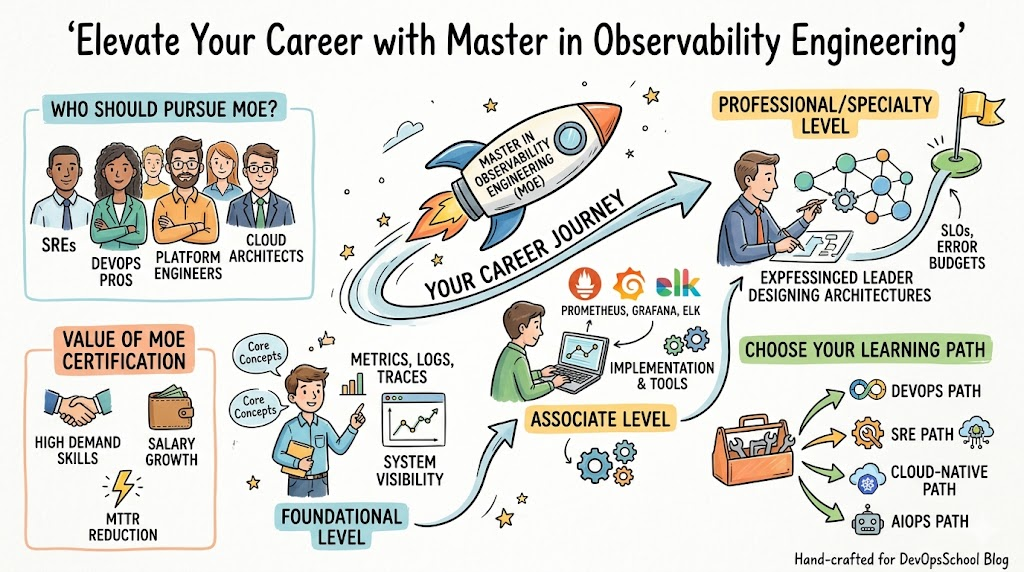
Senior SREs and DevOps professionals find immense value in this certification as they tackle the complexities of microservices. Cloud architects and platform engineers who manage global infrastructures also gain the specialized skills needed for distributed system health. Even data engineers benefit because they must ensure the reliability of high-volume data pipelines.
Managers and technical leaders should pursue this track to understand how observability impacts business continuity and team efficiency. Beginners with a strong Linux foundation use this program to pivot into high-demand reliability roles quickly. The curriculum addresses the needs of both the thriving Indian tech sector and the broader global engineering community.
Why Master in Observability Engineering (MOE) is Valuable
Enterprise adoption of observability frameworks grows daily as companies seek to reduce incident resolution times. This certification validates your ability to handle “unknown unknowns”—those rare, complex failures that simple alerts never catch. You become an asset to any organization by reducing operational noise and improving the developer experience.
Professionals who hold this credential command higher salaries because they solve the “black box” problem in distributed computing. The program ensures your skills remain relevant regardless of which specific vendor tools the industry favors next. You gain a permanent competitive edge by mastering the fundamental laws of telemetry and system behavior.
Master in Observability Engineering (MOE) Certification Overview
The hosting site, DevOpsSchool, provides all the necessary infrastructure, including real-world lab environments and expert-led sessions. You navigate through a series of practical challenges that test your architectural and troubleshooting capabilities.
The program uses a milestone-based assessment approach that focuses on your ability to implement observability pipelines from scratch. You own the entire process, from instrumenting application code to designing long-term telemetry storage solutions. This practical ownership ensures that you leave the program ready to lead observability initiatives in any production environment.
Master in Observability Engineering (MOE) Certification Tracks & Levels
The MOE framework divides expertise into three distinct tiers: Foundational, Associate, and Professional. Each tier builds upon the last, moving from basic telemetry collection to complex distributed tracing and predictive analytics. You choose the track that fits your current role while keeping a clear eye on your next career milestone.
Specialization tracks allow you to focus on niche areas like Kubernetes Observability or FinOps-driven resource management. These tracks ensure that your learning remains highly specific to the challenges your team faces today. As you move through the levels, you document your progress through high-impact projects that prove your technical maturity.
Complete Master in Observability Engineering (MOE) Certification Table
| Track | Level | Who it’s for | Prerequisites | Skills Covered | Recommended Order |
| Core Foundations | Beginner | Junior Ops/Devs | Basic Linux | Logs, Metrics, Dashboards | 1 |
| Systems Associate | Intermediate | SREs/SysAdmins | Core Foundations | Prometheus, ELK, Alerting | 2 |
| Expert Professional | Advanced | Lead Architects | Systems Associate | Tracing, OpenTelemetry, eBPF | 3 |
| SRE Excellence | Specialty | SRE Leads | Systems Associate | SLOs, SLIs, Error Budgets | 4 |
| Platform Specialist | Specialty | Platform Teams | Expert Professional | K8s Observability, Service Mesh | 5 |
| AIOps Specialist | Specialty | AI/ML Engineers | Expert Professional | Anomaly Detection, ML Models | 6 |
Detailed Guide for Each Master in Observability Engineering (MOE) Certification
Foundational Level
Master in Observability Engineering (MOE) – Foundational Tier
What it is
This certification confirms your mastery of the basic telemetry pillars. You demonstrate the ability to configure agents and visualize infrastructure health in real-time.
Who should take it
Aspiring SREs and junior developers benefit most from this entry point. It suits anyone looking to build a career in cloud operations or reliability engineering.
Skills you’ll gain
- Install and configure basic telemetry collectors
- Build operational dashboards for server health
- Understand the core differences between monitoring and observability
- Manage structured log data for easier searching
Real-world projects you should be able to do
- Launch a centralized logging server for a web application
- Create a dashboard that tracks system CPU and memory usage
- Set up basic threshold alerts for infrastructure failures
Preparation plan
- 7 Days: Study the history of monitoring and the definition of the three pillars.
- 30 Days: Complete labs focusing on agent installation and basic data visualization.
- 60 Days: Build a portfolio project that monitors a simple multi-tier application.
Common mistakes
- Candidates often focus on tool features instead of data patterns.
- Many ignore the importance of data structure in logs.
- Students sometimes confuse “visibility” with “observability.”
Best next certification after this
- Same-track option: MOE Associate Tier
- Cross-track option: Linux Professional Institute Certification
- Leadership option: Junior Team Lead
Associate Level
Master in Observability Engineering (MOE) – Associate Tier
What it is
The Associate level focuses on the practical implementation of time-series databases and query languages. You prove your ability to derive actionable insights from high-volume metric data.
Who should take it
Mid-level DevOps engineers and SREs who manage production environments daily should pursue this. It requires a baseline knowledge of containerization and cloud infrastructure.
Skills you’ll gain
- Write complex queries using PromQL
- Implement custom exporters for various database engines
- Design dashboards that correlate infrastructure and application data
- Configure advanced alerting rules to prevent alert fatigue
Real-world projects you should be able to do
- Build a full Prometheus and Grafana stack for a microservices cluster
- Create an alerting system that triggers based on latency trends
- Implement a dashboard that tracks business KPIs alongside technical metrics
Preparation plan
- 7 Days: Deep dive into time-series database architecture and query optimization.
- 30 Days: Work through labs involving complex metric collection and filtering.
- 60 Days: Simulate a system failure and use your observability tools to find the cause.
Common mistakes
- Over-collecting metrics, which increases storage costs significantly.
- Building cluttered dashboards that slow down incident response.
- Failing to tune alerting thresholds for dynamic workloads.
Best next certification after this
- Same-track option: MOE Professional Tier
- Cross-track option: Certified Kubernetes Administrator
- Leadership option: Senior DevOps Lead
Professional/Specialty Level
Master in Observability Engineering (MOE) – Professional Tier
What it is
This advanced certification validates your expertise in distributed tracing and OpenTelemetry. You demonstrate the ability to architect end-to-end observability for global-scale applications.
Who should take it
Senior architects, principal engineers, and SRE leads who design system-wide reliability strategies need this credential. It demands a deep understanding of distributed systems.
Skills you’ll gain
- Architect distributed tracing pipelines using OpenTelemetry
- Implement tail-based sampling to manage tracing costs
- Use eBPF for deep, frictionless kernel-level observability
- Integrate observability data into automated CI/CD feedback loops
Real-world projects you should be able to do
- Implement distributed tracing for a global, polyglot microservices platform
- Build an automated root-cause analysis engine using trace data
- Design a cost-optimized telemetry pipeline for petabyte-scale logs
Preparation plan
- 7 Days: Master the OpenTelemetry specification and tracing standards.
- 30 Days: Practice instrumentation in multiple languages like Go, Java, and Python.
- 60 Days: Design and document a full-stack observability architecture for an enterprise.
Common mistakes
- Neglecting the performance impact of instrumentation on the application.
- Creating overly complex tracing pipelines that become hard to maintain.
- Failing to align observability goals with business uptime requirements.
Best next certification after this
- Same-track option: MOE AIOps Specialty
- Cross-track option: Google Professional Cloud Architect
- Leadership option: Director of Reliability Engineering
Choose Your Learning Path
DevOps Path
This path integrates telemetry collection into every stage of the software delivery lifecycle. You learn to use observability as a gate for production releases, ensuring that only measurable code reaches the user. We focus on shortening the feedback loop between developers and production health.
DevSecOps Path
We treat security as an observability problem in this specialized learning track. You use traces and logs to identify unauthorized lateral movement and anomalous API calls within your network. This path turns your operational data into a powerful weapon for threat hunting and forensic analysis.
SRE Path
The SRE path focuses heavily on reliability metrics and incident management workflows. You master the art of setting SLIs and SLOs that accurately represent the user’s experience. We teach you how to use observability to defend your error budgets and automate your on-call responses.
AIOps Path
Engineers on this path explore the world of automated pattern recognition and predictive maintenance. You learn to feed high-quality telemetry data into machine learning models to identify issues before they impact users. We focus on reducing noise and automating the first line of incident response.
MLOps Path
This track addresses the specific needs of machine learning pipelines in production. You monitor for model drift, data quality shifts, and inference latency across distributed GPU clusters. We ensure that your AI models remain reliable and performant as real-world data evolves.
DataOps Path
DataOps professionals focus on the health and throughput of massive data processing pipelines. You learn to observe data “in flight” to ensure integrity, freshness, and delivery speed across various storage engines. We treat data pipelines as first-class citizens in the observability ecosystem.
FinOps Path
The FinOps path teaches you to link technical performance with financial cost. You use observability metrics to find “zombie” resources and optimize cloud spending without sacrificing performance. We help you prove the financial value of every infrastructure decision you make.
Role → Recommended Master in Observability Engineering (MOE) Certifications
| Role | Recommended Certifications |
| DevOps Engineer | MOE Foundational, MOE Associate, DevOps Path |
| SRE | MOE Associate, MOE Professional, SRE Path |
| Platform Engineer | MOE Associate, MOE Professional, Platform Specialist |
| Cloud Engineer | MOE Foundational, MOE Associate, FinOps Path |
| Security Engineer | MOE Associate, DevSecOps Path |
| Data Engineer | MOE Associate, DataOps Path |
| FinOps Practitioner | MOE Foundational, FinOps Path |
| Engineering Manager | MOE Foundational, SRE Path (Strategy focus) |
Next Certifications to Take After Master in Observability Engineering (MOE)
Same Track Progression
Deepen your expertise by pursuing advanced specializations in kernel-level observability using eBPF. This allows you to gather data without touching the application code, representing the future of frictionless operations. You can also explore specialized AIOps certifications that focus on autonomous system remediation and self-healing architectures.
Cross-Track Expansion
Broaden your horizons by obtaining cloud architectural certifications from providers like AWS or Google Cloud. Understanding how observability interacts with native cloud services provides a comprehensive view of the modern tech stack. You might also consider advanced Kubernetes security certifications to strengthen your platform engineering profile.
Leadership & Management Track
Transition into strategic roles by focusing on engineering management or digital transformation leadership. These certifications help you use observability data to drive business decisions and lead high-performing technical teams. You learn to translate technical reliability into organizational growth and customer trust.
Training & Certification Support Providers for Master in Observability Engineering (MOE)
- DevOpsSchool
This provider leads the industry with a curriculum that balances theoretical depth with intense practical labs. Their instructors bring years of real-world experience to the classroom, ensuring that you learn what actually works in production. You gain access to a massive library of resources and a supportive community of fellow learners. - Cotocus
This organization specializes in transforming corporate teams through tailored observability training programs. They focus on solving real-world infrastructure challenges while teaching the core MOE principles to your engineers. Their consultative approach ensures that the training directly improves your team’s operational efficiency. - Scmgalaxy
As a community-driven platform, this provider offers a wealth of open-source knowledge alongside its premium certification tracks. You benefit from a diverse range of perspectives and a deep commitment to the DevOps philosophy. They provide excellent support for those who prefer a collaborative, community-focused learning environment. - BestDevOps
This site offers a direct, no-nonsense path to mastering observability tools and practices. They prioritize lab-based learning where you spend most of your time building and troubleshooting real telemetry pipelines. It is an ideal choice for engineers who want to get hands-on quickly and avoid marketing fluff. - devsecopsschool.com
This provider focuses specifically on the security implications of observability data. You learn to use logs and traces to build a more secure infrastructure and detect threats in real-time. This is the perfect choice for security-conscious engineers looking to master the MOE curriculum. - sreschool.com
This platform targets the SRE persona with a curriculum that prioritizes reliability, service level management, and incident response. They integrate MOE concepts into the broader SRE framework, providing a holistic view of modern operations. You learn to build systems that are both observable and highly available. - aiopsschool.com
Professionals looking toward the future of automated operations should choose this specialized provider. They teach you how to use observability data as the foundation for artificial intelligence and machine learning in operations. You learn to build the self-healing systems of tomorrow. - dataopsschool.com
This provider bridges the gap between data engineering and operational observability. You focus on the unique challenges of monitoring high-speed data pipelines and ensuring data integrity across the enterprise. It is a vital resource for any modern data professional. - finopsschool.com
This platform teaches you how to turn observability data into financial insights. You learn to use metrics to drive cloud cost accountability and optimize infrastructure spending. It is the best place to learn how to balance performance with profit.
Frequently Asked Questions
1. Find out how much experience I need before starting the MOE program?
You should have at least one to two years of experience in system administration or software development. Familiarity with Linux command lines and basic networking concepts will help you progress much faster through the early stages.
2. Does the MOE certification expire?
The certification remains valid for three years, after which we recommend recertifying or advancing to a higher level. This ensures that your skills stay current with the rapidly evolving observability landscape.
3. Is the exam focused on specific tools or general principles?
The MOE exam prioritizes tool-agnostic principles and open-source standards like OpenTelemetry. While you will use specific tools in the labs, the assessment focuses on your understanding of the underlying data architecture.
4. Can I complete the training while working a full-time job?
Yes, the program is designed for working professionals with self-paced options and flexible schedules. Most students dedicate 5-10 hours per week to complete the certification within a few months.
5. What is the main difference between monitoring and observability in this course?
Monitoring tells you when something is wrong, while observability helps you understand why it is wrong. The course teaches you to build systems that provide enough context to solve complex, novel failures.
6. Does the program cover cloud-specific tools like CloudWatch?
While the core focus is on open-source standards, we do cover how to integrate these with major cloud provider tools. You learn to build hybrid observability solutions that work across any environment.
7. Are there any coding requirements for the Professional level?
You will need a basic understanding of programming to instrument application code using SDKs. We primarily use Python and Go for the labs, but the concepts apply to any modern language.
8. How do the labs work in a virtual environment?
You receive access to a dedicated cloud sandbox where you can launch servers and install observability tools. These labs simulate real production traffic so you can see how your dashboards and alerts respond.
9. Is there a group discount for corporate teams?
Most providers like DevOpsSchool offer bulk pricing for organizations looking to train multiple engineers at once. This is an excellent way for companies to standardize their observability practices.
10. What kind of job roles can I apply for after getting certified?
You will be qualified for roles such as SRE, DevOps Engineer, Platform Engineer, and Observability Specialist. Many companies also look for these skills when hiring for Lead or Architect positions.
11. Does the certification include training on alerting strategies?
Yes, we spend significant time on designing effective alerting systems that reduce noise and alert fatigue. You learn to focus on symptoms that affect users rather than every minor infrastructure hiccup.
12. How does this certification help with career growth in India?
The Indian tech market is shifting rapidly toward SRE and cloud-native practices, creating a massive demand for observability experts. This certification makes you a top candidate for leading multinational and product-based companies.
FAQs on Master in Observability Engineering (MOE)
1. Search for information on how MOE handles high-cardinality data issues?
The program teaches you to use advanced indexing and sampling techniques to manage high-cardinality data without breaking your budget. You learn to store only the data that provides the most diagnostic value.
2. Does the curriculum include the use of eBPF for monitoring?
We include eBPF in the Professional level as it represents the modern way to achieve deep system visibility without application-level changes. You learn to gather kernel-level metrics with minimal overhead.
3. What is the role of OpenTelemetry in the MOE certification?
OpenTelemetry serves as the backbone of our tracing and metric collection modules. We emphasize using this industry-standard framework to ensure your observability pipeline remains vendor-neutral and portable.
4. How do you assess the hands-on lab portions of the exam?
We use automated grading scripts that check the state of your lab environment. You must successfully configure collectors and generate specific dashboards to pass the practical milestones.
5. Can I use the MOE skills to monitor legacy monolithic applications?
Absolutely, the principles of logging and metric collection apply to monoliths just as much as microservices. We teach you how to bring “black box” legacy systems into modern observability platforms.
6. Does the course teach me how to build custom Prometheus exporters?
Yes, the Associate level includes a module on writing custom exporters in Go or Python. This allows you to monitor any unique application or hardware component in your environment.
7. How does the MOE certification address the “Three Pillars” of observability?
We treat logs, metrics, and traces as interconnected streams of data rather than isolated silos. You learn how to jump from a metric spike to the relevant logs and traces in seconds.
8. Is there support for mastering PromQL within the program?
We provide extensive drills and cheat sheets to help you master PromQL for real-time data analysis. You learn to write efficient queries that don’t overload your monitoring server.
Final Thoughts: Is Master in Observability Engineering (MOE) Worth It?
Choosing to pursue the Master in Observability Engineering (MOE) represents a major commitment to your professional excellence. In an era where system complexity grows exponentially, your ability to provide clear insights into system behavior becomes your most valuable asset. This program doesn’t just teach you how to use a tool; it changes the way you think about system design and operational reliability.You gain the power to lead your team through the most difficult technical outages with confidence and data-driven precision. The return on investment for this certification appears not just in your salary, but in the reduced stress of your daily operations. If you want to stand at the forefront of the SRE and DevOps movement, mastering the science of observability is the most logical and rewarding step you can take.
Leave a Reply